


Short answer: yes. Bentonite clay is one of the most commonly used natural binders in industry. It binds iron ore pellets together in steel mills. It glues foundry sand in metal casting molds. It binds animal feed pellets together. It serves as a binding excipient in pharmaceutical tablets. It’s done these jobs, and many more, dependably at industrial scale for decades.
But “binder” describes what bentonite clay does, rather than how. A more useful question is how bentonite clay binds. What mechanism makes it so effective in so many different applications? What limits its use? Let’s start with the science.
What Makes Bentonite Clay a Binder? The Science Behind It
Bentonite clay comes from volcanic ash that weathered. It’s main active ingredient is montmorillonite which is a layered aluminosilicate with 2: 1 sheet structure of alternate silica and alumina sheets. Let’s talk about why bentonite acts the way it does.
Pay attention to the structure. When bentonite meets water it hydrates and expands. Sodium Bentonite can expand 15 to 18 times its original dry volume. As it expands, the montmorillonite particles separate from each other and create a gel network. This gel coats individual particles that it’s mixed with and fills in the gaps in between. As the mixture is dried or heated and the moisture leaves, it pulls those particles together into a solid structure because clay is still in the spaces holding everything together.
A study featured on ScienceDirect discussing the fiber bonding mechanism of bentonite, concluded that bentonite hydrated, expanded, dispersed, and created fibers which spanned adjacent particles and bound them to one another. The strength of this bond was due to surface tension as it dried, but also electrostatic relationships between the charged clay platelets and surrounding particles, as well as mechanical interlocking of everything inside the clay.
The high cec (cation exchange capacity) of bentonite also assists in this although not directly responsible. Because Bentonite has such a high negative charge on its surface it’s able to create an electrostatic relationship with other positively charged surfaces and ions. A study review featured on PMC (National Institute of Health) confirmed that swelling and adsorption properties derived from bentonite clay, comes directly from the montmorillonite. It also stated that you can change the characteristics of montmorillonite by manipulating which cations are in the layers in between sodium and calcium. Which determines how much it will swell as well as how strong of a bind it creates.
Two bentonite types drive different binding outcomes:
- Sodium bentonite swells more dramatically and disperses more completely in water. This gives it stronger colloidal and rheological properties, making it the preferred choice for applications where maximum swelling and gel formation matter, like drilling fluids, iron ore pelletizing, and sealing applications.
- Calcium bentonite swells less but delivers excellent green strength (the mechanical strength of a freshly formed, undried material). This makes it the preferred binder in foundry molding sand, where green strength directly determines whether a mold holds its shape before the metal is poured.
CMS Industries is a mine-owner and exporter of bentonite situated in Kachchh (Kheda), Gujarat, India. We supply all grades of sodium bentonite as well as calcium bentonite with our laboratory testing at every stage confirming quality of raw mineral to the final product. The amount of montmorillonite present and degree of cation saturation in raw bentonite determines its binding value. Therefore correct grade selection and quality sheet accompany application as closely.
Where Bentonite Clay Is Used as a Binder
1. Iron Ore Pelletizing
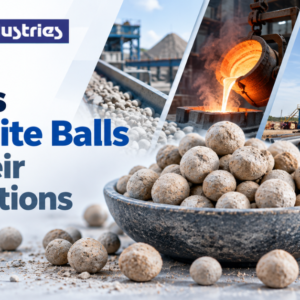
The biggest application by volume of bentonite clay as an industrial binder worldwide is in the iron ore pelletizing industry. Iron ore concentrates are too fine to go directly into a blast furnace. They must be pelletized into spheres about 9 to 16 mm in size that are robust enough to handle handling, transportation, drying, and the heat of ironmaking calcium bentonitte clay. Bentonite clay is the binder of choice. Scientists wrote on ResearchGate in a paper about the bentonite fiber bonding mechanism: “.” A 2025 study published in the Euro-Mediterranean Journal for Environmental Integration examined purified bentonite as an environmentally friendly binder for iron oxide waste pellets. The study also confirmed that bentonite helped agglomeration when producing green pellets and gave the green pellets enough mechanical strength and metallurgical properties to be used in iron production. Typically, only 0.5% to 1.5% bentonite on a weight basis of ore concentrate is required, which makes it one of the least expensive binders for such a large scale application.
2. Foundry Sand and Metal Casting
Metal casting molds need to be rigid enough to maintain their shape when filled with molten metal, heat resistant enough not to combust when exposed to that molten metal, and then friable enough after cooling that they break apart allowing for easy removal of the casting and is sodium bentonite clay safe for cats. Bentonite clay satisfies all three needs. “In foundry applications, bentonite is used as a bonding agent in the preparation of molding sand for casting of iron, steel and non ferrous metals.” It states that bentonite’s unique properties produce green sand molds that offer castability with excellent flowability, compactability and heat resistance needed for quality castings.
Imerys, a global leader in the industrial minerals industry notes that foundry grade bentonite is important in helping to cast high quality foundry products. They go on to say that bentonite is used as the binder for green sand molds where “defect-free final castings are produced. Reclaiming allows for most of the sand and binder to be recycled and reused in a closed loop system.”
Sodium bentonite is used where high dry strength is required. Calcium bentonite is used where green strength is more desirable. Some foundries use a mixture of both.
3. Animal Feed and Aquaculture Pellets
One use of bentonite clay is as a binder in pelleted animal feed and fish feed. Feed ingredients are mixed with moisture, then extruded or pressed through a die to form pellets. Bentonite clay allows the particles to stick together during pelleting, and holds pellets intact during drying, transport and handling. In aquaculture applications, durability of pellets is especially important because broken feed pollutes ponds and lakes, creating waste instead of delivering nutrients to fish. Bentonite binding and swelling properties keep pellets intact through the rigors of pelleting machinery and lengthy storage times until they are eaten by fish.
A secondary function that bentonite adds to animal feed is mycotoxin adsorption. Published studies in PMC have verified that bentonite, montmorillonite and similar mineral adsorbents bind mycotoxins to interlayer space, external surfaces, and edges thereby decreasing uptake of these toxic mold metabolites from contaminated feed ingredients. Bentonite does double duty as both a binder and mycotoxin mitigator.
4. Pharmaceutical Tablets and Drug Delivery
Binding Bentonite Clay was studied and published in Journal of Pharmaceutical Investigation (Springer Nature) also listed on PMC as confirmation that Bentonite clay (Active ingredient montmorillonite) has been used as a binding excipient within tablet formulas in both industrial and pharmaceutical applications due to its swelling ability and adsorption properties. Montmorillonite’s adsorption qualities can aid in entrapment of drugs within the material which may aid in sustained release of the drug.
As a binder within tablets bentonite can create a matrix around the drugs inside a tablet when compressed. This helps the pill stay intact until it reaches the appropriate place in your digestive system where the tablet is supposed to dissolve. Only pharmaceutical grade, purified montmorillonite clay should be used. PMC article clearly states “Pure montmorillonite should be prepared by purifying the raw bentonite.”
5. Ceramics and Construction Materials
In ceramic bodies, bentonite is both a plasticizer and binder. It increases workability and helps to reduce cracking during drying and firing. At common additions of between 1% and 5%, bentonite decreases the energy required to form ceramic materials while increasing the green strength of unfired ware. Bentonite can also be used as a binder in insulating refractory bricks in construction, as well as a bonding agent for soil stabilization and civil engineering fill material. The efficacy of bentonite as a binder in insulating refractory bricks produced from quartz was studied and published on ResearchGate. Tests for bulk density, apparent porosity, cold crushing strength, and water absorption showed positive binder performance at studied inclusion rates.
What Affects Bentonite’s Performance as a Binder?
Not all bentonite performs equally in binding applications. Several factors determine whether a particular bentonite grade will deliver the binding strength needed.
Montmorillonite content: Higher montmorillonite concentration directly improves binding performance. Bentonite with 80% or more montmorillonite generally outperforms lower-purity grades. Lower-quality bentonite requires a higher inclusion rate to achieve the same binding strength, which increases costs and can affect the final product’s properties.
Sodium vs. calcium saturation: As described above, sodium bentonite swells more and disperses more completely, giving it stronger colloidal properties for pelletizing and drilling. Calcium bentonite provides better green strength in foundry and molding applications. The cation saturation of the clay determines which binding mechanism dominates.
Particle size: Finer grinding increases the surface area of the bentonite, which improves its dispersibility and contact with surrounding particles. This translates directly into better bonding at lower inclusion rates.
Moisture content of the mix: Bentonite’s binding mechanism requires hydration. The clay must have enough water to swell, disperse, and form the gel network that creates the bond. Under-moistened mixes produce weak green strength; over-moistened mixes can cause cracking during drying.
Inclusion rate: Typical bentonite inclusion rates vary by application. Iron ore pelletizing uses 0.5% to 1.5% by ore weight. Foundry sand typically uses 2% to 15% by total dry weight, as specified in US patent documents for foundry sand formulations. Animal feed pellets may use 1% to 3%. Getting the inclusion rate right for a specific application requires testing with the actual material rather than relying on general guidelines.
Bentonite as a Binder vs. Bentonite as an Adsorbent
One source of confusion: bentonite clay performs two roles that operate via similar mechanics, but accomplish different tasks: binding vs. adsorption. In binding mode, bentonite holds solids together through swelling, gel strength and physical entanglement. In adsorption mode, bentonite attaches dissolved or dispersed chemical species (think toxins, heavy metals, dyes or pharmaceuticals) to its surface via electrostatic attraction and/or interlayer trapping. The mechanisms of action are the same in both cases: high surface area, negative surface charge, cation exchange capacity and swelling capacity. The difference is the scale and the target of interest. For iron ore pelletizing or foundry sand applications, bentonite is a structural binder. For toxin elimination or drug encapsulation, bentonite is a chemical adsorbent. In animal feeds, it does both jobs at once.
Frequently Asked Questions
1. What makes bentonite clay a better binder than other clay types?
Bentonite’s binding advantage comes from its high montmorillonite content and the montmorillonite mineral’s unique 2:1 layered structure. This structure gives bentonite a higher swelling capacity, larger surface area, and greater cation exchange capacity than most other naturally occurring clays. Kaolin, for example, has far lower swelling and weaker interparticle bonding. Bentonite’s combination of these properties makes it the most cost-effective natural binder available for large-scale industrial use.
2. What is the difference between sodium bentonite and calcium bentonite as binders?
Sodium bentonite swells dramatically when hydrated (up to 15 to 18 times its dry volume) and disperses completely into a colloidal gel. This makes it the stronger binder for iron ore pelletizing, where thorough dispersion and pellet hardness matter most. Calcium bentonite swells less but delivers superior green strength, the mechanical strength of a freshly formed undried piece. This makes it the preferred binder in foundry molding sand and ceramic applications where early handling strength is the priority.
3. How much bentonite clay is typically used as a binder in iron ore pellets?
Most iron ore pelletizing operations use between 0.5% and 1.5% bentonite by weight of the ore concentrate. At this low inclusion rate, bentonite dramatically improves pellet strength without significantly diluting the iron content of the pellets. Higher-purity bentonite with greater montmorillonite concentration allows for lower inclusion rates while maintaining the same binding performance, which is why bentonite grade and quality documentation matter to steel producers.
4. Can bentonite clay be used as a binder in food or pharmaceutical applications?
Yes, but only with grades specifically processed and certified for those uses. Standard industrial-grade bentonite is not appropriate for food or pharmaceutical applications. Pharmaceutical-grade montmorillonite (purified bentonite) is used as a tablet binder and drug delivery excipient. Food-grade bentonite is used in certain animal feed applications and as a clarifying agent in beverages. Always verify that the grade and certification match the regulatory requirements of the specific application.
5. Does bentonite quality affect its binding performance?
Yes, significantly. The montmorillonite content, particle size distribution, cation saturation, and moisture content of bentonite all directly affect its binding strength and inclusion rate requirements. Lower-quality bentonite with higher impurity levels requires a greater amount to achieve the same bond strength as higher-purity grades, which increases cost and can affect the final product. CMS Industries maintains an in-house quality laboratory to test and verify its bentonite grades from raw mineral through to processed product, providing the quality documentation that industrial buyers need to make informed procurement decisions.