


Sensitive skin and new skincare ingredients are an uneasy combination. You’ve probably seen calcium bentonite clay show up in face masks, detox treatments, and cosmetic formulations, and the question is fair: is it actually safe for skin that reacts easily, or is it another trend that sounds better than it delivers?
The short answer is yes, with caveats. Let’s break it down.
What Is Calcium Bentonite Clay, and Why Does It Matter for Skin?
Bentonite is a naturally occurring clay that forms when volcanic ash settles and weathers over time. Its main component is montmorillonite, a mineral in the smectite group that swells when it contacts water, creating a gel-like consistency. That swelling action is what makes the clay so effective at pulling impurities, oils, and debris away from the skin’s surface.
There are two main types used in skincare: sodium bentonite and calcium bentonite. Here’s why that distinction matters.
Sodium bentonite swells more aggressively and carries stronger drawing properties. It’s the variety more commonly used in industrial contexts, like drilling fluids and pond sealing. Calcium bentonite, by contrast, has a milder action, a lower pH, and a gentler overall profile. That makes it significantly better suited for direct contact with skin, particularly sensitive or reactive skin types.
When calcium bentonite clay is mixed with water and applied to skin, it works partly through adsorption, meaning it attracts and binds to molecules on the skin’s surface, drawing out sebum, bacteria, and other impurities. It also releases minerals like calcium, magnesium, iron, and potassium into the skin as it dries.
Companies like CMS Industries, one of India’s leading bentonite manufacturers and exporters, specifically process calcium bentonite to cosmetic-grade specifications. Their CMS CALCIUMBENT® grade is known for higher healing and detoxifying properties, which are the same characteristics that make it useful in personal care applications.
Is Calcium Bentonite Clay Safe for Sensitive Skin? Here’s What the Research Says
The U.S. Food and Drug Administration classifies bentonite as Generally Recognized as Safe (GRAS) for certain food and cosmetic applications. That classification supports its topical use when the clay is properly processed and formulated.
A 2009 study published in the International Journal of Pharmaceutics (Viseras et al.) reviewed the use of clay minerals in topical formulations and found amazing benefits of bentonite clay soap for your skin that smectite-group clays like montmorillonite are well-tolerated on skin. The study also found demonstrated ability to absorb toxins, bacteria, and excess sebum. The researchers noted that particle size, pH, and mineral purity all influence whether the clay is appropriate for cosmetic use.
A more recent 2023 clinical study published in JEADV Perspectives assessed a clay mask containing bentonite on 75 adults with oily or combination skin. At least 50% of participants self-declared sensitive skin. The results showed improvements in sebum content, skin hydration, acne lesions, and transepidermal water loss, with no significant adverse reactions reported across the four-week study period.
Research published in Iranian Journal of Public Health (2017) reviewed several hundred scientific articles on bentonite clay and found it effective for various skin conditions, including diaper dermatitis (where it outperformed calendula), allergic contact dermatitis, and chronic hand dermatitis.
So the science, while not exhaustive, does support the use of cosmetic-grade calcium bentonite clay on sensitive skin under the right conditions.
When Calcium Bentonite Clay Works for Sensitive Skin
For calcium bentonite clay to be genuinely safe for sensitive skin, a few factors need to be in place.
The clay must be cosmetic-grade. Industrial-grade bentonite is processed differently and may contain free silica, heavy metal concentrations, or particle sizes that are inappropriate for skin. Cosmetic-grade calcium bentonite, like what CMS Industries supplies to personal care manufacturers, is mined and processed selectively with lower iron content, controlled pH, and high oil absorption capacity without the irritants you’d find in lower-quality variants.
Quality and purity matter more than most people realize. Some clay products available on the market carry detectable levels of lead or arsenic, a concern flagged by the FDA and documented in peer-reviewed research. This is not an issue with all bentonite products, but it reinforces why sourcing from a reputable manufacturer with quality controls in place is not optional. It’s a baseline requirement.
Leave-on time needs to be reasonable. Letting a clay mask dry completely and sit for 30+ minutes is one of the more common mistakes. As the mask dries past a certain point, it begins to pull moisture from the skin itself rather than just drawing out oil and debris. For sensitive skin, 10 to 15 minutes is a better target before rinsing.
Frequency should be moderate. For sensitive or dry-leaning skin types, once a week is enough. Twice weekly is appropriate for oily or combination skin that tolerates it well.
Who Should Be Cautious with Calcium Bentonite Clay?
Calcium bentonite clay a safe remedy for dogs is not universally appropriate for every skin type. Here’s who should approach it carefully.
People with very dry skin or chronic dry skin conditions like eczema or psoriasis should be cautious. The clay’s absorbent properties, which are a strength for oily skin, can strip what little natural moisture remains in dry or compromised skin, worsening irritation and triggering flares.
Anyone using prescription actives like retinoids, benzoyl peroxide, or strong exfoliating acids should speak with a dermatologist before adding clay masks to their routine. Combining multiple drying or exfoliating agents can compromise the skin barrier faster than you’d expect.
People with rosacea should also approach with care, since the physical texture of clay can irritate already-reactive capillaries.
That said, board-certified dermatologists generally describe calcium bentonite as one of the gentler clay options available. As Dr. Hadley King has noted publicly, there’s little to no evidence that bentonite clay is harmful to the skin, though a patch test before full application remains good practice for anyone trying it for the first time.
How to Use Calcium Bentonite Clay Safely on Sensitive Skin
If you want to try it, here’s a straightforward routine:
- Patch test first. Apply a small amount of prepared clay paste to your inner forearm or behind the ear. Wait 24 hours. No reaction means you’re likely in the clear.
- Mix with water, not apple cider vinegar. ACV is a popular pairing, but the added acidity can irritate sensitive skin. Plain, purified water is the safer choice for reactive skin types.
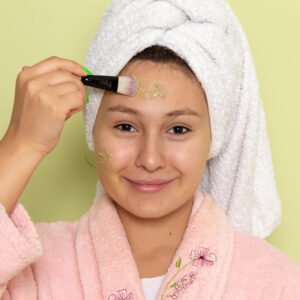
- Apply a thin, even layer. You don’t need a thick coating. A thin layer does the same job and is easier to rinse.
- Remove it before it fully dries. For sensitive skin, aim to rinse it off while it still feels slightly damp on the skin, around the 10-to-12-minute mark.
- Rinse gently. Use lukewarm water and a soft cloth. Rubbing hard to remove dried clay defeats the purpose of a gentle application.
- Moisturize immediately after. Follow with a hydrating, fragrance-free moisturizer while the skin is still slightly damp. This step is not optional for sensitive skin types.
- Limit use to once per week until you understand how your skin responds.
Calcium Bentonite Clay vs. Sodium Bentonite: Which Is Safer for Sensitive Skin?
This question comes up often, and the answer is consistent across dermatology literature.
Calcium bentonite has a lower pH, milder swelling action, and a less aggressive drawing profile. It retains more of its original mineral composition since it doesn’t require chemical activation. It’s the type most commonly found in cosmetic-grade products and is generally considered the better choice for direct skin contact.
Sodium bentonite swells more dramatically and has stronger industrial applications. In skincare, it’s more likely to over-dry the skin, especially sensitive types.
For anyone sourcing raw bentonite for personal care formulation, understanding this distinction before purchasing is worthwhile. CMS Industries, which manufactures both calcium and sodium bentonite grades, processes them for different end applications precisely because their properties differ significantly.
Common Misconceptions About Bentonite Clay and Sensitive Skin
“Natural means safe for all skin types.” Not automatically. Natural ingredients can still cause reactions in sensitive individuals. The clay’s source, processing, purity, and formulation all affect how the skin responds.
“More contact time means better results.” False, especially for sensitive skin. Extended contact time on a drying clay mask draws moisture from the skin and increases the risk of irritation, not the effectiveness of cleansing.
“All bentonite clays are the same.” They’re not. Calcium and sodium bentonite behave differently. Industrial-grade and cosmetic-grade versions differ in purity, particle size, and suitability for skin contact. The grade matters as much as the mineral type.
The Bottom Line
Calcium bentonite clay is genuinely well-tolerated by most skin types, including many people with sensitive skin, when it’s cosmetic-grade, properly sourced, and used correctly. The research supports its use for oil absorption, mild antibacterial action, and general skin cleansing. The risks, mainly over-drying and potential heavy metal content in lower-quality products, are avoidable with the right sourcing and reasonable usage habits.
The grade and origin of the clay matter more than most consumers realize. Whether you’re a formulator selecting raw materials or a consumer picking a face mask, understanding what you’re buying puts you ahead of most people asking this question.
FAQs: Calcium Bentonite Clay for Sensitive Skin
Q1. Can I use calcium bentonite clay on sensitive skin every day?
No, daily use is not recommended for sensitive skin. The clay’s absorbent properties, used too frequently, can strip the skin’s natural moisture barrier and lead to dryness and irritation. Once a week is appropriate for sensitive skin types, and you should always follow up with a good moisturizer.
Q2. What’s the difference between calcium bentonite and sodium bentonite for skin?
Calcium bentonite has a lower pH and milder absorption profile, making it gentler and more appropriate for skin contact, especially for sensitive types. Sodium bentonite swells more aggressively and is better suited for industrial applications. Most reputable cosmetic formulations use calcium bentonite specifically for this reason.
Q3. How do I know if the calcium bentonite clay I’m buying is safe for skin?
Look for cosmetic-grade or pharmaceutical-grade labeling. Reputable manufacturers, like CMS Industries, process and grade bentonite specifically for cosmetic applications, with controlled purity, pH, and particle size. Avoid products with vague sourcing, no grade specification, or those flagged for heavy metal content.
Q4. Can calcium bentonite clay help with acne on sensitive skin?
It can, but carefully. The clay draws out sebum and has some antimicrobial properties that may help reduce breakouts. A 2023 clinical study found improvements in acne lesions in participants with oily and self-declared sensitive skin. That said, if you’re already using prescription acne treatments, adding clay masks can overdo the drying effect, so check with your dermatologist first.
Q5. Is bentonite clay good for skin conditions like eczema or rosacea?
For eczema and rosacea, caution is warranted. Some research shows bentonite can help with certain types of dermatitis, but the clay’s drying and physical exfoliating properties can also aggravate conditions involving compromised skin barriers or reactive blood vessels. If you have either condition, consult a dermatologist before use. A patch test is especially important in these cases.