


When it comes to deep foundation work, diaphragm walls, and excavation support, choosing the right drilling fluid can make or break a project. Two options dominate the construction industry: polymer slurry and bentonite slurry. Both materials stabilise boreholes and support trenches, but they work differently and suit different conditions.
If you’re involved in piling, tunnelling, or horizontal directional drilling, understanding these differences helps you select the right material for your soil conditions, budget, and project timeline. Let’s break down how each slurry works and when to use them.
What Is Bentonite Slurry?
Bentonite clay forms from weathered volcanic ash and contains montmorillonite as its primary mineral, which swells significantly when mixed with water. Sodium bentonite, in particular, is known for its high swelling and water-absorption capacity compared to other bentonite types. This natural clay material has served the construction industry for decades.
When you mix bentonite powder with water, it creates a thick, gel-like fluid. In the case of sodium bentonite, the clay particles can expand up to eight times their original volume after absorbing water. This expansion gives bentonite its thixotropic property, meaning it flows easily when agitated but forms a stable gel when left undisturbed—an essential characteristic in many engineering applications.
CMS Industries manufactures multiple grades of bentonite for different applications, including sodium bentonite based drilling fluids with high viscosity and superior swelling properties. The company’s manufacturing units in Gujarat produce specialized bentonite grades designed to meet the performance demands of construction, foundation works, and drilling operations.
Key Properties of Bentonite Slurry
Bentonite slurry performs best when it maintains certain characteristics:
- Specific Gravity: Typically ranges between 1.05 and 1.15, providing sufficient weight for borehole stability without excessive pressure on surrounding soil.
- pH Level: The mixture stays slightly alkaline, usually between 9 and 12, which protects steel reinforcement cages from corrosion.
- Viscosity: Creates thick fluid that suspends drill cuttings and prevents them from settling at the bottom of excavations.
- Filter Cake Formation: Microscopic bentonite platelets form a filter cake against borehole walls, creating a barrier that supports hydrostatic pressure.
What Is Polymer Slurry?
Polymer slurry represents a newer technology in the drilling industry. Instead of natural clay, it uses synthetic polymers like partially hydrolysed polyacrylamide mixed with water. These polymers were engineered specifically for construction applications.
The most common type is PHPA polymer slurry. When mixed with water, these long molecular chains create viscosity without significant swelling. The result is a clear or slightly milky fluid that works differently than bentonite.
Key Properties of Polymer Slurry
Polymer slurries behave differently from bentonite:
- Non-Swelling: Unlike bentonite, polymer slurry doesn’t swell when exposed to water. It maintains consistent viscosity without volume changes.
- Shear Thinning: The viscosity decreases under shear stress, making pumping and circulation easier during drilling operations.
- Temperature Stability: Polymer slurries maintain their properties at higher temperatures than bentonite, expanding their range of applications.
- Self-Cleaning: Polymer slurry doesn’t suspend sand like bentonite does, so sand drops to the bottom during excavation, simplifying cleanup.
Composition: Natural vs Synthetic
The fundamental difference between these two materials starts with their composition.
Bentonite Composition
Bentonite contains montmorillonite as its main component, along with varying amounts of quartz, feldspar, gypsum, and calcite. It’s a natural material mined from deposits formed over millions of years. In India, major bentonite deposits exist in Rajasthan and Gujarat.
This unique mineral composition also explains bentonite in calamine lotion. Montmorillonite has excellent adsorption and suspension properties, which help calamine lotion stay evenly mixed rather than separating into liquid and solid layers. Bentonite also provides a soothing, cooling effect on the skin by absorbing excess moisture, oils, and irritants, making it effective for relieving itching, rashes, insect bites, and mild skin inflammation.
CMS Industries sources its bentonite from mines in Vandh, Pundi, and surrounding areas of Kachchh, Gujarat. The natural origin means composition can vary slightly between deposits, though modern processing ensures consistent quality suitable for diverse applications, including pharmaceuticals, cosmetics, and personal care products like calamine lotion.
Polymer Composition
Polymer slurry uses synthetic materials manufactured in controlled environments. The most common polymers include:
- Partially hydrolysed polyacrylamide
- Polyethylene glycol
- Polyvinyl alcohol
- Carboxymethylcellulose
Because manufacturers produce these in factories, polymer slurry offers more consistent properties batch to batch.
How They Work: Different Mechanisms
Both slurries stabilise excavations, but they achieve this through different mechanisms.
Bentonite’s Stabilisation Method
Bentonite works by creating a physical barrier. As drilling progresses, the clay platelets in the slurry migrate into the pores of the borehole walls. They stack together, forming a filter cake that’s typically a few millimetres thick.
This filter cake serves two purposes. First, it reduces water seepage from surrounding soil into the excavation. Second, it provides a surface against which hydrostatic pressure from the slurry column can push, preventing collapse.
The slurry must maintain at least 6 feet of head above the groundwater level to create sufficient hydrostatic pressure. CMS Industries’ drilling grade bentonite products are formulated to develop the right viscosity and filter cake properties for this application.
Polymer’s Stabilisation Method
Polymer molecules have such long chains that different parts of individual chains bridge across different solid particles, keeping them consolidated. Rather than building a physical cake, polymers create a chemical network.
The long molecular chains adsorb onto soil particle surfaces. Because the chains are so long, one molecule can attach to multiple particles simultaneously, creating bridges that hold the soil structure together. This mechanism also slows water infiltration into surrounding soil.
Advantages and Disadvantages
Each material brings distinct benefits and limitations to construction projects.
Bentonite Slurry Advantages
Universally Applicable: Works in all soil types, from soft clay to granular soils. This versatility makes it the go-to choice when soil conditions are uncertain.
Natural Material: Being naturally occurring makes it environmentally friendly and widely accepted by regulatory bodies.
Proven Track Record: Decades of use in construction provide extensive performance data and established best practices.
Cost-Effective Base Price: The raw material cost is generally lower than synthetic polymers.
Bentonite Slurry Disadvantages
Heavy Usage: Requires approximately 60 pounds of bentonite per 100 gallons of slurry, meaning substantial material handling and transport costs.
Filter Cake Issues: Leaves a layer of filter cake between concrete and soil that doesn’t bond, potentially reducing the concrete’s friction bearing capacity.
Temperature Limitations: Performance degrades at high temperatures, limiting use in certain deep drilling applications.
Disposal Complexity: Used bentonite requires chemical treatment before disposal and is classified as a marine pollutant.
Limited Reusability: Quality degrades after two or three projects, with only about 40% recoverable for reuse.
Polymer Slurry Advantages
Minimal Material Requirements: Can do the same job as bentonite at just 3.4 to 8 pounds per 1,000 gallons, depending on soil conditions. For a 50,000-gallon project, you’d need just 7 bags of polymer versus 600 bags of bentonite.
Better Load Capacity: Provides greater skin-friction load carrying capacity for drilled shaft sidewalls, increasing total working load.
No De-sanding: The slurry doesn’t suspend sand, eliminating the need for mechanical cleaning equipment and reducing labour costs.
Easy Disposal: Can be chemically broken down with neutraliser products to become environmentally safe water.
High Reusability: Can be recycled multiple times without quality degradation, with more than 60% recoverable per project.
Cleaner Operations: Creates less mess on site and produces cleaner concrete surfaces at the top of drilled shafts.
Polymer Slurry Disadvantages
Higher Initial Cost: The purchase price per kilogram exceeds bentonite, though this often balances out when considering reduced shipping and disposal costs.
Soil Restrictions: Not recommended for highly permeable soils where filter cake can’t form quickly enough. May require bentonite additives in soils without fines.
Limited Acceptance: Still relatively new to many in the drilled shaft industry, and some jurisdictions haven’t approved it for government projects.
Water Sensitivity: Performance depends heavily on water quality. Chlorine in water breaks down the polymer, requiring pre-treatment with chlorine removal products.
Applications in Construction
Different projects call for different solutions. Here is when each slurry type works best.
When to Use Bentonite Slurry
Mixed or Unknown Soil Conditions: When geotechnical data is limited or soil varies significantly across the site, bentonite provides reliable performance regardless of what you encounter.
Deep Foundation Piles: Bentonite excels in bored pile construction, where it maintains borehole stability while drilling progresses. CMS Industries supplies drilling-grade bentonite specifically formulated for foundation work.
Diaphragm Walls: For creating slurry walls in urban construction, bentonite has proven effective over decades of use. It prevents trench collapse while allowing placement of reinforcement cages.
Water Retention Projects: When you need the excavation support to also provide long-term waterproofing, bentonite’s sealing properties serve double duty.
Regulatory Requirements: Some government projects still mandate bentonite use due to its established track record and natural composition.
When to Use Polymer Slurry
Space-Constrained Sites: Urban sites with limited space benefit from polymer’s minimal storage requirements, as it doesn’t need multiple holding tanks or separation plants.
Horizontal Directional Drilling: Polymer slurries commonly support trenchless technology applications, providing borehole stability and reducing friction.
High-Temperature Drilling: When drilling deep or in geologically active areas where temperatures rise, polymer maintains performance better than bentonite.
Projects Prioritising Load Capacity: If maximising pile capacity is critical, polymer’s superior bonding between concrete and soil provides measurable advantages.
Fast-Track Construction: The self-cleaning properties and rapid disposal eliminate waiting time for de-sanding and concrete placement approvals.
Cost Comparison: Beyond Purchase Price
Looking only at material cost per kilogram misses the full picture. Let’s examine total project economics.
Direct Material Costs
Bentonite costs less per bag. A 50-kilogram bag of quality bentonite from suppliers like CMS Industries typically runs more affordably than an equivalent weight of polymer. But you need much more of it.
For that hypothetical 50,000-gallon project mentioned earlier, bentonite would require 600 bags versus just 7 bags of polymer. Even at lower per-bag cost, the total material expense often favours polymer.
Transport and Handling
Shipping 600 bags costs substantially more than shipping 7 bags. The logistics difference becomes even more pronounced for remote sites or projects requiring materials transported by air or over poor roads.
On-site storage also matters. Bentonite needs space for all those bags plus mixing and settling tanks. Polymer’s compact storage footprint saves valuable site area.
Labour and Equipment
Bentonite requires mechanical cleaning equipment to remove sand and maintain specification compliance, adding both equipment rental and operator costs. Polymer’s self-cleaning nature eliminates these expenses.
Mixing time differs too. Bentonite requires at least a day for complete mixing and hydration. Polymer products, especially emulsion types, develop properties almost immediately after mixing.
Disposal Costs
Bentonite disposal involves chemical treatment, testing, and special handling as a potential marine pollutant. These costs add up, particularly on projects with strict environmental regulations.
Polymer disposal is readily conducted by adding an agglomerator, breaking it down into environmentally safe components with minimal processing cost.
Environmental Considerations
Both materials claim environmental advantages, but in different ways.
Bentonite’s Environmental Profile
Being a natural clay mineral, bentonite doesn’t introduce synthetic chemicals to the environment. It’s non-toxic to aquatic life and breaks down naturally over time.
But volume matters. The large quantities required mean more mining activity, more transport emissions, and more material requiring disposal after use. Bentonite is typically mined in Rajasthan, India, so projects in other regions face long transport distances.
Polymer’s Environmental Profile
Modern PHPA polymers are non-toxic and non-hazardous. When properly treated with neutraliser products, they break down into environmentally safe water and by-products.
The minimal quantities needed reduce transport emissions dramatically. A project using 7 bags of polymer instead of 600 bags of bentonite eliminates significant fuel consumption for transportation.
However, it is also important to understand the IOP bentonite powder particularly in applications where polymers are not suitable. IOP-grade bentonite provides excellent wall-support characteristics, high gel strength, and superior filtration control, making it ideal for diaphragm walls, bored piling, slurry walls, and tunnelling works. Unlike polymers, bentonite slurry remains stable over longer open-hole durations and performs reliably in variable soil conditions.
When compared with bentonite, polymer slurries offer a smaller site footprint and lower logistics requirements, making them attractive for sustainability-focused projects. That said, many large-scale infrastructure projects still rely on IOP bentonite powder due to its proven performance, cost efficiency in long-duration excavations, and compatibility with conventional construction practices.
Both systems have their place, and the choice ultimately depends on ground conditions, project scale, environmental constraints, and engineering requirements.
Testing and Quality Control
Both slurry types require monitoring to ensure proper performance.
Standard Tests for Both Materials
Viscosity: Measured with a Marsh funnel, indicating the fluid’s thickness and ability to carry cuttings.
Density: Checked with a mud balance to ensure proper specific gravity for soil support.
pH Level: Monitored with pH strips or meters to maintain alkalinity for steel protection.
Sand Content: Measured to verify contamination levels stay within acceptable limits.
These tests apply to both bentonite and polymer slurries, with similar target ranges for most parameters.
Bentonite-Specific Testing
Filter cake thickness needs regular measurement for bentonite. Too thick, and it impacts pile capacity. Too thin, and it won’t provide adequate support.
Gel strength testing indicates how well the bentonite maintains suspension when static. Higher gel strength means better cutting suspension but can complicate concrete placement.
Polymer-Specific Testing
Water quality becomes critical with polymers. Testing source water for chlorine, calcium hardness, and organic content helps predict how the polymer will perform.
Some specifications require testing the polymer’s flocculation point, where it starts clumping together, to ensure it maintains stability throughout the project.
Mixing and Preparation
Proper mixing determines performance for both materials.
Preparing Bentonite Slurry
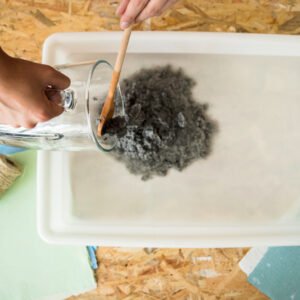
The powder must be added slowly into mixing water to ensure all particles are irrigated and don’t get lumped. High-shear mixers provide the mechanical energy needed to fully hydrate the clay platelets.
Mixing typically happens in batches or continuous processes depending on equipment. After mixing, bentonite needs time to fully hydrate. Powdered polymers require a swelling period after wetting, while emulsion polymers develop properties almost instantaneously.
From storage tanks, the prepared slurry moves to the excavation point for use.
Preparing Polymer Slurry
Polymer preparation follows similar equipment needs but with different timing. The material hydrates faster, reducing wait time between mixing and use.
Water often requires pre-treatment with chlorine neutraliser before polymer addition. For water with high calcium content, adding M-BOOSTER or similar products precipitates free calcium ions, maximising polymer viscosity.
Making the Right Choice
Several factors should guide your decision between polymer and bentonite slurry.
Soil Conditions: If you’re working in varied or highly permeable soils, bentonite provides more reliability. For stable soils with known characteristics, polymer offers performance advantages.
Project Scale: Small projects benefit from bentonite’s lower material cost. Large projects see polymer’s reduced shipping and handling costs overcome its higher per-unit price.
Site Constraints: Urban sites with limited space lean toward polymer. Rural sites with ample storage can accommodate bentonite’s volume requirements.
Regulatory Environment: Check local regulations and client specifications. Some jurisdictions require proven materials like bentonite for certain applications.
Environmental Goals: If sustainability matters to your client or company, polymer’s reduced transport emissions and cleaner disposal may align better with project values.
Technical Requirements: For projects demanding maximum pile capacity or operation in high-temperature conditions, polymer provides measurable technical benefits.
CMS Industries offers consultation on bentonite selection for construction projects, helping contractors choose the right grade based on their specific soil conditions and project requirements.
Frequently Asked Questions
Q1: Can you mix bentonite and polymer slurry together?
Yes, in some cases contractors add small amounts of bentonite to polymer slurry, particularly in permeable soils lacking fines. The bentonite helps form a filter cake while the polymer provides viscosity and consolidation. This hybrid approach combines advantages of both materials but requires careful proportioning and testing to achieve desired properties.
Q2: How long does each type of slurry remain stable in the borehole?
Bentonite slurry maintains stability for several days if properly managed, though properties may drift requiring adjustment. Polymer slurry typically stays stable for shorter periods, usually 12 to 24 hours before viscosity begins degrading. Both need monitoring and potential reconditioning for extended excavation work.
Q3: What happens if it rains during drilling operations using these slurries?
Rain dilutes both types of slurry, reducing density and viscosity. Bentonite handles dilution better initially but requires more material to restore properties. Polymer slurry needs careful density monitoring during rain, as excessive dilution can cause performance loss. Cover excavations when possible, or plan to add material to compensate for rainwater.
Q4: Do these slurries affect concrete strength?
Both can affect concrete if they contaminate the mix during placement. Bentonite’s filter cake creates a weak layer between concrete and soil, potentially reducing friction capacity. Polymer breaks down when concrete’s high alkalinity contacts it, actually improving soil bonding. Proper concrete placement technique minimises contamination from either slurry type.
Q5: Which slurry works better in cold weather conditions?
Bentonite handles cold weather reasonably well, though mixing takes longer and viscosity increases in low temperatures. Polymer slurry faces more challenges in freezing conditions, as ice crystals can damage the long molecular chains. For winter construction, bentonite generally provides more reliable performance, though both need cold-weather modifications to mixing procedures.