


If you’ve ever seen a construction crew keep open a deep trench without it falling in on itself, you probably saw the unseen force of bentonite at work. The bentonite soil stabilisation process is one of the more quietly important techniques used in modern foundation and civil engineering work, and it shows up on far more job sites than most people realise.
Let’s explore what the process actually looks like, how it fits into a construction project, and what typically drives its cost up or down.
What Is Bentonite Soil Stabilisation?
Bentonite manufacturers soil stabilisation involves blending bentonite clay with water to produce a slurry that supports loose or unstable soil as it is excavated or to impart cohesion and decrease the permeability of soils that are inherently too weak or too porous to stand on their own. Clay’s ability to swell and its fine-particle structure allow it to make a tight, low-permeability seal on surfaces inside soil, which is what holds a trench wall in place or stops water from getting through a barrier.
Why this is important on a job site. Sandy or loose soils will tend to cave in as soon as you start to dig. The bentonite slurry fills the spaces between particles and forms a thin filter cake on the face of the excavation, holding that wall in place until concrete or backfill or some other structural element takes over. In weak ground, an open trench without that support can cave in within minutes, endangering workers and equipment and sending a project back to square one.
Where Bentonite Fits Into Soil Stabilisation
It dispels a common confusion here. Often, bentonite applications in waste water treatment soil stabilisation and treatment of expansive soil are lumped together, but they are not the same.
- It is sometimes called bentonite soil in its natural form: expansive, clay-rich ground that swells and shrinks with moisture. Usually it is treated with lime or cement to reduce the swelling tendency, not with more bentonite.
- Bentonite is actually a good thing for loose, sandy or coarse-grained soils which have no cohesion and strength. The fine clay particles fill the voids between the larger grains, improving cohesion and reducing permeability.
So when engineers speak of the bentonite soil stabilisation process, they are generally referring to the use of bentonite as a support and sealing agent during excavation, piling and barrier construction, rather than using it in the already expansive soil.
The Bentonite Soil Stabilisation Process: Step by Step
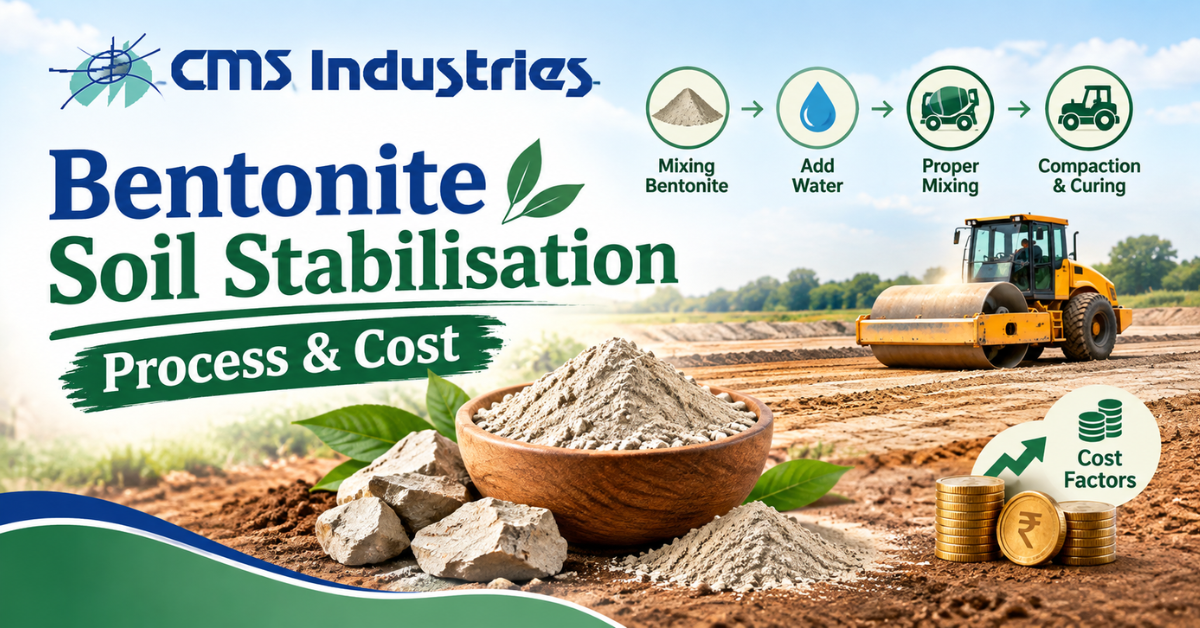
Details vary from project to project, but most bentonite dust for skin stabilisation work goes as follows:
- Study of the site and tests on the soil. Engineers check the type of soil, groundwater level, and permeability to ensure bentonite slurry is the right solution for the site.
- Slurry blend design. Bentonite powder is blended with clean water in proportions planned to meet target viscosity, density, and gel strength values depending on the particular soil conditions.
- Trenching or slurry-assisted drilling. During the excavation, the trench or borehole is at all times kept full of bentonite slurry to keep hydraulic pressure on the walls and stop them from collapsing.
- Formation of filter cake. The slurry naturally forms a thin, low-permeability layer along the face of the excavation which seals the soil and reduces the loss of water into the surrounding ground.
- Structural placement or backfilling. Once the trench design depth is reached, crews can either place backfill material such as a soil-bentonite mix or lower reinforcement and pour concrete and displace the slurry as they go.
- Quality test. Throughout the process, the density, viscosity, pH, and sand content are checked to confirm the slurry is performing as designed, and permeability testing is performed on the finished material.
- Monitoring and curing. Slurry walls and liners will cure over a period of days to weeks and will not be fully functional until they have cured.
Common Methods That Use Bentonite for Stabilisation
Slurry Trench Cutoff Walls
A soil-bentonite cutoff wall is made by using a bentonite-water slurry to keep an open trench during excavation and then replacing the slurry with a soil-bentonite backfill mixture when the trench reaches full depth. The finished wall is a low-permeability barrier that prevents the movement of groundwater and is a standard method of containing contaminated groundwater at industrial and landfill sites.
Bentonite Grouting and Injection
In sandy or loose soils that require some cohesion but not a full excavation, contractors may inject bentonite slurry mixed directly into the ground. A study in the journal Coatings found that a slurry mixture of about 3% bentonite clay and approximately 10% added water by weight of dry sand resulted in sand that was significantly more resistant to shear forces after curing, showing that even small amounts of bentonite can improve loose soil noticeably.
Diaphragm Walls and Piling Support
In boreholes and trench sections of deep foundations, bentonite slurry is used to prevent wall collapse during the installation of reinforcement cages and concrete. This is one of the most common applications of bentonite in piling and diaphragm wall construction, and it is the very reason for the existence of CMS Industries’ Civil Engineering Bentonite grade, designed for high viscosity and strong swelling performance in piling work.
Geosynthetic Clay Liners
Bentonite is bonded between layers of geotextile fabric to create a manufactured liner product, which is installed under landfills, ponds and containment areas to provide a low permeability barrier without full slurry trenching.
What Affects the Cost of Bentonite Soil Stabilisation
There is no one figure that applies to all bentonite stabilisation projects, as so many variables move the total cost. The main ones are
- Length and depth of the borehole or trench. Deeper and longer excavations require more slurry volume, more time for excavation, and heavier equipment.
- Soil and groundwater conditions. Labour and material costs are normally higher on rocky, contaminated, or high-water-table sites than for simple sandy or clay ground.
- Grade and rate of use of bentonite. Sodium bentonite of a higher swelling grade tends to be more expensive per tonne than material of a lower grade, but less volume is needed to achieve the same slurry performance.
- Backfill material design. A soil-bentonite backfill mix designed to meet a certain permeability target requires more design and testing work than a simple support slurry used only during excavation.
- Labour and equipment. Day rates include long-reach excavators, mixing plants, and experienced crews, and these vary widely by region.
- Testing and quality control. Testing density, viscosity and permeability throughout construction costs money but protects against wall failure later.
- Pricing of raw materials. Like any mined mineral, bentonite pricing varies with the costs of mining, processing, and transport. U.S. producer price data from the Federal Reserve Bank of St. Louis show the bentonite price index has been steadily rising over the past few years, a reasonable proxy for material cost trends across the industry generally.
The wide range of published cost estimates for soil-bentonite slurry walls is due to all of these variables, and estimates for one part of the country or level of project rarely apply to another. The most reliable number will come from a site-specific quote from a geotechnical contractor based on your actual soil report, project depth, and location.
Getting an Accurate Cost Estimate
If you are budgeting for a bentonite stabilisation project, there are a few steps that make the estimate far more reliable than a generic figure found online:
- Perform a geotechnical site investigation. Soil borings and permeability tests give the design team a picture of what they are really up against.
- Obtain a slurry mix design from a qualified engineer. This tells you how much bentonite is actually needed for the project and avoids guessing at the consumption rates.
- Get quotes from more than one contractor. Labour, equipment, and mobilisation costs vary by contractor and location.
- Get grade-specific bentonite pricing from suppliers. The material price is based on the swelling grade and quality specification your project requires.
- Add testing & quality assurance. “Plan on slurry testing; don’t make it an afterthought,” he says.
Where CMS Industries Fits In
CMS Industries mines bentonite in the Kutch region of Gujarat, processes it, and has developed its civil engineering bentonite grade for the swelling, viscosity, and green strength needed for slurry trench and piling jobs. CMS Industries is a bentonite manufacturer and supplier and provides the material for these stabilisation projects, but the excavation, mix design and installation work remains with the geotechnical contractor or engineering firm running the job. Getting the material specification right from the start makes a real difference when the slurry is doing its job down under.
Final Thoughts
The use of bentonite for soil stabilisation is not so much a matter of treating problem soil as it is using the swelling and sealing behaviour of bentonite as a tool for excavation, piling and barrier construction. The process itself is a relatively predictable sequence, from site testing through slurry mixing, trenching and backfilling, but the cost is very much dependent on depth, soil conditions, bentonite grade, and local labour and equipment rates. If you want a project-specific quote with a real soil investigation behind it, then you’re better off than picking some generic per-square-metre figure you find online.
Frequently Asked Questions
What does bentonite do in soil stabilisation?
Bentonite forms a slurry to support trench and borehole walls during excavation and a low-permeability seal to prevent the flow of water. It binds loose or sandy soils together and also helps to prevent collapse during construction.
Is bentonite used to fix expansive soil around a house foundation?
Usually no. The naturally expansive, clay-rich soils are usually stabilised with lime or cement to reduce swelling. Rather, it is mixed with loose, sandy, or coarse-grained soils. It helps to improve cohesion and fill in voids between particles, rather than cause further swelling.
How much does bentonite soil stabilisation cost?
Costs are project dependent and vary widely based on depth of trench, soil conditions, bentonite grade, equipment and labour rates in the area. The most reliable figure is a site-specific quote from a geotechnical contractor based on an actual soil investigation.
What is a bentonite slurry trench cutoff wall?
It is a vertical barrier constructed by digging a trench with the support of a bentonite slurry and then filling this trench with a soil-bentonite mix. The wall is a barrier to groundwater flow and can often be seen at the boundary of landfill and contaminated sites.
Which bentonite grade works best for piling and trench stabilisation?
Generally, high-swelling sodium bentonite, designed for high viscosity and high gel strength, is the best performer for piling and slurry trench work. The bentonite grade for this very purpose is designed by CMS Industries Civil Engineering.