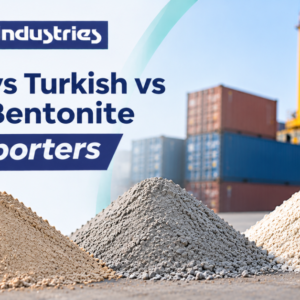



Three origins keep popping up on supplier lists for bulk bentonite: India, Turkey, and Greece. Both have deep reserves, processors ready to export and long trading histories. But the clay, the logistics, and the commercial conditions differ considerably from one country to another.
This guide helps you evaluate Indian vs Turkish vs Greek bentonite on the factors that impact your landed cost and product performance. You will discover production and export figures, the types of clays each country is famous for, the applications that fit each origin, and a checklist to select suppliers. The numbers are from the U.S. Geological Survey, trade data providers, government mineral reviews, and producer publications.
The Big Picture: Production and Exports
Let’s start with scale. World bentonite output is estimated to be about 19.4 million tonnes in 2024, according to the USGS Mineral Commodity Summaries 2026.
| Country | Mine production, 2024 (USGS) | Notes |
| India | About 3.7 million tonnes (estimate) | Largest producer after the United States |
| Turkey | About 2.53 million tonnes | Large sodium and calcium deposits |
| Greece | About 1.03 million tonnes | USGS notes the figure includes crude ore. |
| United States | About 3.99 million tonnes | World’s largest producer, for reference |
But production is only part of the story. Who feeds the world? Exports are the answer. As of 2024, the largest exporters of this commodity are India (about 1.5 million tonnes), Turkey (about 1.1 million tonnes) and the USA (about 0.7 million tonnes), which together account for about 60% of global exports in volume, according to IndexBox.
The picture changes. The top exporters are the United States (201 million), China (167 million), Turkey (155 million) and India (101 million), according to 2022 data from OEC. India ships large tonnages at relatively low unit values, indicating that bulk and less-processed material accounts for a large share of its exports.
Greece is a smaller exporter tonnage-wise but a big processor. Bentonite is listed among Greece’s leading mineral exports in the USGS Minerals Yearbook for Greece.
Indian Bentonite: Volume and Sodium Clay from Kutch
This is why India is on so many shopping lists. India’s bentonite occurs mainly in Gujarat and Rajasthan. In a 2015 review, the Indian Bureau of Mines reported that Gujarat represented 97% of the value of India’s bentonite production and that India’s total bentonite resources were about 583 million tonnes.
Natural sodium bentonite is famous in the Kutch district of Gujarat. Its processors are located near Mundra and Kandla ports, which handle both container and dry bulk vessels.
Strengths for importers:
- High volumes and possibility of full bulk vessel cargo
- Natural sodium grades for drilling, piling, foundry, and pelletising
- Available as lumps and processed powder
- Competitive FOB price aided by short haul from mine to port
Warnings:
- Testing of each lot is important, as the quality of deposits and suppliers is different.
- Raw lumps have high moisture, so compare prices on a dry-tonne basis
Turkish Bentonite: Europe’s Main Supplier
Turkey has become Europe’s main external supplier. According to TrendEconomy’s compiled trade data, Turkey supplied about 72% of the European Union’s imports of bentonite in 2023 by value, or some $129 million of $178 million. The latest UK customs data also shows Turkey as the number one country of origin for bentonite imports.
Turkey has deposits of sodium and calcium. Karakaya Bentonite is a Turkish producer claiming to have most of the sodium bentonite reserves in Türkiye in its product brochure and describes them as high-swelling with properties comparable to US bentonites. Another producer, Bentaş Bentonit says almost 90% of Turkey’s white bentonite reserves are in the area around Ordu, Ünye and Fatsa on the Black Sea coast, and it uses these clays to make clumping cat litter.
Strengths for importers:
- Short sea routes to Europe, the Mediterranean and the Middle East
- White and light-coloured clays for cat litter and certain special purpose uses
- Foundry and drilling natural sodium grades from specific deposits
- A wide range of producers with export experience
Watch-outs:
- Sodium reserves are kept by a few producers, so check carefully on origin and grade.
- Freight to South and East Asia takes longer than from India
Greek Bentonite: Milos and Processed Grades
The story of bentonite in Greece is centred on the island of Milos. Imerys, which acquired Greek minerals group S&B, operates bentonite mines and processing plants on Milos. The acquisition made Imerys a leading producer of bentonite products in Greece and Europe, including foundry binders, sealing products and drilling additives, according to the USGS Minerals Yearbook for Greece.
Bentonite also plays an important role in borehole sealing, where selecting the right sealing material is essential for preventing unwanted water movement and protecting groundwater. Depending on site conditions and project requirements, engineers may evaluate bentonite and cement grout as alternative sealing materials.
For a detailed comparison, read CMS Industries’ article: Bentonite vs Cement Grout for Borehole Sealing.
Milos has a history of sodium activation. The 1985 USGS Minerals Yearbook reported a new plant at Milos to granulate, activate sodium, and dry clays. A recent US patent on pelletising binders also describes soda ash activated bentonite from Milos with a swelling index of 42 mL per 2 g.
Strengths for importers:
- Integrated processors for engineered, consistent grades
- Extensive experience in the foundry, pelletising and sealing markets
- For buyers within the EU, supply is within the EU single market without customs duties.
Watch-outs:
- Smaller than Turkey or India
- Higher share of processed, engineered grades, which generally means a higher price per tonne
- Supply concentrated in fewer large producers
Indian vs Turkish vs Greek Bentonite for Importers: Side-by-Side
Let’s look at it at a glance.
| Factor | India | Turkey | Greece |
| Production, 2024 | About 3.7 Mt (estimate) | About 2.5 Mt | About 1.0 Mt |
| Export volume, 2024 | About 1.5 Mt (largest) | About 1.1 Mt | Smaller share |
| Main clay types | Natural sodium (Kutch); calcium | Sodium and calcium; white clays | Calcium clays, often soda activated |
| Typical product mix | Lumps, powder, granules | Powder, granules, cat litter | Activated and engineered grades |
| Main export reach | Asia, Middle East, Europe, Americas | European Union, UK, Middle East | Europe and global industrial buyers |
| Main ports | Mundra, Kandla | Black Sea and Aegean ports | Milos and mainland Greek ports |
| Price position | Often lowest FOB, especially bulk | Mid-range | Often higher, processed grades |
The price row reflects the general pattern in the trade data and product mix, not fixed quotes. Prices vary by grade, volume, and goods, so always compare like for like.
Which Origin Suits Which Application?
Here is a practical starting point by end use: this is your shortlist guide, followed by sample tests.
| Application | Origins worth testing first | Why |
| Drilling fluids and HDD | India, Turkey | Natural sodium grades with high swelling |
| Piling and diaphragm walls | India, Turkey | Natural sodium bentonite for stable slurries |
| Foundry green sand | Greece, India, Turkey | Activated and natural sodium foundry grades |
| Iron ore pelletising | India, Greece | High-swelling sodium and activated grades |
| Cat litter | Turkey, India | White clumping clays and sodium granules |
| Bulk civil and sealing work | India | Large volumes at low cost per tonne |
What Drives Your Landed Cost?
Next steps: look beyond the FOB price. There are 5 factors that determine the true cost from each origin.
- Freight distance and mode of transport. Bulk vessels from India are suited to big buyers in Asia and the Middle East. Turkey and Greece have shorter routes to Europe.
- Moisture. Powder will hold less water than the raw lumps, so you may be paying freight on water. Compare on a dry tonne basis.
- Import duties and terms of trade. Bentonite is generally classified under HS subheading 2508.10 in most countries; however, duty rates, trade agreements, and any additional surcharges will depend on the importing country and origin. Please refer to the current schedule for each origin.
- Fit grade. A cheaper clay which needs a higher dose can be more expensive in use. Price the dose, not the tonne.
- Reliability of supply. When you sign a long contract, lead times, port congestion and supplier capacity are just as important as price.
Supplier Selection Checklist
Whatever it is, use this list:
- Request a technical data sheet with named testing methods such as API, ASTM, or your industry standard.
- Request a lot-wise certificate of analysis for each shipment.
- Test samples in your own application before signing a contract.
- Check that the clay is natural sodium, calcium, or activated by soda.
- Check moisture content, mesh size, and packaging.
- Check the ownership of mines or long-term access to raw materials of the supplier.
- Compare quotes on the same Incoterm, say FOB or CIF.
- Request references from buyers in your industry and geography.
Sourcing Bentonite from India
For buyers who shortlist India, Kutch is the obvious starting point. CMS Industries is an ISO 9001:2015 certified bentonite miner, processor and exporter with manufacturing units at Mandvi Taluka, Kutch, near Mundra and Kandla ports. The company says it has a monthly capacity of over 26,000 tonnes of lumps and over 9,000 tonnes of powder, for grades for oil drilling, foundry, civil engineering, HDD, pelletising, cat litter and animal feed. As with any supplier, ask CMS Industries for technical data sheets and samples and test them against offers from other origins.
Final Word
There is no one best origin. India provides volume, natural sodium clay and competitive prices for bulk. Turkey is ahead of the European market with short routes and a wide mix of sodium, calcium and white clays. EU buyers have a home advantage in Greece, supplying engineered activated grades from integrated processors. Match origin to your application, goods route and volume, test samples side-by-side and let the numbers in your own process decide.
Frequently Asked Questions
1. Which country exports the most bentonite?
According to IndexBox, in 2024 India was the world’s largest exporter of bentonite, shipping 1.5 million tonnes, or 33% of all global exports. The 2022 OEC data ranked the United States, China, and Turkey highest in value.
2. Is Indian bentonite sodium or calcium-based?
Both are made in India. Gujarat is known for natural sodium bentonite in Kutch. It swells strongly and suits drilling, piling, foundry, and pelletising. According to the Indian Bureau of Mines 2015 review, Gujarat accounted for 97 per cent of the value of India’s bentonite production.
3. Why is Turkish bentonite popular in Europe?
Turkey’s proximity to European markets and the availability of both sodium and calcium clays, including white clays for cat litter. Trade data from TrendEconomy revealed that Turkey accounted for around 72% of the EU’s bentonite imports in 2023, by value.
4. What is special about Greek bentonite?
Greek bentonite is mainly produced in Milos, where Imerys operates mines and processing plants. For a long time, Milos producers have been soda-activating their clays, and the Greek supply is known for engineered grades for foundry, pelletising, and sealing markets across Europe and beyond.
5. How should I compare bentonite from different countries?
Compare landed cost, test data, and samples on a like basis. Review your process for the clay type, moisture, swelling, and dosage. Take lot-wise certificates from all the suppliers before signing a contract, including Indian suppliers like CMS Industries.