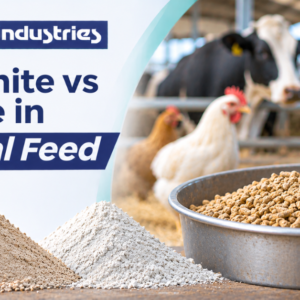



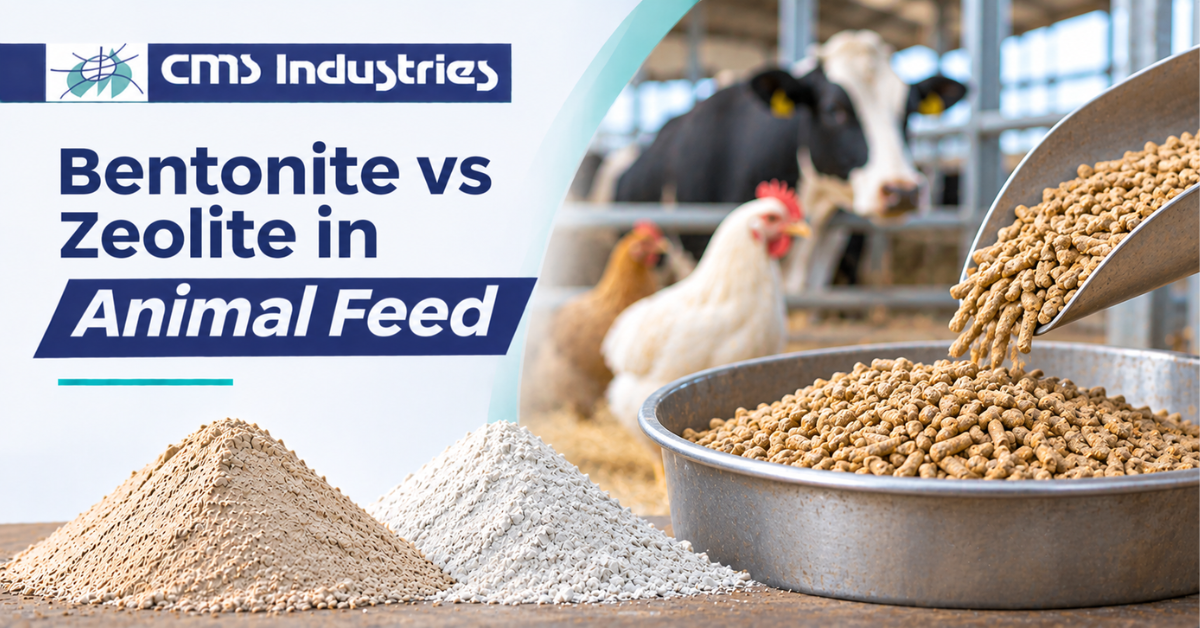
Walk into any feed mill, and you will find at least one mineral clay on the list of ingredients. The most common of these are bentonite and zeolite. Both are natural aluminosilicates, both help bind pellets and keep mash flowing, and both are marketed as toxin binders. So which one do you put in your formula?
There is no simple answer to the bentonite vs. zeolite question because the two minerals are constructed differently and are treated differently by regulators. This guide compares them for structure, approved uses, dose limits, mycotoxin evidence, and practical handling. It’s all based on EU feed additive regulations, European Food Safety Authority (EFSA) opinions, and peer-reviewed reviews so you can check every claim.
What Are Bentonite and Zeolite?
That’s why they behave differently. Both are aluminosilicates, but their crystal structures have little in common.
Bentonite is a clay composed primarily of smectite, generally montmorillonite. It consists of a stack of thin plate-like layers. Some molecules and water can slip between those layers, so bentonite swells, forms gels, and can bind some flat molecules on its large surface.
The zeolite used in feed is usually clinoptilolite of sedimentary origin. It is a tectosilicate – a rigid, three-dimensional framework riddled with tiny channels and cages. It does not bulge. Instead, it exchanges cations, e.g., ammonium, through its fixed pores.
| Feature | Bentonite | Zeolite (clinoptilolite) |
| Mineral group | Clay (smectite, phyllosilicate) | Tectosilicate framework |
| Structure | Stacked, expandable layers | Rigid, porous channels and cages |
| Swelling in water | Yes, especially sodium bentonite | No |
| Main binding route | Surface and interlayer adsorption | Cation exchange within pores |
| Typical feed roles | Pellet binder, anti-caking, aflatoxin binder | Pellet binder, anti-kaking |
How the EU Regulates Each Mineral
The European Union keeps one of the most detailed public records of approvals for feed additives, making it a useful benchmark even for buyers outside Europe.
Commission Implementing Regulation (EU) No 1060/2013 allows bentonite as a technological additive for all animal species in the functional group of binders. Under that regulation, the total bentonite in complete feed shall not exceed 20,000 mg/kg, or 2%.
For importers and manufacturers, understanding the origin and quality of bentonite is also important when evaluating suppliers. Indian, Turkish and Greek bentonite can differ in mineral characteristics, processing, specifications and suitability for particular applications. Buyers should compare technical data sheets and test results rather than relying on country of origin alone.
For a detailed comparison, read CMS Industries’ article: Indian vs Turkish vs Greek Bentonite for Importers.
The same regulation also allows a specific bentonite (identification number 1m558) as a substance for the reduction of contamination of feed by aflatoxin B1. Requires at least 70% dioctahedral montmorillonite. Suitable for ruminants, poultry and pigs.
Zeolite (clinoptilolite of sedimentary origin, identification number 1g568) is authorised for all animal species as a binder and anticaking agent by Commission Implementing Regulation (EU) No 651/2013. The additive shall consist of not less than 80% clinoptilolite and not more than 20% clay minerals, free from fibres and quartz. Total clinoptilolite from all sources shall not exceed 10 000 mg per kg of complete feed, or 1%.
Look what is not there. The EU authorisation for clinoptilolite is for binding and anticaking only. It does not have a mycotoxin reduction function as bentonite does for aflatoxin B1.
Bentonite vs Zeolite in Animal Feed: Side-by-Side
Let’s go through it in the points the formulators ask most about.
| Point | Bentonite | Zeolite (clinoptilolite) |
| EU maximum in complete feed | 20,000 mg/kg (2%) | 10,000 mg/kg (1%) |
| EU functional groups | Binder, anticaking agent and others; aflatoxin B1 reduction (specific additive) | Binder, anticaking agent |
| Aflatoxin B1 evidence | In vivo data in dairy cows; authorised AfB1 binder for ruminants, poultry and pigs | Some studies show benefit, but no EU mycotoxin authorisation |
| Pellet durability | Improves durability at 1 to 2% of complete feed (EFSA) | Authorised as a binder |
| Coccidiostat interaction (poultry) | Contraindicated with coccidiostats other than robenidine above 5,000 mg/kg | Not flagged in the same way in the EU entry |
| Swelling and water uptake | High | Low |
| Handling | Dust hazard; use breathing, eye and hand protection | Dust hazard; similar protection advised |
Mycotoxin Binding: What the Evidence Says
That’s where most of the marketing claims live, so it’s worth looking closely at the evidence.
Aflatoxin B1 and Bentonite. In EFSA’s opinion of 2011, bentonite adsorbs aflatoxins from water at different pH values and, to a lesser extent, from gastric juice. Two studies with dairy cows showed a clear reduction of aflatoxin in milk at 0.03 to 1% bentonite. The European Federation of Feed Manufacturers FEFAC reports in vitro binding of 90-95.3% for aflatoxin B1 at pH 5, and that bentonite can reduce aflatoxin carry-over from feed into milk by as much as 26%.
Bentonites are not identical. A study in Clays and Clay Minerals refers to previous work where aflatoxin adsorption capacity varied by a factor of ten among 20 bentonite samples. The mineral name is important, but so is the choice of product.
Other mycotoxins: A 2022 review of mycotoxin binders indexed on PubMed reported average adsorption across several mycotoxins of 62% for bentonite and 52% for clinoptilolite, with montmorillonite at 76% and activated carbon the highest at 83%. The most easily adsorbed were aflatoxins. A 2016 review in the Turkish Journal of Veterinary and Animal Sciences also observes that aluminosilicates aren’t effective against all mycotoxins.
Aflatoxins and zeolites. The same Turkish review cites trials in which clinoptilolite added to aflatoxin-contaminated broiler and quail diets reduced some of the toxic effects. These are promising results but have not led to a mycotoxin authorisation for clinoptilolite in the EU.
The conclusion is that bentonite has the better regulatory track record as an aflatoxin binder. Neither mineral is a broad-spectrum fix for every mycotoxin.
The Hidden Cost: Binding Nutrients and Drugs
This is the rub with any mineral binder. Nonselective binding. The 2022 review warns that the non-specific adsorption process also consumes some of the nutrients required by animals. Authors of a 2023 study in Toxins, which compared three smectites and one zeolite in a poultry digestive model, described aluminosilicates as a double-edged sword, adsorbing aflatoxin B1 but also trace minerals needed by birds.
Drug interactions, too, matter.” EFSA notes that supplementation of diets with bentonite is incompatible with robenidine and is expected to reduce the efficacy of other coccidiostats. The EU aflatoxin entry also mentions that it should not be taken orally with macrolides.
Things you can do in practice about it:
- Do not exceed the maximum permitted level for the mineral in question.
- Check for compatibility with any coccidiostat or medication in the diet.
- Check trace mineral and vitamin levels when adding a binder.
- Do not use a binder to “rescue” feed that exceeds legal limits for mycotoxins.
Pellet Binding and Flowability
Both minerals aid feed mills. According to EFSA, the addition of bentonite at 1 to 2% in complete feed can improve pellet durability. It expands and forms a gel, which helps to bind pellets together. In the EU, both bentonite and clinoptilolite are approved as anticaking agents, which keep mash and premixes flowing through bins and augers.
For high output mills, the choice is often a function of the dose allowed, pellet quality targets, and cost per tonne of feed.
Choosing Between Bentonite and Zeolite
What to do next: Start with this guide on making decisions.
| Your main goal | Better first choice | Why |
| Aflatoxin B1 control in ruminants, poultry or pigs | Bentonite (authorised AfB1 grade) | EU-authorised function with in vivo evidence |
| Pellet durability | Bentonite | EFSA-documented effect at 1 to 2% |
| Anticaking in mash or premix | Either | Both authorised as anticaking agents |
| Poultry diets with coccidiostats | Check carefully; zeolite or low-dose bentonite | Bentonite above 5,000 mg/kg conflicts with most coccidiostats. |
| Ammonia or cation exchange focus | Zeolite | Framework structure built for cation exchange |
Quality Checklist for Feed-Grade Minerals
Whatever you choose, buy to specification, not just the name:
- Mineral composition. Request X-ray diffraction and smectite content for bentonite or clinoptilolite content for zeolite.
- Data on aflatoxin binding. When buying bentonite as a binder, ask for the adsorption test results at pH 5, which is the method used by the EU.
- Pollutants. Check for heavy metals, dioxins, and other undesirable substances according to your local feed rules.
- Moisture and particle size: They influence mixing, dust, and flow.
- Feed safety certification: Look for established feed safety schemes and complete traceability.
- Local approval. Ensure the product is authorised for your species under your national feed legislation.
Sourcing Feed-Grade Bentonite from India
Kutch in Gujarat is one of the major sources of sodium bentonite in India. CMS Industries is an ISO 9001:2015 certified bentonite miner and processor in Mandvi Taluka, Kutch. The company offers an animal feed, bentonite, under the name of CMS FEED. It is described by the company as a highly colloidal product and used as a pelletising aid and flowability agent. CMS Industries’ website does not list smectite content or aflatoxin binding data, so request a full specification, contaminant analysis, and binding test results from CMS Industries before adding it to a formula.
Final Word
Both bentonite and zeolite are valuable feed minerals, but they are not interchangeable. Bentonite swells and binds pellets well and is authorised in the EU as an aflatoxin B1 binder with a higher permitted dose of 2%. Zeolite is a rigid cation exchanger authorised in the EU as a binder and anti-caking agent up to 1%. Neither binds all mycotoxins. Both can bind nutrients and some drugs. Purchase on confirmed specs, keep within limits, and select by your primary goal.
Frequently Asked Questions
1. Is bentonite or zeolite better as a mycotoxin binder?
Bentonite is in a stronger position against aflatoxin B1. One specific bentonite is authorised in the EU as an aflatoxin B1 binder for ruminants, poultry and pigs. In the EU, clinoptilolite is only authorised as a binder and anticaking agent.
2. How much bentonite can be added to animal feed?
EU Regulation No. 1060/2013 establishes a maximum level of bentonite in complete feed at 20,000 mg per kg, or 2%. EFSA also mentions that 1 to 2% bentonite can increase pellet durability. Also check your national feed rules.
3. What is the maximum zeolite level in feed?
Clinoptilolite of sedimentary origin is limited to 10,000 mg per kg of complete feed or 1% from all sources (EU Regulation No 651/2013). The additive shall contain at least 80% clinoptilolite and shall be free of fibres and quartz.
4. Can bentonite interfere with coccidiostats in poultry feed?
Yes. EFSA says bentonite is incompatible with robenidine and is likely to reduce the efficacy of other coccidiostats. EU rules prohibit the use of coccidiostats other than robenidine in combination with bentonite at levels higher than 5,000 mg per kg of complete poultry feed.
5. How do I choose a feed-grade bentonite supplier?
Request XRD for smectite content, aflatoxin-binding data at pH 5, heavy metal and dioxin results, and feed safety certification. Some suppliers (e.g., CMS Industries) offer feed grades. Request full specifications before use.