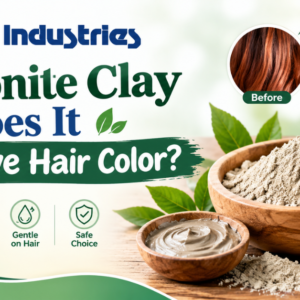



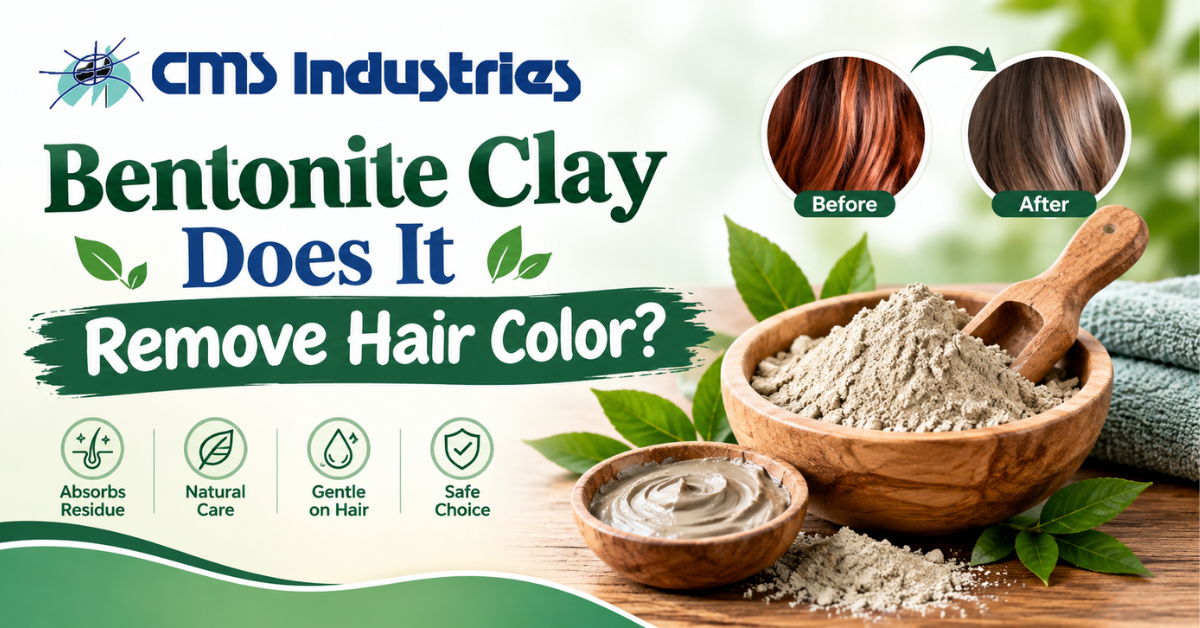
So, yes, bentonite clay can fade and slowly strip your hair colour, but it does so by pulling out oils, minerals, and product buildup in general—not by specifically targeting dye molecules. If you colour your hair and want that colour to last, a bentonite clay mask is not the treatment for you.
So, let’s break down why this happens, what really goes on at the hair strand level, and how to intentionally use bentonite clay if fading your colour is exactly what you want.
What Is Bentonite Clay?
Bentonite clay is made from weathered volcanic ash. Over long geological periods, that ash chemically decomposes into montmorillonite, a clay mineral famous for its high absorbency and for its ability to swell when it meets water. This same clay is made into powders and grades used in construction, agriculture, and personal care products, including face masks and clarifying treatments.
Bentonite is very useful and very disruptive to hair dye due to its cation exchange capacity. In simple terms, the clay surface is negatively charged, and it attracts positively charged atoms to it, away from whatever surface it is touching.
Does Bentonite Clay Remove Hair Colour?
Yes, mostly it does, though the effect is cumulative over time and not a stripping of colour in one wash. Each time you use it, the adsorptive properties of bentonite clay pull the oils, residue, and loose particles of pigment from the hair shaft. Some artificial hair dye is on the surface of the strand, and some is in the outer layer of the cuticle. Repeated usage of bentonite clay masks slowly pulls some of that pigment out, along with everything else the bentonite clay used for water purification attaches to.
This is why the effect seems to be different from person to person. The speed of the colour fading depends on the hair porosity, the type of dye, the depth of the colour deposit, and the number of applications of the mask. You see a noticeable change for some people after one or two masks. Others take a few applications over a few weeks before the change is noticeable.
How Bentonite Clay Interacts With Hair
A peer-reviewed paper in Applied Clay Science on purified natural bentonite notes that its large surface area and high cation exchange capacity, due to its very small particle size, make it well suited for pharmaceutical and cosmetic uses, including as a carrier, thickener, and cleansing agent in personal care formulations.
The same mechanism that works on hair works like this:
- Negative surface charge: The surface layers of the montmorillonite particles carry a negative charge.
- Attraction for positive ions. Many synthetic dye compounds, oils and minerals carry a slight positive charge or are attracted to positively charged sites and are therefore drawn toward the clay.
- Physical adsorption. As the clay dries and rinses away, it takes the trapped particles with it, leaving hair stripped of build-up, natural oils, and some amount of colour.
- The effect is compounded by repeated exposure. Each mask pulls out a little bit more, which is why bentonite clay fades colour gradually instead of stripping it all at once.
Does It Strip Hair Dye or Just Fade It?
This is where the honest answer gets a little more nuanced than most quick online guides would have you believe. Bentonite clay is not sold or formulated as a dye remover, and there is little formal clinical research to test it specifically for use against hair dye. The majority of what’s online is anecdotal and written by beauty writers—not controlled studies.
What is well documented is the general adsorptive strength of bentonite and its long history of use as a clarifying agent in skin and hair care. Combine this proven cleaning ability with the fact that hair dye sits partly on the surface of the strand, and fading becomes a reasonable and explainable result, not a mystery.
So the practical takeaway is this: bentonite clay is not going to act like a chemical dye stripper that you would buy at a beauty supply store. It is slower, and the outcome depends a lot on your hair and how deep the colour was applied. But noticeable fading is a normal and expected result of repeated use.
How to Use Bentonite Clay If You Want to Fade Your Colour
So here is a simple way that people often follow if they want to fade unwanted hair colour:
- Select a pure, additive-free bentonite clay. Avoid products with added fragrances or synthetic ingredients. You want a pure mask made of only minerals.
- Mix the clay with water or apple cider vinegar. A common ratio is one part clay to about one part liquid, adjusted till you get a smooth, spreadable paste. Do not use metal mixing bowls and spoons, as bentonite can react with metal.
- For use on clean, damp hair. Work the paste through each section from roots to ends, saturating the colour-treated areas completely.
- Leave it on for 20-45 minutes. Time will make the fading more effective, but it also makes the hair drier. Balance the time versus how your hair responds.
- Rinse well with warm water. Bentonite clay washes out easily but can be difficult to rinse out, so be patient and use a mild shampoo if necessary.
- And finish with a deep conditioner. The clay is absorbent and pulls out natural oils as well as colour and buildup, so hair typically needs a bit of extra moisture after.
- Repeat weekly if necessary. This is normal and fades gradually over a few sessions. It is usually kinder on hair than trying to push for a quick result.
How to Protect Your Hair Colour If You Don’t Want It to Fade
If you’ve dyed your hair recently and want the colour to last, the best thing to do is to avoid bentonite clay treatments altogether. A few more tips for preserving fresh colour:
- Space out clarifying treatments of any kind, not just bentonite, since most clarifying products pull out buildup and some pigment along with it.
- Use colour-safe shampoos and conditioners designed to reduce fading.
- Limit exposure to hot water. Heat opens the hair cuticle, which accelerates colour loss.
- And if you just dyed your hair, give it a few weeks before trying any strong clarifying masks.
Bentonite Clay in Cosmetic and Personal Care Products
Bentonite’s absorbency is also why it turns up so often in commercial skincare and cosmetic formulations as well as DIY hair masks. CMS Industries develops a cosmetic bentonite grade from bentonite based on a higher oil absorption capacity and the ability to draw other impurities out of a formulation. This is the same underlying property that drives the hair colour fading effect described above. That grade is intended for skincare and personal care manufacturing, not advertised as a hair dye remover, but the science that both use traces back to the same mineral behaviour.
Safety Considerations
Bentonite clay help with food poisoning is generally safe for use on hair and scalp, but there are a few precautions to consider:
- Do a first patch test, especially if you have sensitive skin or have had reactions to natural or mineral-based products.
- Expect to be dry after use. Bentonite pulls out natural oils and everything else, so hair can feel stripped, especially after the first few washes.
- Don’t overdo it. Usually weekly or biweekly is enough. Possible side effects of daily use are dry scalp and hair.
- Read the list of ingredients. Pure or cosmetic-grade bentonite is the safer choice than industrial material not meant for skin or hair contact.
Final Thoughts
Bentonite clay does fade and can strip hair colour meaningfully with repeated use, but it works through general adsorption, not a dye-specific chemical process. Patience and repeated masks get there slowly if you want your colour gone. If you want your colour to remain bright and true, this is one clarifying treatment to skip for a while. To summarise, the same cation exchange and oil absorption behaviour seen in CMS Industries’ Cosmetic Bentonite grade is the mineral science behind why this clay works double duty as a skincare staple and an accidental hair colour remover.
Frequently Asked Questions
Does bentonite clay remove hair dye completely in one use?
No. Bentonite clay gradually removes hair dye with repeated use rather than stripping it out all at once. “Most people need more than one mask, over the course of a few weeks, to see a noticeable colour change.”
Will bentonite clay affect my natural hair colour?
No. Bentonite clay does not change or lighten the natural undyed hair pigment. This only affects artificial dye and build-up that is on or near the surface layer of the hair.
How long should I leave a bentonite clay mask on coloured hair?
Most guides suggest 20-45 minutes. The longer you leave it on, the more it will fade, and the more it will dry it out, so it’s best to initially apply it for a shorter time and adjust accordingly to your hair’s response.
Is bentonite clay bad for colour-treated hair?
It’s not damaging in the traditional sense, but it will speed up the fading of colour and can leave your hair feeling dry afterward. To keep your colour bright, the best thing to do is to avoid bentonite clay treatments for a few weeks after dyeing.
Can I use bentonite clay to fix a bad dye job?
Many people do use it in this way, using repeated masks to slowly lift unwanted colour. Results vary according to hair type and dye depth, and it works more slowly than a commercial colour remover, so patience is part of the process.