


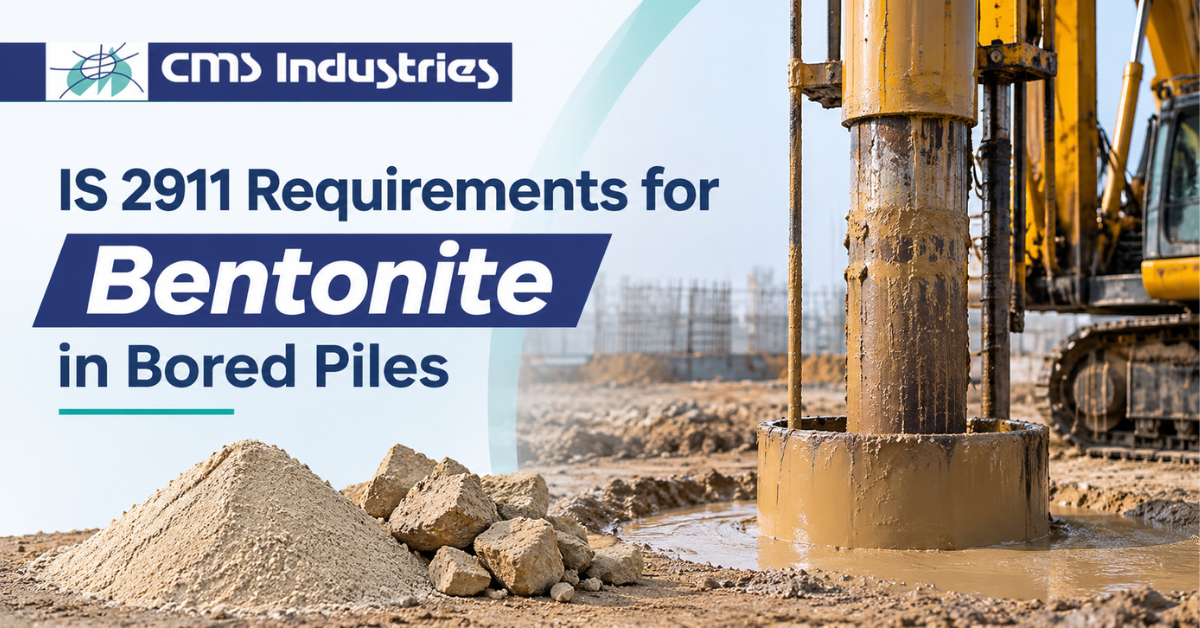
The quality of a bored pile depends on the quality of the hole into which it is poured. If the ground is loose or the water table is high, a support fluid is needed in the bore to keep its sides open until concrete is poured. That fluid is usually a bentonite slurry in India, and IS 2911 lays down the rules for it.
This guide summarises the Requirements for Bentonite in IS 2911 (Part 1/Sec 2):2010, code for bored cast-in-situ concrete piles. You’ll see each limit, the test behind it, how it changed from the older 1979 edition, and what site teams check before concreting.
Why Bored Piles Need Bentonite Slurry
This is why the code is so interested in this clay. The bentonite used for piling is a montmorillonite clay which has exchangeable sodium ions. When mixed with water, it forms a thixotropic suspension. Left alone, it turns into a jelly. It is again liquid when stirred or pumped.
That behaviour does two things in a pile bore:
- In sand or gravel, the slurry moves a short distance into the walls of the bore and gels to form a thin filter cake of low permeability. Then the fluid pressure is forced against this cake and does not allow the soil to move.
- In clayey soil, not much slurry goes into the walls, so most of the work is done by the hydrostatic head of the fluid column.
IS 2911 also prescribes that site teams maintain the slurry level at least 1.5 m above the groundwater level. That extra head prevents the bore from collapsing.
Where the Bentonite Rules Sit in IS 2911
IS 2911 and Where Bentonite Rules Fit IS 2911 are multi-part codes for pile foundations. The bored pile bentonite rules are found in:
- IS 2911 (Part 1/Sec 2): 2010 Code of Practice for Design and Construction of Pile Foundations: Part 1 Concrete Piles: Section 2 Bored Cast In-situ Concrete Piles (Second Revision)
- Requirements of Drilling Mud (Bentonite) Clause 7.4, Requirements for drilling mud Annex D
- Clauses 8.2 to 8.4 concerning slurry control, bore cleaning, and tremie concreting
- IS 2911 (Part 3):1980 covers under-reamed piles, and there is a separate part on the bentonite appendix.
IS 2911 Requirements for Bentonite: The Annex D Limits
Let’s break it down. 4.4.1 Piling Work: The bentonite powder and suspension shall comply with the requirements of clause D-3 in Annex D.
| Property | IS 2911 (Part 1/Sec 2): 2010 limit | Test method or tool |
| Liquid limit of bentonite | 400% or more | IS 2720 (Part 5) |
| Density of fresh suspension | 1.03 to 1.10 g/ml, depending on pile size and soil | Mud balance |
| Density before concreting | Bring down to 1.12 g/ml or less by flushing (contaminated slurry may reach 1.25 g/ml). | Mud balance, sample from bore bottom |
| Marsh viscosity | 30 to 60 seconds; up to 90 seconds in special cases | Marsh cone |
| pH of suspension | 9 to 11.5 | pH meter or indicator paper |
The code also requires the suspension to be prepared with fresh water and to be circulated by means of a pump. Let us look at each limit separately.
Liquid Limit of 400% or More
The liquid limit is a measure of how much water the clay can take before it begins to behave like a liquid. A high value indicates a sodium bentonite that swells strongly and develops viscosity and gel strength at a low dose. Labs test it to IS 2720 (Part 5) – the Indian method for liquid and plastic limits of soils. Low liquid limit clay requires you to add more powder to get the same slurry properties, which increases density and sand load.
Fresh slurry density of 1.03 to 1.10 g/ml
Slurry density is how much solid material it has. A new mix should be between 1.03 and 1.10 g/ml. The upper end of the range is generally required for larger piles and weaker soils. After mixing, the site engineer checks with a mud balance.
Density Before Concreting: 1.12 g/ml or Less
In boring, the soil particles get mixed into the slurry and raise the density, sometimes to 1.25 g/ml. Good concrete and heavy, sand-laden slurry are enemies. It can get stuck in the pile shaft or lie at the toe. So the code needs to flush until the density is less than or equal to 1.12 g/ml. This is supported by clause 8.2.2; concreting should not be commenced if the specific gravity of the bottom slurry is more than 1.12.
Marsh Viscosity of 30 to 60 Seconds
The marsh cone test is a quick field test for the thickness of the slurry. The tester measures the time taken for a standard funnel to empty a certain volume. IS 2911 calls for 30 to 60 seconds but allows 90 seconds in special cases. Thin slurry might not hold the bore. Very thick slurry is difficult to pump and makes it harder for concrete to displace.
Along with slurry performance, it is important to identify the correct bentonite classification when sourcing or importing the material. The applicable HS code can affect customs classification and import documentation. For guidance, read CMS Industries’ article: Bentonite HS Code 25081010 vs 25081090: Which One Applies?.
pH Between 9 and 11.5
Sodium bentonite slurry is alkaline in nature. A reading outside 9 to 11.5 is often an indication of contamination from cement, saline groundwater, or acidic soil. Any of these may interfere with the gel structure and filter cake of the slurry.
What Changed from the 1979 Edition?
Many tender documents and older method statements still refer to IS 2911 (Part 1/Sec 2) 1979 edition. The two versions differ in ways that matter on the ground.
| Point | IS 2911 (Part 1/Sec 2): 1979 | IS 2911 (Part 1/Sec 2): 2):2010 |
| Liquid limit | More than 300% and less than 450% | 400% or more |
| Sand content of powder | Not greater than 7% | No separate limit in Annex D |
| Fresh slurry density | 1.034 to 1.10 g/ml | 1.03 to 1.10 g/ml |
The 1979 code limited sand content primarily to reduce wear on pumping equipment. Many projects still have that 7% cap in their own specs. Check your contract before you sign off on a material.
The under-reamed pile code IS 2911 (Part 3):1980 has retained the old limits of liquid limit 300 to 450% and 7% sand cap. It demands a differential free swell of more than 540%.
Site Testing: A Step-by-Step Routine
Next steps: Here is a simple routine that site teams use to stay within the IS 2911 limits.
- Inspect the incoming powder. Ask the supplier to issue a test certificate indicating the liquid limit according to IS 2720 (Part 5). If the contract requires it, send a sample from each lot to a lab.
- Stir in fresh water. Use a mixer or pump circulation. Before use, allow the slurry to hydrate so the clay can fully swell.
- Try the fresh slurry. Mud balance for density, marsh cone for viscosity, and meter or paper for pH.
- Maintain the standard. Keep slurry at least 1.5 m above groundwater throughout boring.
- Watch while boring. Determine the specific gravity at the intervals specified in clause 8.2.1.
- Flush before concreting. Scrub the bore bottom with fresh bentonite or air lift until no more coarse material is coming out and the bottom slurry reads 1.12 g/ml or less.
- Take notes on everything. Clause 8.6.1 requires that the density of fresh and contaminated mud be recorded regularly before concreting.
Concreting Through Bentonite Slurry
Even perfect slurry is useless if the concreting is wrong. IS 2911 (Part 1/Sec 2) specifies the requirements of tremie concrete in slurry-filled boreholes:
- Rich concrete: at least 400 kg cement per cubic metre
- High workability: slump of 150 to 180 mm; the concrete can flow and push the slurry up
- Tremie embedment: The tremie pipe is always a minimum of 1 m inside concrete
- Tremie plug: plug the tremie, separating the first concrete charge from the slurry
- Short breaks only. If concreting is stopped, it should be resumed within 1 or 2 hours, the tremie being left in position.
The lighter slurry is pushed up as the concrete rises from the bottom. That’s why controlling density is so important.” A slurry about as dense as concrete will not get out of the way cleanly.
Common Problems and Their Fixes
| Problem on site | Likely cause | Practical fix |
| Bore walls collapse. | Slurry too thin, or level too low | Raise slurry level above groundwater; check viscosity and density. |
| Bottom slurry above 1.12 g/ml | Soil and sand mixed in during boring | Flush with fresh slurry or use air lift, then retest. |
| pH out of range | Cement or saline water contamination | Replace with fresh slurry; review water source |
| Slurry thickens over days. | Long storage, contamination | Desand, dilute or replace before reuse. |
| High powder use | Low-grade clay with weak swelling | Switch to a grade with a higher liquid limit. |
How to Choose a Piling-Grade Bentonite
Use this checklist before approving a supplier:
- Ensure the edition of the code referenced in your contract requires the liquid limit. 400% or more if it’s the 2010 code, or 300 to 450% for older specs.
- If your contract has the 7% cap, ask for sand content.
- Ask for a lab trial mix with fresh density, Marsh viscosity, and pH at your intended dose.
- Verify that the powder is a natural sodium bentonite or properly activated grade.
- Ask for a test certificate with every single lot, not just with the first one.
The major bentonite belt of India is in Kutch, Gujarat. CMS Industries is an ISO 9001:2015 certified miner and processor based in Mandvi Taluka, Kutch. It provides civil engineering bentonite for bored piling, diaphragm walls, and slurry walls under the brand names CMS PILING 200, 300, and 500. It does not post test values for those grades on its website. So, like any supplier, get a datasheet and lot test certificate from CMS Industries to compare to the Annex D limits before approving the material.
Final Word
IS 2911 briefly states the bentonite rules, but each of them is to guard against a real failure. The liquid limit safeguards slurry quality at the source. Limits on density and viscosity allow for a stable borehole and easy slurry displacement. The pH range indicates contamination. The check of 1.12 g/ml before concreting is to protect the finished pile. Test at each stage, record results, and match your material to the edition your contract cites.
Frequently Asked Questions
1. What liquid limit does IS 2911 require for bentonite?
IS 2911 (Part 1/Sec 2): 2010 The liquid limit shall be 400% or more when tested by IS 2720 (Part 5). The older 1979 edition and the underreamed pile code require between 300% and 450%. Use the edition required by your contract.
2. What should be the density of bentonite slurry for piling?
Depending on the size of the pile and the soil, the fresh slurry should be in the range of 1.03 to 1.10 g/ml. It may go up to 1.25 g/ml in boring. Flush the bore until the bottom slurry is 1.12 g/ml or less before concreting.
3. What is the marsh cone viscosity limit in IS 2911?
The Marsh viscosity required by IS 2911 (Part 1/Sec 2) is 30 to 60 seconds. The code allows for up to 90 seconds in some special cases. If the slurry is very thin, it may not support the bore. If it is very thick, it will resist displacement by the concrete.
4. Does IS 2911:2010 limit the sand content of bentonite?
Annex D of the 2010 edition has no separate limit for sand content. The 1979 edition and IS 2911 (Part 3) limit sand content to 7%, primarily to minimise pump wear. Many project specs still have that cap, so check yours.
5. How do I check whether a bentonite brand meets IS 2911?
Get a lot-wise test certificate from the supplier for the liquid limit. Conduct a trial mix for density, Marsh viscosity, and pH. Suppliers such as CMS Industries will provide piling grades. Ask for their datasheet and compare it with Annex D.