


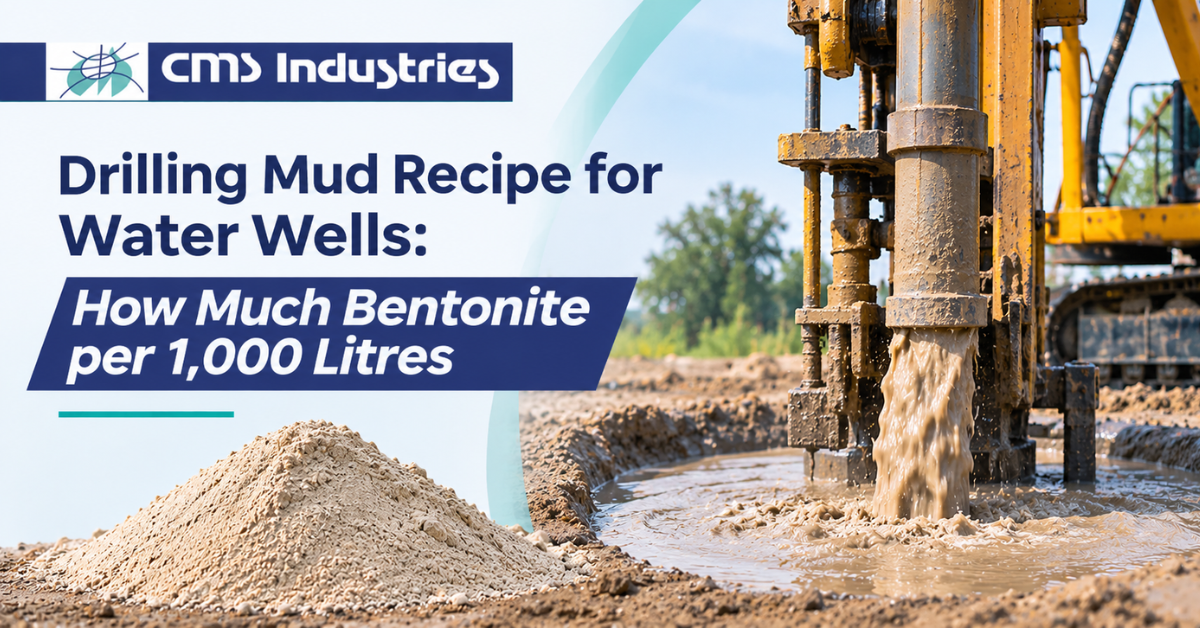
Ask ten borewell drillers how much bentonite they put in a tank of water, and you will get ten answers. Some are feelers, some bag counters, and some habitual. The problem is that if you use too little bentonite, the hole collapses; if you use too much, you slow down drilling, waste powder, and choke off the aquifer you are trying to tap.
This guide gives a practical drilling mud recipe for water wells. The measurements are per 1,000 litres of water. You will be given initial amounts of bentonite, soda ash, the desired values to be checked with a Marsh funnel and mud balance, and a basic mixing procedure. The figures have been taken from published manufacturer guidelines and state drilling programme training material and converted to metric units for Indian sites.
What Drilling Mud Does in a Water Well
That’s why the recipe matters. In mud rotary drilling, the fluid pumped down the drill pipe does several jobs at the same time:
- Lifts drilling mud from the bit to the surface.
- Hydrostatic pressure maintains borehole wall integrity.
- Builds a thin wall cake on sand layers so that fluid does not drain into the formation
- Cools and lubricates the bit.
- Does not settle cuttings on the bit when the pump stops. Suspends cuttings
Sodium bentonite does most of this job. When it hydrates, its thin clay platelets disperse through the water, build viscosity, and form a gel. The aim is a mud thick enough to do these jobs but no thicker.
Start with the Water: Pre-Treatment with Soda Ash
The water quality is 80 to 97% of a drilling slurry and determines the performance of the bentonite. The optimum hydration of bentonite is when the make-up water has a pH of 8.5 to 9.5. Many borewells, municipal, and pond sources are around pH 7 or less, and hard water contains calcium that prevents the clay from swelling up properly.
The fix is sodium carbonate (soda ash). This increases the pH and precipitates the calcium. Baroid, a major drilling fluid maker, recommends 0.6 to 1.2 kg of soda ash per 1,000 litres for hardness reduction in make-up water, and up to 2.4 kg per 1,000 litres as a general treatment range.
These make-up water targets are also included in training material used by the Nebraska Water Well Program:
| Make-up water property | Target |
| pH | 8.5 to 9.5 |
| Calcium | Below 100 ppm |
| Chlorides | Below 500 ppm |
| Chlorine | Below 50 ppm |
Always add the soda ash first, test the pH with a meter or paper, then add the bentonite. This step is the most common reason for a driller to report that the bentonite “did not mix well”.
Drilling Mud Recipe for Water Wells: Bentonite per 1,000 Litres
Let’s unpack that. Most rates published are in US units, so a quick conversion is useful here. 1 pound per 100 U.S. gallons is about 1.2 kg per 1,000 litres.
Baroid recommends its AQUAGEL bentonite viscosifier in the range of 10 to 50 lb per 100 gallons, or 12 to 60 kg per 1,000 litres. The wide range is due to the different soils, hole diameters, and grades of bentonite. In it, a reasonable starting recipe seems to be:
| Ground condition | Bentonite per 1,000 litres (starting dose) | Target marsh funnel viscosity. |
| Firm clay, silt, fine sand | 25 to 35 kg | 32 to 38 seconds per quart |
| Medium to coarse sand | 35 to 45 kg | About 38 to 45 seconds per quart |
| Gravel, loose or caving layers | 45 to 60 kg | 45 seconds per quart or higher |
Plus, in all cases: soda ash 0.6-1.2 kg/1,000 litres, before the bentonite.
These are starting points, not ironclad rules. Bentonite varies a lot in quality. A high yield clay can achieve the target viscosity at a much lower dose, while a low yield clay may require more. Always make a trial batch, test, and adjust.
Why bring the bar down? Industry recommendations for water-based muds are that a good bentonite mud should have a viscosity of 32 to 38 sec/qt. and that the viscosity should be held to a minimum consistent with hole stability. The thinner the mud, the faster the bit and drilling. Coarse gravel requires thicker mud to lift it.
Optional Polymer Additions
In water-sensitive clays, or where fluid loss is high, drillers will often add a small dose of polymer to the bentonite mud. Baroid lists its QUIK-TROL GOLD filtration control additive at about 0.3 to 5.7 kg per 1,000 litres, depending on the requirement. Only use polymers approved for potable water wells and follow the manufacturer’s breakdown procedure before well development.
Ready Reckoner: Batch Sizes for Common Mud Pits
Below is a quick table for a typical 30 kg per 1,000 litres mix with 1 kg soda ash per 1,000 litres.
| Water volume | Soda ash | Bentonite at 30 kg/1,000 L | Number of 25 kg bags | Number of 50 kg bags |
| 500 litres | 0.5 kg | 15 kg | 0.6 | 0.3 |
| 1,000 litres | 1 kg | 30 kg | 1.2 | 0.6 |
| 2,000 litres | 2 kg | 60 kg | 2.4 | 1.2 |
| 5,000 litres | 5 kg | 150 kg | 6 | 3 |
| 10,000 litres | 10 kg | 300 kg | 12 | 6 |
How Much Mud Does Your Hole Need?
So first find the borehole volume:
Volume (litres) = 0.785 × diameter (m) × diameter (m) × depth (m) × 1,000
For a 150 mm (6 inch) hole drilled to 60 m, we have 0.785 x 0.15 x 0.15 x 60 x 1,000, or about 1,060 litres. That volume plus a reserve for losses and settling must be in your pits. Drillers often design surface pits to hold two to three times the volume of the hole.
Step-by-Step Mixing Method
Next steps: Do this for each new batch.
- Pour the measured amount of clean water into the pit or tank.
- Check the pH. If less than 8.5, add soda ash at 0.6 to 1.2 kg per 1,000 litres and mix. Retest until pH is between 8.5 and 9.5.
- Add the bentonite slowly. Run it through a mixing hopper or jet, or dust it into a flowing stream of water. If you dump in whole bags at one time, you will get lumps that never fully hydrate.
- Mix by shearing. Keep the pump or mixer going so the clay breaks up evenly.
- Let it imbibe. Let the slurry swell before you start drilling. Baroid recommends that its bentonite be pre-hydrated before use. A properly hydrated mud will develop much more viscosity per kilogram.
- Test the mud. Look at Marsh funnel viscosity and mud weight.
- Adapt. If the mud is too thin, add a little bentonite. If the treated water is too thick or heavy, add water.
- Log the readings in your drilling log as well as the dose used.
Testing Your Mud on Site
Three inexpensive tools cover most water well work.
| Test | Tool | Target for water wells |
| Viscosity | Marsh funnel and cup | 32 to 38 seconds per quart for normal drilling (fresh water reads about 26) |
| Mud weight | Mud balance | Below 9.0 lb/gal, roughly 1.08 SG (fresh water is 8.34 lb/gal). |
| Sand content | Sand content kit | Below about 2.5 to 3% |
| pH | Meter or paper | 8.5 to 9.5 |
The mud weight deserves special mention. As drilling progresses, cuttings and sand are added to the mud, and that increases the weight. Heavy mud slows penetration, pumps more fluid into the aquifer, and builds a thicker wall cake. If the weight is over 9 lb/gal, settle or desand the mud or dilute with treated water.
Maintaining the correct bentonite slurry properties is essential for bored pile construction. Engineers and contractors should also understand the relevant requirements of IS 2911 when selecting and testing bentonite for pile foundations. For more details, read CMS Industries’ article: IS 2911 Requirements for Bentonite in Bored Piles.
Common Mistakes and How to Fix Them
| Problem | Likely cause | Fix |
| Mud stays thin despite extra bentonite. | Untreated, low pH or hard water | Pre-treat with soda ash and retest pH |
| Lumps or “fish eyes” in the pit | Bentonite added too fast | Feed slowly through a hopper or jet. |
| Hole keeps caving. | Viscosity or mud level too low | Raise viscosity in small steps; keep pits topped up. |
| Slow drilling, high pump pressure | Mud is too thick or too heavy. | Dilute with treated water; remove sand. |
| Mud thickens suddenly and flocculates. | Calcium or gypsum contamination | Treat with soda ash or replace with fresh mud. |
| Low yield after completion | Thick wall cake left in the screen zone | Keep mud weight low; develop the well thoroughly. |
Choosing Bentonite for Water Well Drilling
The right grade can reduce your cost and dose per meter. Look for: 1.
- Natural sodium bentonite or suitably activated high-swelling grade
- Viscosity or yield at specific concentration, test certificate
- Fine, even ground so it mixes without lumps
- Low grit – Sand in the powder contributes to sand content in the mud
- Batch after batch, quality is consistent, so your recipe works on every job
The primary source of sodium bentonite in India is the Kutch district of Gujarat. CMS Industries is a bentonite miner and processor based in Mandvi Taluka, Kutch, and is ISO 9001:2015 certified. They have a water well drilling-grade mud rotary drilling named CMS WELLDRILL. The product’s uses are detailed on the website, but no dosages or test values are published. So, just like with any supplier, ask CMS Industries for a datasheet and run a trial batch with the recipe above to determine your own best dose.
Final Word
A good drilling mud for a water well is a simple thing: treated water, the right amount of bentonite, and regular testing. Begin with soda ash to raise the pH to 8.5 to 9.5. For normal ground, add about 25 – 35 kg of bentonite per 1,000 litres. For coarse sand or gravel, add more. Check viscosity and weight frequently and keep both as low as the hole will permit. You will be better off for the well you finish.
Frequently Asked Questions
1. How much bentonite do I need per 1,000 litres of water?
For normal clay, silt, and fine sand, begin with 25 to 35 kg per 1,000 litres. Coarse sand and gravel may require 45 to 60 kg. Test viscosity and adjust for your bentonite grade. Manufacturers’ ranges are around 12 to 60 kg.
2. Why add soda ash before bentonite?
Soda ash pushes the water’s pH up into the 8.5-9.5 range and gets rid of calcium hardness. Bentonite then swells completely and builds more viscosity per kilogram. 0.6 to 1.2 kg per 1,000 litres usually does the trick.
3. What Marsh funnel viscosity should well mud have?
Most water well drilling goes well at 32 to 38 seconds per quart. Fresh water takes about 26 seconds to boil. Only go thicker when you have to lift coarse gravel or hold loose caving layers, and keep it as low as stability will allow.
4. What should the mud weight be for a water well?
Keep mud weight less than 9.0 lb/gal, or 1.08 SG. Fresh water has a weight of 8.34 lb/gal. “Weaker mud allows us to drill faster, inject less fluid into the aquifer, and create a thinner wall cake that is easier to remove,” he says.
5. Which bentonite grade works best for borewell drilling?
The best quality is a natural sodium bentonite that is low in grit, finely ground, and high in swelling. Ask for a test certificate showing yield or viscosity. Indian producers like CMS Industries offer water well grades, so do a trial batch before buying in bulk.