


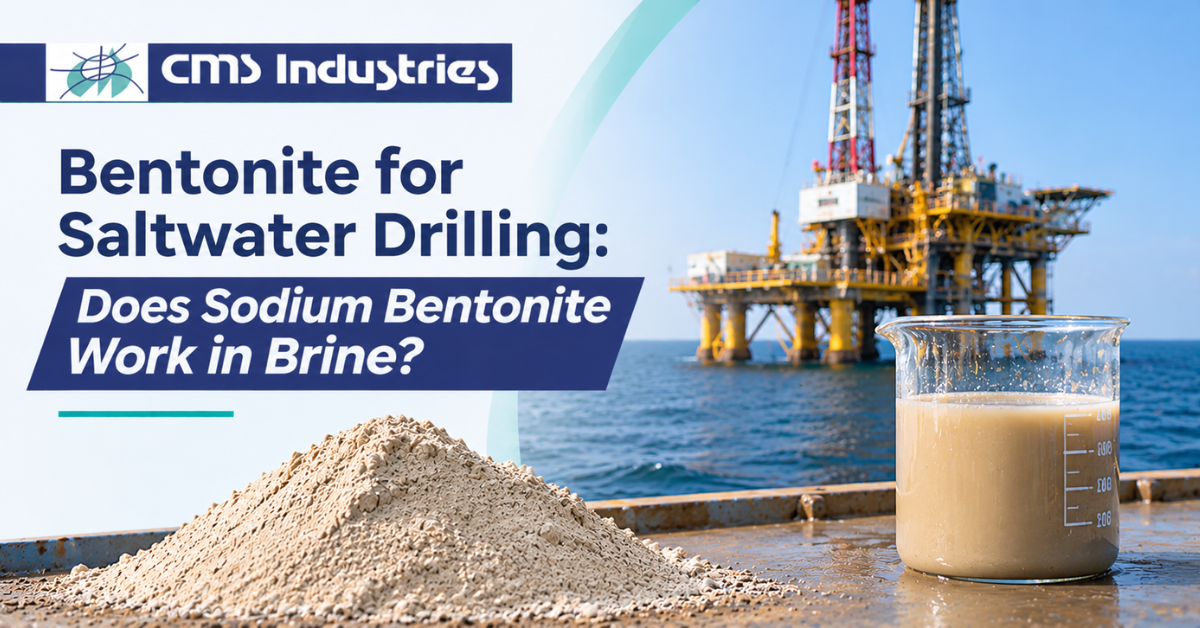
Drillers on coastal sites, offshore rigs, and saline inland aquifers all face the same problem, sooner or later. They mix the sodium bentonite normally, but with salty water, and the mud never gets thick. The powder settles, the hole looks like muddy water, and the hole won’t stay open.
Does bentonite work in brine at all? The quick answer: not directly, but yes, if you do it right. From prehydration to salt-tolerant clays and polymers, this guide will tell you what salt does to bentonite, how far you can push it, and the practical options for bentonite for saltwater drilling. The facts are taken from drilling fluid patents, industry short course papers, and peer-reviewed studies, so you can verify each one.
Why Salt Stops Sodium Bentonite from Swelling
That’s why fresh water is so important.” Sodium bentonite is composed of very thin clay platelets stacked up. In fresh water, water molecules wedge themselves between the layers; the stack opens up, and millions of tiny platelets spread through the liquid. That’s what gives viscosity, gel strength, and a thin, low-permeability filter cake.
Salt does something to the chemistry around platelets. The dissolved sodium, calcium, and magnesium ions crowd the platelet surfaces and diminish the repulsion that keeps them apart. The effects are soon seen.
- The clay hydrates much less, so the same dose gives a much lower viscosity
- Platelets flocculate, clumping edge to face instead of evenly spread
- The gel strength increases and then decreases as the clumps become larger aggregates.
- Fluid loss increases, and the filter cake becomes thicker and more leaky.
Solids settle out in the pit when the mud is still. US Patent 5,723,416 says it plainly: “As salinity increases, the swelling capability of bentonite decreases rapidly, and at approximately seawater salinity the clay becomes inert in a drilling mud.”
How Much Salt Is Too Much?
Let’s look at it by chloride level, which is the figure most drilling fluid tests report on.
| Water type | Approximate chloride level | What happens to sodium bentonite mixed diredirectly ? |
| Fresh, soft water | Very low | Full swelling and normal yield, especially after soda ash treatment |
| Brackish water | Up to about 6,000 ppm | Yield drops; mud needs more powder and careful testing. |
| Saltwater | Above about 6,000 ppm | Direct hydration largely fails; clay settles and gives a small share of its fresh-water viscosity. |
| Seawater | About 19,000 ppm | Bentonite added straight to seawater becomes close to inert. |
| Saturated salt brine | Roughly 190,000 ppm (calculated for saturated NaCl) | Direct use of bentonite is not practical. |
The 6,000 ppm figure is taken from U.S. Patent 4,500,436. It is stated that attempts to hydrate bentonite in salt water with chloride concentrations above this resulted in settling and viscosities much lower than in fresh water. US Patent 5,723,416 for seawater composition with chloride at about 18,970 ppm.
And a pinch of salt does the trick. In a University of Houston study of a 4% bentonite mud with xanthan gum, fluid loss increased by more than 30% with the addition of only 0.5% sodium chloride.
Calcium and magnesium are also a nuisance at much lower levels. “The usual treatment when calcium is expected above 200 ppm is soda ash,” one drilling fluid patent notes.
Option 1: Prehydrate the Bentonite in Fresh Water
This is the standard answer to needing to drill with saltwater but getting some fresh water locally. The idea is simple: let the clay swell completely in fresh water first and then add the swollen slurry to the brine system.
The method is described in a Southwestern Petroleum Short Course paper on brine drilling:
- Use a separate mixing trough with good, clean water.
- Add bentonite. 3. Treat the water with soda ash for the removal of hardness. In this step, the paper uses soda ash instead of caustic soda.
- Add 20 to 30 lb of bentonite per barrel of water, or about 57 to 86 kg per 1000 litres.
- Allow the clay to fully hydrate in this concentrated slurry.
- 3. Bleed prehydrated slurry into brine or salty mud system as needed.
According to the same paper, such prehydrated bentonite shows reasonable viscosity and filtration control in brine over a reasonable period of time. It doesn’t last forever. The salt will still work on the clay over time, so plan for regular top-ups and testing.
For better results, do the following: Add a protective polymer to the fresh-water slurry before it enters the brine. Coatings like PAC (polyanionic cellulose) or xanthan gum coat the platelets and delay flocculation.
Option 2: Use a Salt-Tolerant Clay
Many drilling teams do not use bentonite as the primary viscosifier in high salt concentrations. Industry patents say that bentonite muds are generally not run under high-salt conditions, and “salt gel” or attapulgite takes over.
Attapulgite (also known as palygorskite or salt gel) and sepiolite are needle-shaped, non-swelling clays. They work by mechanical shearing to give them viscosity, not by swelling, so they still work with salt. According to a 1983 paper by Edgar W. Sawyer, these clays thicken salt- and gypsum-contaminated water but don’t get too thick when salt or calcium enters the mud.
But there’s a catch. Attapulgite alone gives poor filtration control, as its needle-like particles do not build the tight plate-like filter cake that is built by bentonite. Drillers use it in combination with starch or cellulose polymers to control fluid loss.
Option 3: Polymer-Extended or Polymer-Based Systems
Water-soluble polymers have emerged as the primary tool for drilling with salt water and seawater. A paper published in 2025 in Frontiers in Materials, reviewing research on seawater bentonite slurries, says PAC can increase the viscosity of seawater slurry and xanthan gum is a salt-resistant additive for bentonite slurry in undersea tunnelling.
Some common options are:
- Xanthan gum: Suspension and viscosity in salt water
- PAC: controls the fluid loss and increases viscosity
- Starch: a low-cost fluid loss control in salt systems
- Speciality salt-tolerant blends: proprietary blends of bentonite with gums and caustic agents
Some patented systems, such as US Patent 4,500,436, even claim to hydrate bentonite directly in seawater with caustic and thinning agents. These are proprietary formulas, so don’t try to copy them on site; just follow the data sheet from the maker.
For practical guidance on bentonite quantities and mixing ratios for water well drilling, read CMS Industries’ article: Drilling Mud Recipe for Water Wells: How Much Bentonite per 1,000 Litres.
Bentonite for Saltwater Drilling: Choosing the Right Approach
Here’s a quick guide to match your water to the method.
| Your situation | Suggested approach |
| Slightly hard or brackish water, low chloride | Treat with soda ash, use sodium bentonite, test viscosity and adjust dose. |
| Salty make-up water and fresh water are available nearby. | Prehydrate bentonite in treated fresh water, then add to the system with a protective polymer. |
| Seawater as the only water source | Attapulgite or sepiolite with starch or PAC, or a polymer-based system |
| Drilling through salt beds or saline aquifers with freshwater mud | Expect contamination; keep polymer on hand and monitor chlorides. |
| Saturated brine is needed for salt sections. | Salt-tolerant clay and polymers; bentonite is not practical. |
Site Checks for Saltwater Mud
Testing tells you when salt has begun to win. These checks should be routine for you:
- Test make-up water chlorides before mixing. Use a chloride titration kit.
- Test for pH and hardness. Treat with soda ash in the presence of calcium.
- Run the Marsh funnel viscosity on each new batch and at regular intervals.
- Watch out for fluid loss with a filter press, as salt increases it quickly.
- Watch for warning signs: unexpected thinning or thickening, settlement in the pit, thick and soft wall cake, or increasing chloride readings.
- Keep a log of all the readings so you can see trends before the hole gets unstable.
Common Mistakes with Bentonite in Brine
- To add bentonite straight to seawater and expect fresh-water results.
- Hard water skipping: Soda ash wasting powder before salt even comes into play.
- Adding more and more bentonite to thicken a salty mud, which mainly increases solids and mud weight
- Prehydrate one and forget it, as salt keeps degrading the clay over time
- Use of non-sanitary-approved polymers in potable water wells
Sourcing Bentonite for Coastal and Saline Projects
Even if you prehydrate, the quality of the sodium bentonite still matters. A high-swelling clay builds more viscosity in the fresh-water slurry, so less of it carries over into the brine system.
CMS Industries is a bentonite miner and processor certified to ISO 9001:2015 and located in Mandvi Taluka, Kutch. We offer sodium bentonite grades for water well drilling, oil drilling, HDD, and civil engineering work. Its website says its water well grade maintains thixotropic properties when mixed with brine, and its civil engineering bentonite maintains thixotropy in highly saline soil. Those are the company’s claims, so ask CMS Industries for test data in water matching your site’s chloride level and do a trial mix before committing to a full order.
Final Word
Sodium bentonite does not mix well with salt. At chloride concentrations above approx. 6,000 ppm, bentonite added directly to the water swells hardly at all, and in seawater it is almost inert. That doesn’t exclude it. Prehydrate in soda ash-treated fresh water, protect with polymer, and top up as salt wears it down. If salinity increases further, change the primary viscosifier to attapulgite, sepiolite, or a polymer system. Test your water, and the right choice is evident.
Frequently Asked Questions
1. Does sodium bentonite swell in salt water?
Only badly. Salt ions crowd the clay platelets and keep them from separating. Therefore, the bentonite hydrates much less and flocculates. Direct mixing largely fails above about 6,000 ppm chloride, and the clay becomes almost inert in seawater.
2. How do you use bentonite with seawater?
The bentonite is pre-hydrated in fresh water treated with soda ash at 57 to 86 kg per 1,000 litres, and then the swollen slurry is added to the seawater system. It also lasts longer with a protective polymer like PAC or xanthan gum.
3. What can replace bentonite in saltwater drilling?
Non-swelling clays, such as attapulgite and sepiolite, thicken salty water by shearing, not swelling. Drillers usually use them in combination with starch or PAC to control fluid loss. Another popular choice is polymer-based systems based on xanthan gum.
4. Does salt contamination affect bentonite fluid loss?
Yes. Salt flocculates clay, and the filter cake therefore becomes thicker and more permeable. One study done at the University of Houston found that adding only 0.5% sodium chloride boosted fluid loss in a bentonite and xanthan gum mud by more than 30%.
5. Can Indian sodium bentonite be used for coastal borewells?
Yes, if you use the right method. Treat the water. If the site water is saline, prehydrate the clay in fresh water. Test chlorides often. Some producers, such as CMS Industries, have water-well grades available. Always request test data in brine before ordering.