


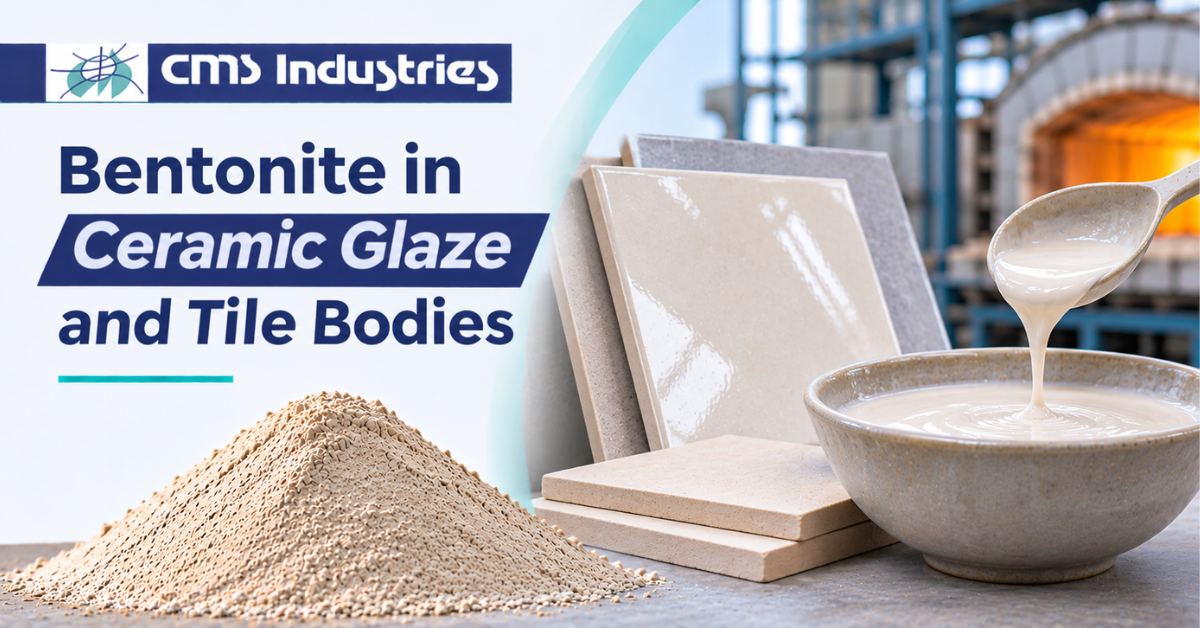
Go into any tile plant or pottery studio, and you’ll see a few bags of bentonite sitting alongside the kaolin and feldspar. It is rarely more than a few per cent of a recipe, but it can determine whether a glaze settles into a brick at the bottom of the tank or whether a green tile survives the journey from press to kiln.
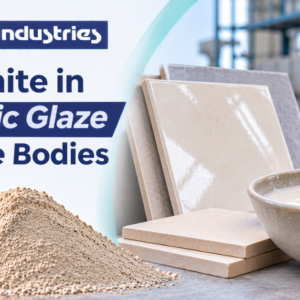
Using Bentonite in Ceramic Glaze and Tile Bodies: This guide covers what it does, how much to add, what can go wrong, and how to pick the right grade. The guidance is based on published ceramic research, technical references used by glaze chemists, patent literature, and Indian industry data.
Why Ceramics Use Bentonite
Here’s why such a minuscule addition has such a massive impact. Bentonite is a clay composed primarily of smectite minerals, like montmorillonite. Its particles are extremely fine and plate-like. Bentonite can have a surface area of nearly 1,000 square metres per gram, about 50 times that of kaolin, says Digitalfire, a widely used ceramic technical reference.
That large surface area gives bentonite three useful powers in ceramics:
- Suspension: its plates form a gel in water like a “house of cards” that props up heavier particles
- Plasticity: makes the clay body easy to shape and less prone to cracking
- Dry strength: its fine particles fill the voids between the larger grains, holding them together
The same properties have side effects, which we go over below.
Bentonite in Glazes: Keeping the Slurry in Suspension
A glaze is not a solution but a suspension. The heavy substances such as frits, silica, feldspar and colourants will sink to the bottom of the bucket or tank and form a hard layer if left to themselves. This is called hard panning by potters and is a particular problem with fritted glazes.
Similarly, bentonite and zeolite are both used in animal feed applications, but they differ in their mineral properties, binding characteristics and suitability for specific feed requirements. Understanding these differences is important when selecting the right mineral additive.
For a detailed comparison, read CMS Industries’ article: Bentonite vs Zeolite in Animal Feed.
Bentonite solves this by gelling the water. According to Digitalfire, bentonite-like materials are better than any other material at gelling in water in small amounts and at suspending other particles.
How Much Bentonite to Add to a Glaze
Let’s break it down by type of glaze.
| Glaze situation | Suggested bentonite addition | Source |
| Fritted or low-clay glaze that settles hard | 1 to 3% of dry glaze weight | Potclays |
| Glaze with almost no clay, being gelled with a flocculant | About 2% | Digitalfire |
| Powdery glaze that dusts after drying | Often 3 to 5% | Digitalfire |
| Glaze already containing 20% or more clay | Usually none is needed. | Digitalfire |
Digitalfire also warns that if a glaze’s clay content exceeds about 25%, the drying shrinkage can be sufficient to crack the glaze layer. So bentonite is a tool for low-clay glazes, not a fix for every recipe.
How to Add It Correctly
This step trips many beginners. Digitalfire says you can’t add bentonite to an existing wet slurry — it clumps into balls that even a propeller mixer won’t break up. Instead:
- Weigh the bentonite along with the other dry glaze materials.
- Thoroughly mix dry to break up bentonite particles.
- Add the powder to the water and mix.
- Strain out the mash.
- Add small amounts of flocculant or water to adjust specific gravity and thixotropy.
Potclays says the same thing: mix the bentonite into the glaze powder, then add water and sieve.
Glaze Problems from Too Much Bentonite
More isn’t better. Digitalfire cautions that too much bentonite in a glaze will cause it to dry too slowly and shrink too much, resulting in cracks that become crawling during firing. Bentonite also contains iron, which can colour white or light glazes.
Bentonite in Tile Bodies: Green Strength and Plasticity
Tiles are now made on a fast, automated line. A US patent on tile manufacture describes the normal sequence: mix raw materials, wet grind, spray dry the slip to 4 to 7% moisture, press the powder into green tiles, dry, glaze and fire. The unfired tile has to make it through conveyors, dryers, and glazing lines without cracking or chipping between pressing and firing.
Green and dry strength counts there. The same patent also states that bentonites are sometimes added in small amounts as a powder to the raw materials before grinding, to increase strength.
What Research Shows
A study by Manfredini and co-workers published in 1991 in the bulletin of the Spanish Ceramic and Glass Society tested bentonite in a low-plasticity floor tile body. Its findings are still a useful reference:
- The addition of 2% of activated bentonite increased the modulus of rupture of the green tiles by over 100% compared to the base body.
- Stronger results were obtained with bentonites with finer particles and higher smectite content.
- 1.5 to 2.5% additions of pure high-smectite bentonite were described as particularly suitable for industry.
- Amounts greater than about 4 to 5% reduced the useful firing range and could cause unwanted effects.
- Digitalfire has similar advice for pottery and porcelain bodies: as little as 2% bentonite can greatly improve workability and dry strength, and up to 5% is common when high plasticity is desired in a white-burning body.
Results vary with the body. Borregaard, a producer of organic tile binders, reports on its website that the addition of bentonite can reduce the clay fraction, but in their experience, it did not show improvements in green or dry strength. This is a reminder to run your own trials on your own raw materials.
Typical Addition Rates
| Application | Typical bentonite range | Main purpose |
| Low-plasticity floor or wall tile body | 1.5 to 2.5% | Green strength, fewer breakages |
| Pottery and porcelain bodies | About 2%, up to 5% | Workability and dry strength |
| Glazes with little clay | 1 to 3% | Suspension, less settling |
| Powdery glazes | 3 to 5% | Harder dry glaze layer |
Bentonite in Ceramic Glaze and Tile Bodies: Benefits vs Drawbacks
Here’s the trade-off all in one.
| Benefit | Matching drawback |
| Strong suspension in glazes | Slow drying if overused |
| Higher green and dry strength | More drying shrinkage and cracking risk |
| Better plasticity | Bodies hold water longer and dry less completely |
| A small dose needed. | Adds iron, which can darken white bodies and glazes |
| Low cost per tonne of body | Narrower firing range at high add-ons |
Watch the Iron and Colour
Bentonite contains a little iron. According to Digitalfire, 5% bentonite increases the iron content of a body by about 0.25%, but at 2.5% the extra iron may not matter at all. For white-body porcelain tiles and light glazes, use a low iron grade and keep the dose modest.
Watch Drying and Firing
Bentonite slows the water down. Digitalfire warns that bodies with bentonite take longer to dry and less completely, which can create a higher risk of cracks or even explosions in firing if ware is put in the kiln damp. If you increase the bentonite level, alter the drying cycles.
Bentonite vs Organic Binders in Tiles
Now many tile plants weigh bentonite versus organic binders and plasticisers. The tile patent points out that one disadvantage of organic additives is that pressed tile bodies with an excess of organic material tend to black core. Bentonite is a mineral; it does not burn organic matter, but it does bring shrinkage, slower drying, and iron.
| Factor | Bentonite | Organic binders |
| Black coring risk | None from the binder itself | Rises with high organic content |
| Effect on fired colour | Can add iron tint | Burns out, little colour effect |
| Effect on slip viscosity | Can thicken slip | Product dependent |
| Cost | Low | Usually higher per kg |
Some plants take a mixed approach: a bit of bentonite for strength and plasticity, and a little organic dose to fine-tune.
India’s Tile Industry and Bentonite
India is one of the world’s largest producers of tiles. In 2016, India was the world’s second-largest producer and consumer of ceramic tiles, with Gujarat’s Morbi cluster accounting for over 70% of the national production, CARE Ratings said. According to India’s energy agency BEE, Morbi is the heart of India’s ceramic industry, accounting for about 70% of the Indian market for wall tiles, floor tiles, vitrified tiles and sanitaryware.
Gujarat also has India’s largest bentonite deposits, which help shorten the supply chain for the Morbi plants.
How to Choose a Ceramic-Grade Bentonite
Next is buying to spec and confirming in trials.
- Smectite content: the higher the smectite, the stronger the gelling and binding at a lower dose.
- Iron content. Ask for Fe₂O₃ data, particularly for white bodies and light glazes.
- Particle size: fine, uniform milling assists dispersion and suspension.
- Low grit and sand content protect glaze surfaces and mill linings.
- Swelling and viscosity data – these are measures of how strongly the clay will gel.
- Moisture: Uniform moisture will keep the batch weights accurate.
- Lot-to-lot consistency: ask for a Certificate of Analysis with every shipment.
- Plant trial: check green strength, drying shrinkage, slip viscosity, and fired colour before change.
Sourcing Bentonite from Gujarat
Bentonite is mainly sourced from Kutch in Gujarat, which is easily accessible from Morbi. CMS Industries is an ISO 9001:2015 certified bentonite miner and processor at Mandvi Taluka, Kutch. They offer sodium and calcium bentonite in powder and lump form for various industries. It does not list a dedicated ceramic grade on its website. Ask CMS Industries if a grade is suitable for glaze or tile body use. Request iron content, particle size, and swelling data before conducting a trial.
Final Word
A little goes a long way, and that’s why bentonite has earned its place in ceramics. 1 to 3% in glazes to prevent settling of low clay slurries. In tile bodies, 1.5 to 2.5% can greatly improve green strength. Push the dose too high, though, and you pay in shrinkage, slow drying, iron colour, and a narrower firing range. Choose a low-iron, high-smectite grade, dry blend correctly, and check the dose with trials on your own line.
Frequently Asked Questions
1. How much bentonite should I add to a glaze?
For fritted or low clay settling glazes, add 1 to 3% of the weight of dry glaze. Most glazes that already have 20% or more clay usually do not need any. Too much bentonite will slow the drying and cause crawling and cracking.
2. Why does bentonite form lumps in my glaze?
Bentonite clumps when added to a wet slurry, and even a propeller mixer cannot break the clumps apart. First dry-blend the other glaze powders together, then add water and mix, then sieve.
3. How much bentonite is used in ceramic tile bodies?
Studies of low-plasticity floor tile bodies have indicated that 1.5 to 2.5% high-smectite bentonite is effective, and 2% activated bentonite more than doubles the green strength. Additions above 4 to 5% may tend to close up the firing range.
4. Does bentonite change the colour of white tiles?
It can be. Bentonite contains iron, and 5% bentonite can increase the iron content of a body by about 0.25%. At lower doses, around 2.5%, the effect is usually small. Choose a low iron for white bodies and light glazes.
5. How do I choose a bentonite supplier for ceramics?
Request smectite content, iron oxide levels, particle size, grit content, and swelling data, plus a certificate of analysis for each lot. Some companies, such as CMS Industries, will provide you with data to test your plant before you switch.