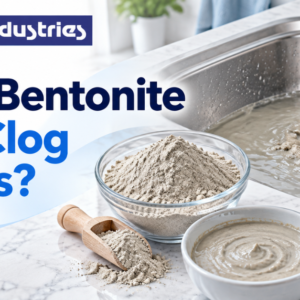




Watch. Pour a spoonful of dry bentonite into a glass of water. The powder drops through, softening and thickening into a gel. Does bentonite clay swell in water? Yes, much of it does. But how much it swells depends on the kind, and the gap between kinds is enormous.
Let’s see. This guide tells you why the clay swells, how much it swells, why the sodium and calcium kinds behave so differently, and where that behaviour is important in drilling, construction and pond sealing. All figures are taken from government, academic, and industry sources and are detailed at the end.
Quick Answer: Does Bentonite Swell When It Gets Wet?
Yep. Sodium bentonite will absorb about four to five times its weight of water, and it can expand five to fifteen times its dry volume when it is allowed to soak freely. Calcium bentonite swells much less. Published numbers will depend on the grade, the water, and the test method.
What Is Bentonite and Why Does It Take Up Water?
Sure. The exact article is on CMS Industries, so I’ve inserted it naturally using the title as the anchor text.
Bentonite is a clay formed from weathered volcanic ash glass. According to Encyclopedia Britannica, it is a member of the smectite group, a group of hydrous aluminium silicate minerals that also contain iron and magnesium, and either sodium or calcium. It was named for Fort Benton, Montana, where it was first discovered by geologists.
The swelling is caused by two traits. First, the particles are very small, so a little scoop has a lot of surface area. Second, clay is formed from thin layers, and water can pass between the layers. The US patent record says bentonite grains attract films of water that are thicker than the films on other clays, and those films push the particles apart. The same document also mentions that the crystal structure is expanding. Now, here’s the thing. Bentonite is not like a sponge that absorbs holes. It grows physically.
The New South Wales government says bentonite is useful because of its special properties, including hydration, swelling, water absorption, and viscosity. Swelling is at the heart of all four. For a closer look at how cosmetic-grade bentonite differs from retail products and what buyers should consider when sourcing it, see Bentonite Cream: Industrial Cosmetic-Grade Sourcing vs Retail Products.
How Bentonite Swells in Water, Step by Step
Here is the simple order of the process:
- The water touches the clay. Each microclay particle has water in contact with its surface.
- Water flows between the layers. Molecules slip into the gaps between the thin sheets of clay.
- The cations hold the water. Water is attracted and held between the layers in thick films by sodium ions.
- The layers separate. The films thicken, the particles separate, and the entire mass augments in bulk.
- It forms a gel. Sodium bentonite makes permanent, gel-like suspensions, Britannica says.
- The mass blocks flow. That’s why engineers use it to seal dams and liners; it swells up tight.
How Much Does Bentonite Expand in Water?
The truth is in the middle, really. Patent applications describing bentonite properties give the following figures:
- Water absorption: about four to five times the clay’s own dry weight.
- Free swell volume: 5 to 15 times dry volume at full, unconfined saturation
- Higher estimates: some filings report commercial bentonite at ten to twenty times its dry volume.
Why are the numbers different? It is determined by grade, purity, and testing method. It is only possible to compare two data sheets in a fair way if they are using the same method. Many labs use a Swell Index or Free Swell test to measure the change.
Space matters as well. Bentonite in an open beaker will expand freely. Walls keep it contained. It can’t expand out from under the soil or concrete. Instead, it pushes back. It fills all the gaps. That pressure is how swelling becomes sealing.
Sodium Bentonite vs. Calcium Bentonite: Swelling Differences
Not all types of bentonite behave the same way. The dominant cation in the interlayer space determines the swelling degree. Industry divides the material into three groups.
Sodium Bentonite: High Swelling
The most common type in the United States is the high-swelling sodium bentonite, sometimes referred to as Western or Wyoming bentonite, according to the Minerals Education Coalition. OneMine, a mining reference, states that sodium-rich bentonite typically forms gel-like masses when it encounters water. These clays swell to many times their original size, notes Britannica.
Calcium Bentonite: Low Swelling
Calcium bentonite swells up less. The low-swelling one, Southern bentonite, is usually found in Mississippi, the Minerals Education Coalition reports. Calcium bentonites are non-swelling clays that break down into a fine granular product, often marketed as an absorbent under the name ‘fuller’s earth’, according to Britannica.
Mixed and Activated Bentonite
Between the two are intermediate types. “Mixed clays swell moderately and yield smaller gel volumes than sodium types of equal weight,” says the OneMine reference. Calcium bentonite can also be upgraded by producers. According to a patent record, sodium bicarbonate replaces calcium with sodium and improves swelling.
Here is a quick comparison:
- Sodium bentonite: Strong swell, thick gel, strong seal.
- Intermediate swelling of mixed bentonite. Less volume of gel.
- Calcium bentonite is a low-swelling absorbent.
What Affects How Much Bentonite Swells?
The five most important factors are the following:
- Type of cation. Sodium yields high swelling. Calcium causes low oedema.
- Water chemistry. Salt water can affect performance. Engineers see salt as a real problem. Patent applications describe special barrier panels for groundwater with more than four percent sodium chloride.
- Size of the particles. The finer the particles, the more surface area is exposed for the water to reach the clay.
- Confinement. Lateral expansion of free clay. Clay, when confined, builds up pressure.
- Purity and grade. High-swelling sodium bentonite is the most economically important type, a report by the New South Wales government says.
Does Bentonite Keep Swelling Forever?
No. Clay swells until it is fully hydrated or until it has no space left. The gel grows to a peak in an open container and then holds its shape. The clay under the soil settles into equilibrium with the pressure around it. When the clay dries, it shrinks and can crack. Add water again, and it swells up again. That is why sealing work often relies on the clay to close small gaps by itself. Salty water can affect the final product, so test with water from your own site before you commit to a grade.
Why Swelling Matters: Where Industry Uses It
According to Britannica, sodium bentonite has many jobs, including sealing dams, bonding foundry sands, making drilling muds, and clarifying water. Sodium bentonite is suitable for petroleum, paper, metallurgy, casting, ceramics, and rubber work,” says a study in the Journal of Scientific & Industrial Research. The same study warns that high swelling causes unwanted precipitation during clarification of liquid foods, and high water impermeability keeps it out of Portland cement. So some work better when they are swollen, others worse. Match the clay to the job.
Imagine a farm pond with a leaky bottom. Workers line the bottom with sodium bentonite, a clay that swells into a tight layer that slows seepage. The same concept applies to a landfill liner or a trench wall, only on a much larger scale. Companies extract and process bentonite for these needs. CMS Industries is a Gujarat-based company with mines in and around Kachchh and runs ISO 9001:2015-certified units near Mundra and Kandla ports. The company says it can produce more than 9,000 metric tonnes of powder and 26,000 metric tonnes of lumps a month. Its sodium bentonite page mentions swelling, sealing liners, reduced seepage, and self-repair of small breaks. It also offers grading for pond sealing, piling, horizontal directional drilling, oil well drilling, water well drilling, and geosynthetic clay liners. All those jobs depend on controlled swelling.
How to See Bentonite Swell Yourself
In a jar test, you can see the effect in minutes. This is not a replacement for a lab swell test, but it does allow you to compare two samples side by side.
- Put the same amount of water into two clean glasses.
- Sprinkle slowly one level teaspoon of each sample into its own glass so the powder doesn’t clump.
- Stir gently, then leave the glasses.
- Mark the level of the clay after an hour, then again after several hours.
- Compare the levels. The sodium bentonites give a high gel layer. Calcium bentonite is still a fine-grained suspension.
Handling Tips
Dry bentonite creates dust, so wear a mask when pouring it. Wet bentonite gets slick, so clean up spills quickly. And forget the drain, because thick slurry can settle out and clog pipes. Instead, scrape the leftovers into the trash.
Next Steps
Bentonite will swell in water, but the amount will depend on the type, the water quality and the conditions. Most of the bad results come from little errors, so a quick test run is time and money well spent. Before buying a product, there are a few things you should check:
- Ask about the swell index or free swell data and what test method it came from.
- Sodium for sealing and drilling, and calcium for absorbent purposes.
- Test with the water you intend to use, particularly if it contains salts.
You can view product details for each grade on the CMS Industries website , which states it also supplies custom bentonite to client specifications.
FAQs
Does bentonite clay swell in water?
Yes. “Sodium bentonite is a highly swelling clay. It can absorb four to five times its weight and expand five to fifteen times its volume. Calcium bentonite swells much less. The precise result will depend on the grade, the water chemistry, and whether the clay is free to expand or is confined.
How long does bentonite take to swell?
Swelling begins within minutes, and fine powder swells faster than coarse lumps. Full hydration can take hours depending on grade, mixing, and water quality. Be sure to check the test time behind any swell figure on the supplier’s data sheet.
Which swells more, sodium or calcium bentonite?
Sodium bentonite swells a lot more. The Minerals Education Coalition refers to it as the high-swelling type, while calcium is the low-swelling type. Britannica states that sodium clays expand to many times their original volume, while calcium clays do not.
Does bentonite shrink when it dries?
Yeah. When dried, bentonite loses water and shrinks, and it can crack. When water returns, the clay swells again and often closes up little cracks. This self-repair is stated as a benefit on the supplier page for sealing work.
Can swollen bentonite clog drains?
Yes. Wet bentonite produces a thick gel which can settle in piping and cause flow blockages. Don’t ever pour thick slurry down a household drain, but scoop leftovers into the trash, or let them dry first.