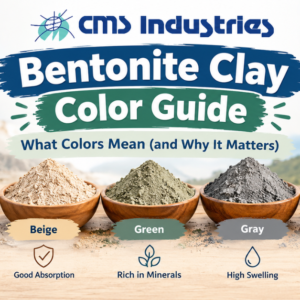



Open two bags of bentonite from different suppliers, and you may find they are not the same colour at all. One might be pale cream, another olive green, another grey-brown dust. New buyers to the sourcing of bentonite often think that the lighter bag has to be the purer, better product. That assumption is partly right and sometimes downright wrong. We’ll look at what’s behind the spectrum of colours of bentonite and when that colour should, and shouldn’t, matter when evaluating quality.
Why Does Bentonite Clay Come in Different Colours?
Volcanic ash weathered over millions of years becomes the clay mineral montmorillonite, creating bentonite. The ash that begins this process is rarely from one single, homogeneous source. The resulting clay will incorporate varying amounts of iron, magnesium, and other elements depending on the surrounding rock, the chemistry of the groundwater, and what trace minerals were present during formation. Those trace minerals – mostly iron – are the primary reason the colour of bentonite changes from mine to mine, and sometimes even within the same mine.
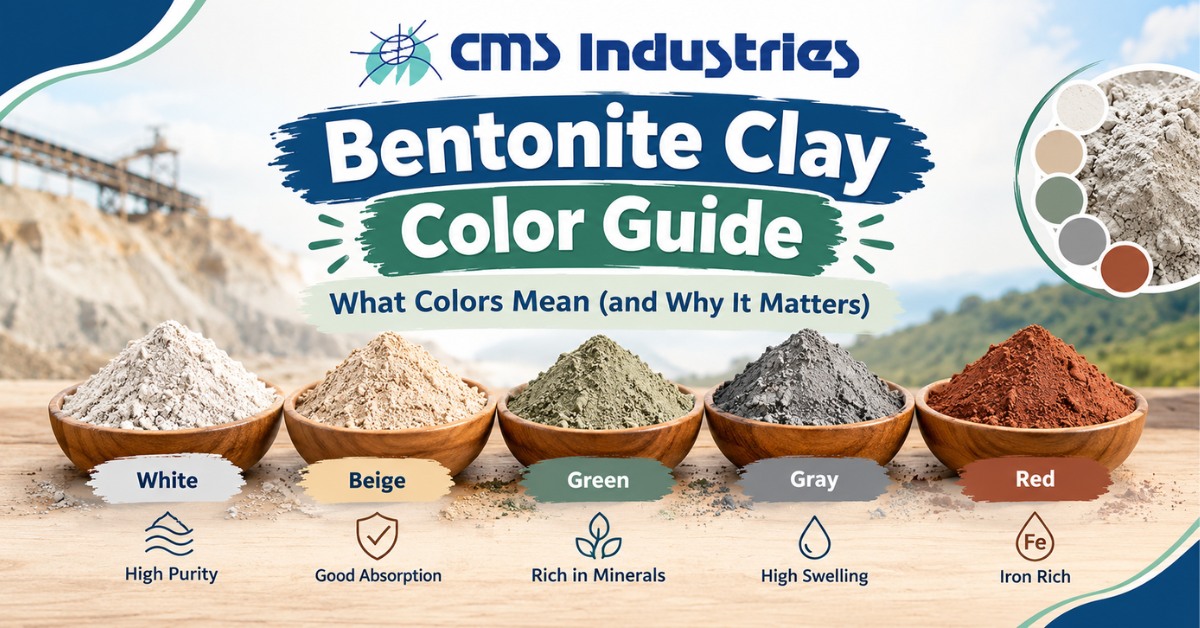
Common Bentonite Clay Colours and What Causes Them
White or Cream Bentonite
White bentonite has a low iron content, and this is what keeps its colour pale and not grey or green. The lower iron content of white bentonite makes it the preferred choice where colour consistency is important in the final product, such as cosmetic powders, ceramic glazes, and paper coatings, where even small quantities of iron-rich clay can visibly darken these applications.
Grey or Beige Bentonite
Grey and beige shades are among the most common natural colours for bentonite, including a good portion of what is mined in Wyoming and in India’s Kutch region. This colour usually indicates a medium level of iron, higher than white bentonite, but not enough to make the clay strongly green or brown.
Green or Olive Bentonite
The green colour of green bentonite clay help in food poisoning is caused by ferrous iron, the reduced form of iron that is formed under certain geochemical conditions during the formation of the clay. Some buyers think green clay has detoxifying or therapeutic cosmetic properties, but the colour is only an indicator of mineral content and formation environment, not a promise of any particular skin benefit.
Tan, Brown, or Yellowish Bentonite
These warmer shades are generally the result of a higher iron oxide content, sometimes blended with other trace minerals picked up during weathering. Bentonite clay remove hair color in this colour range is common for industrial and construction-grade material where colour has little bearing on the performance of the clay in drilling, foundry or civil engineering applications.
Reddish or Pink Bentonite
A reddish or pink tinging indicates a specific form of iron oxide embedded in the clay structure. This colouring is not often seen in commercial bentonite. It is less common than white, grey or tan bentonite and is more likely to be of interest in cosmetic and speciality clay markets rather than in industrial supply chains.
Dark Grey or Nearly Black Bentonite
Darker shades, sometimes almost black, mostly reflect manganese content in addition to iron, not iron alone. This colouring occurs in some regional deposits and is less common in the mainstream commercial bentonite supply.
Does Colour Tell You Anything About Quality?
This is where a lot of online advice oversimplifies things. Colour is a rough visual indicator of mineral content, chiefly iron, but it is not a direct measure of bentonite’s actual performance properties such as swelling capacity, cation exchange capacity, or percentage of montmorillonite. A pale, near-white bentonite is not necessarily a higher grade than a grey or tan one. It just has less iron. This is very important for cosmetic or ceramic uses where colour consistency is important and much less important for drilling mud, foundry sand, or pond sealing where performance properties determine the purchase.
Sodium bentonite, used extensively in drilling and civil engineering work for its high swelling power, is usually grey to beige and not white. Some white bentonite is a lower-swelling calcium type, selected specifically because its colour is more suitable for cosmetic or paper applications, not because it swells or bonds better than darker grades.
Colour vs Montmorillonite Content: What’s the Real Relationship
Bentonite’s swelling and binding properties come from a clay mineral called montmorillonite, and while this is loosely correlated with colour, it does not correlate directly with colour. A batch of bentonite with 85% montmorillonite and high iron content may appear darker than one with 70% montmorillonite and less iron, but the former is better suited for most industrial uses. Colour is determined by trace mineral chemistry. The content of montmorillonite is the percentage of the actual working clay mineral in the sample. These are related but different metrics, and mixing them up leads buyers to the wrong conclusions.
Sodium vs Calcium Bentonite Colour Differences
There is a loose pattern to keep in mind, but not an absolute rule:
- The sodium bentonite is usually grey, beige or light brown, and this is the grade with high swelling, strong gelling and drilling or civil engineering performance.
- Calcium bentonite is usually more white, cream or light grey. It is the grade of choice for cosmetics and food clarification, where colour consistency and oil absorption are more important than swelling power.
This pattern exists because the geological conditions that favour sodium-dominant clay formation often differ somewhat from those favouring calcium-dominant formation, but exceptions are common enough that colour alone should never replace lab testing when choosing a grade.
When Colour Actually Matters for Quality
Colour becomes a real quality factor in some applications:
- Cosmetics and Skincare: Buyers want to see consistency from batch to batch, so an unexpected colour shift can mean a change in source material or mineral content that is worth looking into.
- Ceramics and glazes: The iron content directly impacts the fired colour, so a ceramics manufacturer needs predictable, low-iron bentonite to avoid discolouring a glaze or clay body.
- Paper coatings: Low-iron bentonite grades are not just a preference but a practical necessity. This is due to the brightness and whiteness targets in paper production.
In these cases, colour is not simply cosmetic. It is an indirect measure of the iron content, which has a direct influence on the final product.
When Colour Does Not Matter for Quality
In most industrial applications, colour does not affect performance:
- Drilling fluid does not care about the colour of the mud but cares about viscosity, gel strength and fluid loss control.
- Foundry sand cares about green and dry compressive strength, not the colour of the binder.
- Swelling and low permeability are what count for pond sealing and civil engineering, and they have nothing to do with the way the clay looks in the bag.
How to Actually Judge Bentonite Quality
A proper quality check is not based on colour but on measurable properties:
- Quantity of montmorillonite. The higher the percentage, the better the swelling and binding performance generally.
- Free swell test or swelling index. This measures the extent to which the clay swells on contact with water, a direct measure of performance.
- Cation exchange capacity (CEC): The higher the CEC, the more active and higher quality the montmorillonite clay generally is.
- Water content. Excess moisture impacts the storage stability and performance of the clay after mixing or application.
- Mesh size or particle size. A finer grind generally improves the rate of dispersion and uniformity in water-based applications.
- Classification of sodium or calcium. This predicts the swelling behaviour much better than colour alone.”
- Batch testing documentation. You are getting real quality data from a supplier who will provide lab results for montmorillonite content, CEC, and swelling index for each batch, not just a visual impression.
Common Bentonite Colour Myths
Several beliefs are common and deserve a direct correction:
- “White bentonite is always the purest form.” False. White bentonite has less iron, which affects appearance, not automatically purity or montmorillonite percentage. Lower quality = Darker bentonite.
- Not true. Many of the higher-performance sodium bentonite grades used in demanding industrial applications are grey or tan, not white. Green bentonite possesses unique detoxifying properties not found in other colours.
- This claim appears in cosmetic marketing, but there is no evidence to support any special therapeutic property of colour itself other than the general absorptive behaviour common to all bentonite types.
How CMS Industries Tests and Grades Its Bentonite
CMS Industries mines sodium and calcium bentonite from deposits spread across the Kutch region of Gujarat, where the natural colour varies by mining location. The company processes the raw material into grades suited to specific industries, instead of relying solely on visual sorting. Colour alone does not determine how well bentonite performs in drilling, foundry, civil engineering or cosmetic applications, so working with a supplier who tests for montmorillonite content, swelling index and other measurable properties provides buyers with a much more reliable picture of quality than colour alone ever could.
Final Thoughts
Bentonite colour is dependent on the trace mineral content, primarily iron, that it gathers during its formation from volcanic ash. That colour is very important in cosmetics, ceramics and paper making where visual uniformity is part of the product specification and is of little consequence in drilling, foundry and construction work where swelling, strength and permeability drive the buying decision. The safest bet for any buyer is to treat colour as just one small visual cue and rely on actual lab testing, montmorillonite content, swelling index, and CEC for the real answer on quality.
Frequently Asked Questions
Does white bentonite clay mean it is higher quality than gray bentonite?
Not always. White bentonite just contains less iron, which impacts colour, but not necessarily purity or performance. For example, many of the high-performing industrial grades of sodium bentonite used in drilling are naturally grey or beige rather than white.
What causes green bentonite clay’s colour?
The green colour of bentonite is mainly due to ferrous iron present in the structure of the clay at the time of formation. The green colour is from the mineral content, not a different chemical type than other types of bentonite.
Can bentonite colour change between batches from the same mine?
Yes. Natural deposits are not perfectly uniform, so trace mineral content, and therefore colour, can vary slightly from one mining location to another or from one depth to another within the same broader deposit.
Is bentonite colour important for drilling or foundry use?
No. Colour is not a good predictor of swelling capacity, compressive strength, and viscosity, all of which are important to the performance of drilling fluid and foundry sand. These industries are concerned with lab-tested properties, not appearance.
How can I verify bentonite quality beyond just looking at the colour?
Request suppliers for batch testing data for montmorillonite content, swelling index, cation exchange capacity, and moisture content. These measurable characteristics give a much more reliable picture of quality than colour alone.