


If you’ve ever grabbed a bag of bentonite clay and wondered what’s really in it, you’re not alone. This clay is everywhere from cat litter boxes to oil rigs to skincare shelves, and most people never stop to ask what makes it work. Let’s break it down.
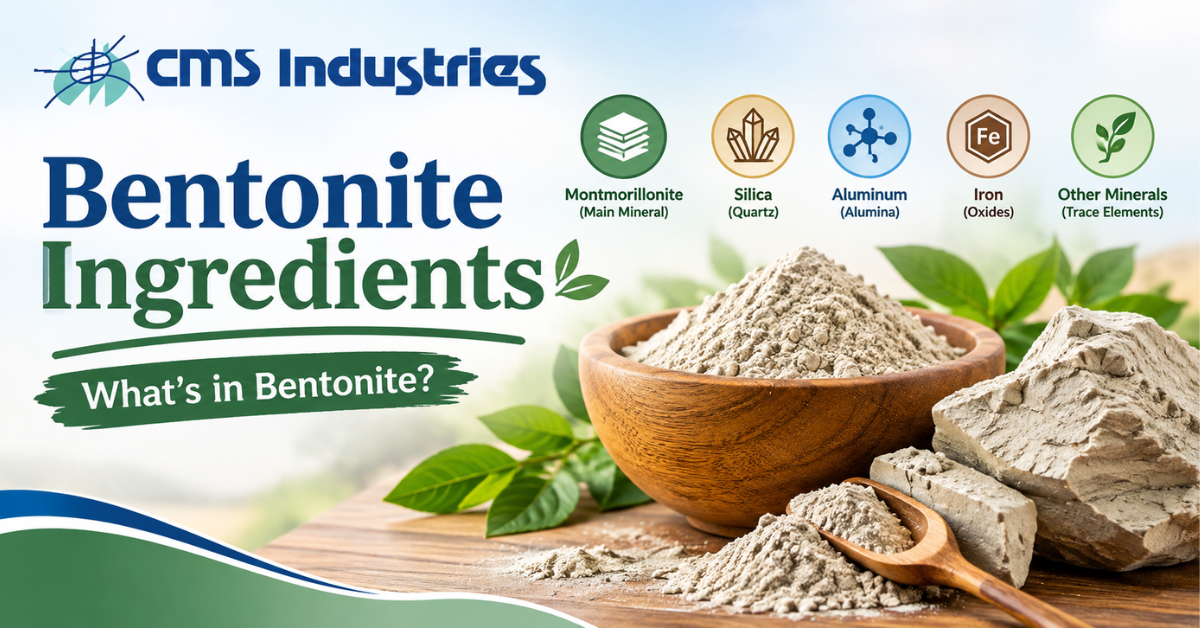
Bentonite is not a chemical compound. It is a natural rock consisting mostly of one clay mineral with some smaller minerals mixed in. The exact ratio depends on where the clay was mined and how the volcanic ash that created it cooled and settled millions of years ago. Knowing the bentonite ingredients in your product tells you a lot about its performance, whether you’re sealing a pond, casting metal, or drilling a well.
This guide goes through what bentonite is made of, how sodium and calcium bentonite differ, and why the mineral mix matters for real-world use.
What Is Bentonite Made Of?
Sodium Bentonite is a soft, absorbent clay that develops from the weathering of volcanic ash. According to the U.S. Geological Survey, it is a pale-coloured, porous rock composed mainly of clay minerals of the montmorillonite group, along with some colloidal silica, formed when glassy volcanic material weathers and chemically alters over a long period of time.
That one sentence tells you so much. Bentonite begins as ash from an eruption. Over thousands of years, water and chemical reactions turn that glassy ash into clay. Montmorillonite is the main mineral formed and is responsible for almost all the properties that people care about: swelling, water absorption, plasticity, and binding strength.
The Main Mineral in Bentonite: Montmorillonite
Depending on the source, bentonite deposits usually contain 60 to 90 per cent montmorillonite. It is a member of a family of clay minerals called smectites, which have a layered structure in which water molecules can slide between the layers. And that’s why bentonite swells so much when it gets wet.
Montmorillonite is usually expressed by the chemical formula (Na, Ca)0.33(Al, Mg)2Si4O10(OH)2·nH2O and is a hydrous aluminium silicate with sodium, calcium, and magnesium between the layers.
This is why that structure is important. Montmorillonite consists of stacks of thin plates (like book pages), and each particle is one such stack. Water is sucked up between those pages, and the clay expands sometimes several times its dry volume. Bentonite is ground very fine, and because of its high surface area, it is capable of absorbing liquids in small quantities to many times its own weight.
Bentonite Chemical Composition Breakdown
Here’s a quick reference for what raw bentonite is typically made up of (by weight):
- Silicon dioxide (SiO₂): approx. 42-65%, the backbone of the silicate structure of the clay
- Aluminium oxide (Al₂O₃): 14 to 28 percent, as the octahedral sheet of montmorillonite
- Water (H₂O): 11% to 23% approx., water bound in the structure and between the layers of clay
- 1 to 25 per cent magnesium oxide (MgO) – an alternative to aluminium to help drive swelling
- Iron oxide (Fe₂O₃): Usually 0% to 4%; it is often responsible for a tan, grey, or greenish cast
- Sodium oxide (Na₂O): about 0 to 3.5%, the mineral that causes sodium bentonite to swell strongly
- Calcium oxide (CaO): ~0% – 3%, more prevalent in types of calcium bentonite
- Potassium oxide (K₂O) and titanium dioxide (TiO₂) are found in trace amounts
These numbers vary from mine to mine, which is exactly why two bags of “bentonite dust for skin” can behave differently in the field. Both products originate from the same base mineral, but a drilling fluid engineer and a foundry technician aren’t seeking the same ingredients in bentonite.
Sodium Bentonite vs Calcium Bentonite Ingredients
The primary distinction in commercial bentonite is the cation between the layers of clay, either sodium or calcium.
- Sodium bentonite contains sodium ions in the interlayer space. This gives it a very high swelling and gelling power. “A lot of drilling mud, pond sealing, and geosynthetic clay liner applications use sodium bentonite, which can swell to 16 times its original size and absorb up to 10 times its own weight in water,” according to the Wyoming State Geological Survey.
- Calcium bentonite has calcium ions instead of sodium ions in that same space. It expands less in water but has a finer particulate structure and a higher absorption of oils and greases—hence its frequent use in cat litter, cosmetic clay masks, and decolourising or bleaching applications.
- No one type is “better” in all circumstances. It’s all about the job for the right choice. Sealing seepage requires the maximum swelling of a pond liner. Oils need to be absorbed, not swollen. A face mask. That’s the only reason bentonite is processed into so many grades for so many specialities, instead of being sold as one generic product.
Trace Minerals and Accessory Ingredients in Bentonite
Raw bentonite in cosmetic industry deposits contain, besides montmorillonite, usually minor amounts of accessory minerals that were part of the original volcanic ash. Typical are:
- Quartz – a hard silica mineral left over from the parent cinder
- Feldspar – another type of silicate mineral found in volcanic rock
- Gypsum – a calcium sulphate mineral, occasionally in trace pockets
- Cristobalite – a silica polymorph that may form during ash alteration
- Kaolinite and illite are other clay minerals that may be mixed in at low percentages.
- Biotite mica and opal – minor accessory minerals reported in some deposits.
None of these accessory minerals are predominant in the clay, but they influence colour, grinding behaviour and purity grade. An industrial-grade bentonite for foundry or earthing work can afford to have a little more of them, whereas a high-purity bentonite for pharmaceutical or cosmetic use is processed further to remove these accessories.
How Bentonite Forms in Nature
Bentonite deposits are a result of volcanic eruptions, often in ancient seas or lake beds. During an eruption, fine ash was blown and washed into standing water, where it was deposited in thick beds. Over long periods of geologic time, this glassy ash chemically reacted with the surrounding water and was altered to montmorillonite and its associated minerals. Some deposits were thus formed, and others were subsequently altered by hydrothermal groundwater flowing through buried ash beds.
The world’s largest deposits of bentonite are found in Wyoming, Montana and South Dakota in the United States and in major deposits across India, China, Turkey and Greece. Over the decades, the Kutch region of Gujarat has witnessed a steady rise in mining and processing activity, partly because the area has some of the richest bentonite reserves in the country.
Why Bentonite’s Ingredients Matter Across Industries
The mineral mix in a batch of bentonite determines precisely what job it can do well. This is shown by a few examples:
- Oil and water well drilling. Sodium bentonite with high swelling capacity is used to thicken the drilling fluid to cool the drill bit and carry rock cuttings out of the borehole.
- Foundry casting: Bentonite bonds sand moulds to hold molten metal in shape with high green and dry compressive strength.
- Civil engineering and piling: Bentonite with a high viscosity stabilises trench walls and boreholes during excavation.
- Animal feed – Food-grade bentonite binds toxins in the gut and helps absorption of nutrients in livestock and poultry.
- Water Treatment: Bentonite works well to remove suspended solids and impurities from water because of its small particle size and adsorptive properties.
- Cosmetics: Bentonite is rich in calcium, which helps absorb excess oil, so it’s found in clay masks and mineral-based skincare.
CMS Industries takes the raw bentonite that comes out of the mines in Gujarat and processes it into these separate grades. Each grade matches the mineral composition that an industry actually needs, be it a drilling site, a foundry floor, or a piling project. A good reminder that bentonite is not one product. It is a family of products made from the same base mineral but refined and blended differently, depending on where it ends up.
How to Check Bentonite Quality Before You Buy
If you are sourcing bentonite for an industrial application, a few checks go a long way to confirm you are getting the right mix of ingredients for your job.
- Ask for the quantity of montmorillonite. The higher the percentage, the better the swelling and binding properties.
- Determine if it is sodium or calcium bentonite. This one fact tells you almost all you need to know about the swelling behaviour.
- Ask for a chemical analysis (XRF or the like). This is a check of your specification against the silica, alumina, iron, and moisture content.
- Check the moisture content. Bentonite that is either too wet or too dry can be difficult to mix and handle.
- Confirm particle size/mesh grade. The finer the grinding, the better the dispersion and reaction in water.
- Ask for the mine source. Different regions have different natural ratios of trace minerals in their deposits.
Suppliers that can walk you through these points instead of just handing over a generic spec sheet usually know their stuff.
Final Thoughts
Bentonite is just a grey or tan powder on the outside; it looks simple. But that’s where the ingredient profile really kicks in and gives you all the performance. Montmorillonite is the swelling and binding power; sodium and calcium ratios determine its reaction to water, and trace minerals such as quartz and feldspar round out the picture. When you know what is really in bentonite, it is easier to choose the right grade for drilling, casting, sealing, farming, or skin care instead of guessing.
Questions like these are common from customers trying to match a grade to their application, especially with years of experience mining and processing bentonite from the Kutch belt in Gujarat. If you are going through a similar decision, understanding the mineral composition first will save you time later on.
Frequently Asked Questions
What are the main ingredients in bentonite clay?
Bentonite is primarily the clay mineral montmorillonite, which usually makes up 60% to 90% of the rock. It also contains lesser quantities of quartz, feldspar, and trace oxides of iron, magnesium, sodium, and calcium that remained from the volcanic ash from which it was formed.
Is bentonite a natural or synthetic product?
Bentonite is 100% natural. It develops as volcanic ash weathers and is chemically changed over long periods of geologic time to become montmorillonite and other clay minerals. The raw mineral itself is not created in the laboratory.
What is the difference between sodium bentonite and calcium bentonite ingredients?
Sodium bentonite has sodium ions in between the clay layers and has high swelling and gelling powers. Calcium bentonite has calcium ions instead. It swells less but is better at absorbing oil and grease. It is suited to different applications.
Does bentonite contain heavy metals or harmful substances?
Raw bentonite may naturally contain minute quantities of metals such as iron and, depending on the deposit, sometimes very small traces of other elements. Each batch is tested by reputable suppliers and reported against relevant safety standards for the intended use.
Why does bentonite composition vary between suppliers?
Each bentonite deposit is unique in how it forms, dependent on the original volcanic ash, the local geology, and changes in the ash over time. Where it is mined, how it is processed, and what grade is chosen all affect the final mineral ratio that a supplier delivers.