


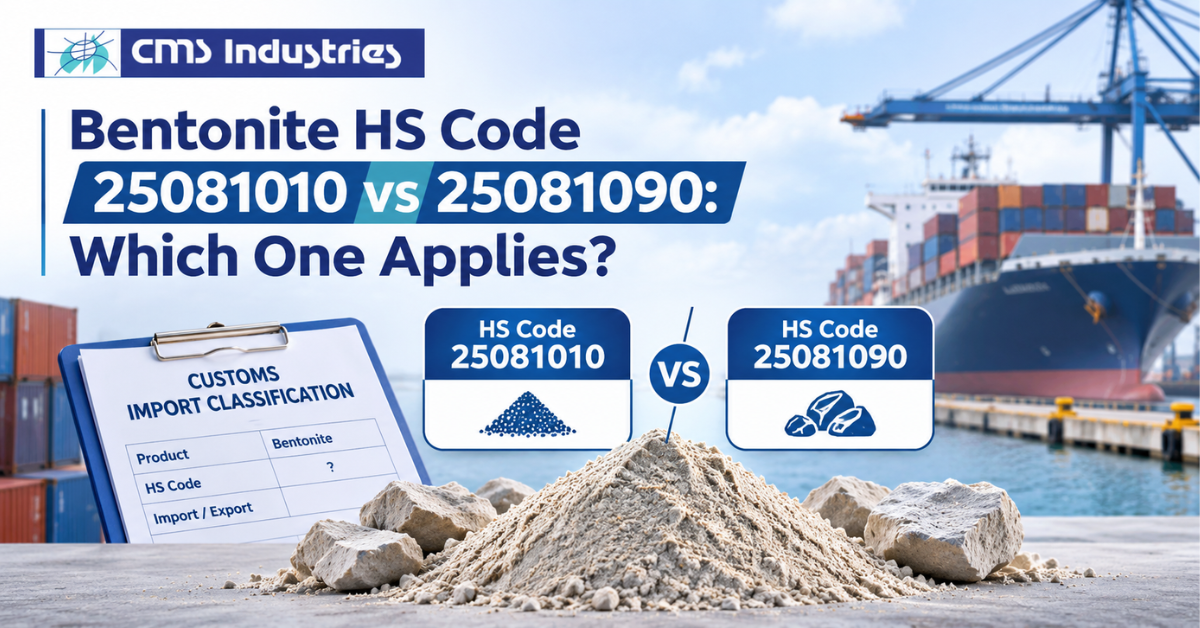
Choose the wrong tariff line on a shipping bill, and you expose yourself to questions, delays, and sometimes penalties. The most common confusion among bentonite traders in India is between two 8-digit codes that look almost similar. Bentonite HS Code 25081010 vs 25081090 comes down to one thing: is the clay processed or not?
This guide explains what each code means, how customs officers interpret the difference, what duty and GST apply, and when bentonite falls entirely out of Chapter 25. All rules mentioned here are from the Customs Tariff of India, GST rate notifications, and a CESTAT ruling. You can verify the source yourself.
How the Bentonite Tariff Code Is Built
Let’s take it apart. An Indian tariff code is an 8-digit number, each pair of digits restricting the previous one.
| Digits | Level | Meaning |
| 25 | Chapter | Salt, sulphur, earths and stone, plastering materials, lime and cement |
| 2508 | Heading | Other clays, andalusite, kyanite and sillimanite, whether or not calcined; mullite; chamotte or dinas earths |
| 2508 10 | Subheading | Bentonite |
| 2508 10 10 | Tariff item | Crude |
| 2508 10 90 | Tariff item | Other (includes processed and ground) |
The first six digits, 2508.10, are the World Customs Organization’s Harmonised System, so all member countries use those. The last two digits are India’s own split. Your buyer in the US, UK, or Indonesia will file under their own national extension of 2508.10, not under 25081010 or 25081090.
What is HS Code 25081010 (Crude Bentonite) Covers
Under the heading BENTONITE, tariff item 2508 10 10 reads “Crude”. It fits clay as mined.
Normally belong here: goods
- Run-of-mine bentonite lumps direct from the mine
- Hand-sorted only or stacked for natural weathering lumps
- Bulk raw clay for further processing by the buyer
Raw bentonite contains a lot of water. The Indian Bureau of Mines notes that crude bentonite reaching a processing plant contains 25 to 40% moisture, indicating how little work has been done to it at this stage.
What HS Code 25081090 (Other Bentonite) Covers
Tariff item 2508 10 90 states: Other (includes processed and ground). Some ITC (HS) listings give a fuller description: other bentonite, including processed, activated, and ground forms.
Typical items that belong here:
- Bentonite powder (dried and powdered)
- Granules and sized grades, e.g., for cat litter base
- Foundry, drilling, civil engineering and pelletising grades made to specification
- Bentonite treated with soda ash (sodium-activated) bentonite, which buyers usually order for piling and drilling
- Lumps dried, crushed or graded at a plant before shipping
This is by far the busiest code. BUSY compiled Ministry of Commerce trade data shows India exported about ₹805 crore worth of goods under 25081090 in FY 2025-26. Exports under 25081010 were about ₹73 crore in FY 2024-25, by comparison.
Bentonite HS Code 25081010 vs 25081090: The Side-by-Side View
And that is why the line between the two is important for your paperwork.
| Point | 2508 10 10 | 2508 10 90 |
| Tariff description | Bentonite: Crude | Bentonite: Other (includes processed and ground) |
| Typical form | Raw, as-mined lumps | Powder, granules, dried or activated grades |
| Typical moisture | High (raw clay arrives at plants with 25 to 40%) | Low, as the clay has been dried |
| Customs duty (BCD) | 5% | 5% |
| GST / IGST | 5% | 5% |
| Export policy | Free | Free |
| Unit of quantity | kg | kg |
You will notice the duty and GST columns are identical. So why does the right code still count? There are three reasons:
- Accurate declarations are a legal requirement. One such particular is the tariff item. The Customs Act, 1962 authorises officers to seize goods and levy penalties if the goods do not match the entry in any particular.
- Your papers must be the same. E-invoices, e-way bills, shipping bills, bill of entry, and certificate of origin should have the same code. Mismatch causes queries.
- The code is followed by trade data and incentives. The duty drawback rates and future export schemes pertain to a specific tariff line, so check each line in the current schedule, rather than assuming they are the same.
Duty and GST on Bentonite Imports into India
Customs duty (generally known as BCD) at 5% is leviable under the First Schedule to the Customs Tariff Act, 1975, on both the tariff items. On top of that, a Social Welfare Surcharge of 10% of BCD is levied, and IGST is charged at the applicable GST rate. Both lines of bentonite will attract GST at 5% as per Notification No. 9/2025-Central Tax (Rate), dated 22 September 2025.
However, importers should also compare the overall landed cost of bentonite lumps and powder, rather than looking at customs duty alone. Freight, handling, processing requirements and infrastructure costs can significantly affect which option is more economical.
For a detailed cost comparison, read CMS Industries’ article: Bentonite Lumps vs Powder: Which Is Cheaper to Import?.
Here’s a quick worked example for an import having an assessable value of ₹100,000:
- Customs Duty (BCD) 5%: ₹5,000
- Social Welfare Surcharge @10% of BCD: Rs. 500
- IGST 5% on ₹ 105,500 (value + duty + surcharge) ₹ 5,275
- Total duty & tax: ₹10,775, or approx. 10.8% of value for assessment
The registered businesses can usually claim the IGST portion as input tax credit. Duty actually payable may be reduced by trade agreements or exemption notifications, so check the rate with your customs broker for the country of origin.
When Bentonite Leaves Chapter 25 Altogether
This is the most costly pitfall for importers. Note 1 to Chapter 25 restricts the chapter to products in the crude state or merely physically processed, such as washing, crushing, grinding, powdering, and screening. Even washing with chemical substances is allowed as long as it removes impurities without changing the structure of the product.
Acid activation crosses that threshold. In Adani Wilmar Limited v. Commissioner of Customs, Kandla (CESTAT Ahmedabad, decided 29 July 2010), the importer declared acid-activated calcium bentonite under 2508.10. The Tribunal found in favour of Customs and held that the goods were covered by heading 3802 in respect of activated products of natural minerals. It found that the acid treatment had changed the clay and that the importer had not provided any evidence that its structure had not been altered.
So the practical rule is as follows:
- Raw lumps 2508 10 10
- Bentonite, dried, crushed, sized or activated soda ash: 2508 10 90
- Acid-activated bentonite and bleaching earth: heading 3802, not chapter 25.
If your product is near this line, request a process note and test report from your supplier before filing.
How to Choose the Right Code: A 5-Step Check
Here’s what’s next. Before you begin document preparation, take your product through these five questions.
- Has the clay been dried, crushed, ground, or sieved in a plant? If not, go to 2508 10 10. If yes, go to 2508 10 99.
- Has it been activated with soda ash or other additives? Soda ash-activated grades are generally declared under 2508 10 90.
- Has it been acid treated? Yes. Check heading 3802 and have the supplier’s safety data sheet available.
- Is your declaration in line with the supplier’s invoice? Request the code on the commercial invoice and packing list and check it against the certificate of analysis.
- Still not sure? Get a written opinion from a licensed customs broker or apply to the Customs Authority for Advance Rulings before your first shipment.
Common Classification Mistakes to Avoid
Traders keep making the same mistakes over and over:
- Dried lumps are called “crude”. As-mined state is no longer the case for sun-dried lumps at a plant, crushed to size, or graded lumps. Processed bentonite lumps are recorded under the code 25081090 in the Indian customs records.
- Copying last year’s code. If your supplier changes their process, for example, adding activation, the code could also change.
- On Indian documents, use the six-digit code. GST returns permit shorter codes based on turnover, but customs documents such as the shipping bill and bill of entry require the full eight-digit tariff item.
- Ignore the tariff of the buyer. Your importer files under their own national code. Provide specifications and a product description so that their broker can classify it correctly at their end.
Buying Bentonite from Gujarat: What to Ask Your Supplier
Gujarat’s Kutch district is the main bentonite belt in India with access for exports through the ports of Mundra and Kandla. Here, suppliers ship either raw lumps or processed powder, so the tariff line can vary from order to order.
CMS Industries, a bentonite miner, processor, and exporter from Mandvi Taluka, Kutch, certified ISO 9001:2015, offers bentonite lumps and powder in all grades for foundry, oil drilling, civil engineering, HDD, cat litter, animal feed, and more. If you are ordering from any supplier, CMS Industries included, you should ask for three things: a clear description of the processing that has been done, the tariff item printed on the invoice, and a certificate of analysis. That paperwork makes it easy for both sides to classify.
Final Word
There is only one question that determines whether 25081010 or 25081090 applies: Has the bentonite been processed? Raw clay, as mined, falls under 25081010. Grades activated to go under 25081090 are dried, ground, granulated, or soda ash activated. Acid-activated clays move from Chapter 25 to heading 3802. Both bentonite lines currently have the same duty and GST, but proper classification will still protect your shipment, your paperwork, and your record with customs.
Frequently Asked Questions
1. What is the HS code for bentonite powder in India?
Bentonite powder is classified under tariff item 2508 10 90 (other bentonite (processed and ground)). Drying and grinding are processing, so the powder is no longer crude. The only exception is acid-activated powder, which is covered in heading 3802.
2. What is the HS code for bentonite lumps?
Raw, as-mined lumps are classified under 2508 10 10, Bentonite: Crude. Dried, crushed, or graded lumps at a plant are generally declared under 2508 10 90. Check what the supplier did with the lumps before filing.
3. Is there any duty difference between 25081010 and 25081090?
14 No. Both attract 5% BCD, a 10% social welfare surcharge on the duty, and 5% IGST on imports. Both also charge 5% GST on domestic sales. Accurate declarations and matching documents still require correct classification.
4. Does activated bentonite fall under HS code 2508?
It is contingent upon the activation. Soda ash activated bentonite is generally classified under 2508 10 90. Acid-activated bentonite moves to heading 3802 as held by CESTAT in the Adani-Wilmar case because the structure of the clay gets modified due to acid treatment.
5. Where can I confirm the correct bentonite HS code?
The Customs Tariff of India, published by CBIC and ITC (HS), is from DGFT. For a definitive answer, apply to the Customs Authority for Advance Rulings. Exporters, like CMS Industries, can also provide details about the process to help with classification.