


Ask any buyer importing clay in bulk, and you’ll hear the same question. “Do we bring in raw lumps and grind them ourselves, or pay more for ready powder? The answer to the Bentonite Lumps vs Powder debate is rarely found in the price per tonne on a supplier quote. Moisture, goods, processing and order volume affect it.”
This guide runs through each layer of the costs, including a worked example that you can copy into your own spreadsheet. The facts come from the U.S. Geological Survey, the Indian Bureau of Mines, and published customs tariff schedules, so you can check every number for yourself.
What Is the Difference Between Bentonite Lumps and Powder?
Bentonite is a clay, consisting mainly of the mineral montmorillonite. India accounts for a large part of the world’s production. According to USGS estimates, India produced about 3.7 Mt in 2024 and 2025, far ahead of China’s 2.1 Mt.
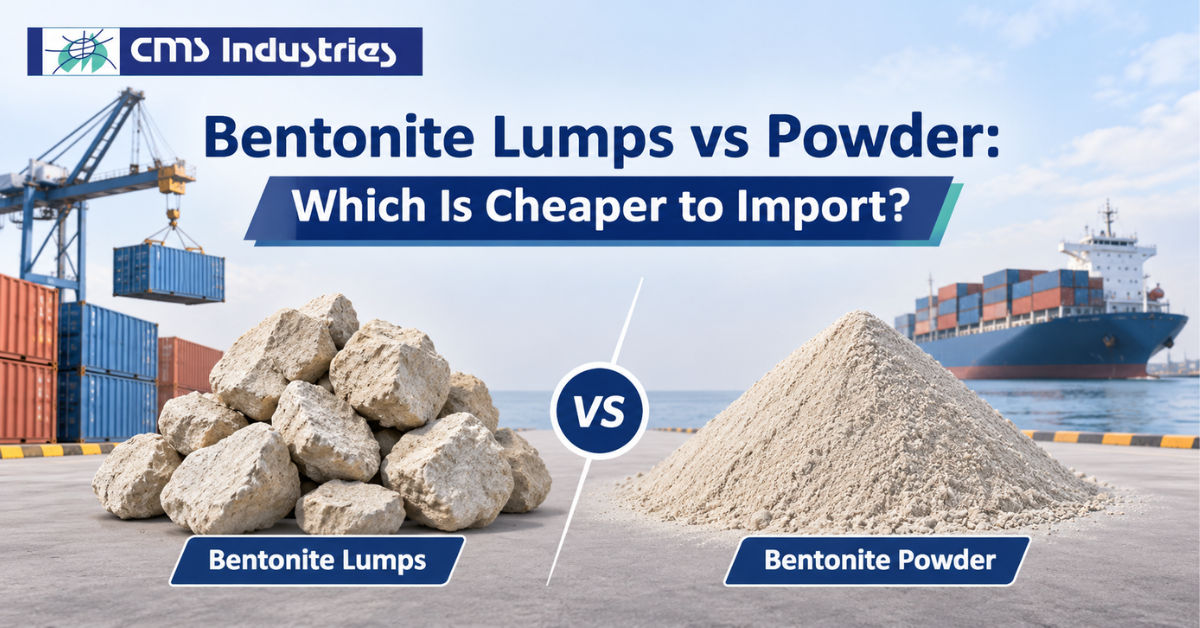
- Bentonite lumps are the clay as it is dug from the pit, graded, and sometimes sun-dried. Raw bentonite arriving at a processing plant is 25 to 40% moisture (Indian Bureau of Mines).
- The clay, after drying, crushing, grinding in roller or hammer mills, and sizing, is bentonite powder. Indian suppliers typically quote powder moisture between 8 and 12%, and drilling grades made to API Specification 13A has a cap moisture of 10% by weight.
Both forms are the same mineral; lumps just leave more work and more water for the purchaser.
Import Duty on Bentonite: Same HS Code for Both Forms
But here’s the good news. In most markets, lumps and powder are classified by the customs authorities under the same HS subheading, 2508.10 (Bentonite). The tariff line itself does not discriminate between forms.
Some recent examples of:
[Source: USGS] HTS 2508.10.0000 Free Normal Trade Relations United States 31-Dec-2025. Depending on the country of origin, there may be extra surcharges, so check the live schedule before booking.
- United Kingdom: 0% duty on imports from third countries plus 20% VAT.
- South Africa: Free general rate plus 15% VAT on CIF value plus duty.
There’s one caveat. VAT and other value-based charges are levied on the declared value of the goods. Powder has a higher invoice price and hence attracts more VAT in rupees or dollars. Most registered businesses do get import VAT refunded, but the payment still ties up working capital until the refund is received.
Bentonite Lumps vs Powder: Breaking Down the Real Landed Cost
Let’s break it down. There are five cost layers that determine which form is cheaper to import.
1. FOB Price at the Port of Loading
Lumps are cheaper at the source because the supplier does not dry and mill. The spread is clearly shown in the older Indian customs records. A 10,000-tonne bulk cargo of processed bentonite lumps was shipped from Kandla to Amsterdam in November 2016 at around USD 30 per tonne. About a month ago, 250 tonnes of processed bentonite in 1,250 kg bulk bags were shipped from Mundra to Oman at about USD 79 per tonne. Prices have changed since then, so these numbers should be seen as an indication of the gap rather than a current quote.
2. The Water You Pay to Ship
That’s the hidden cost most buyers miss. “Your lumps are 30% moisture. Three out of 10 tonnes that you pay freight on is water that your dryer is going to take out anyway. 10% moisture powder wastes a lot less freight space.
It’s just maths. To make one tonne of powder at 10% moisture, you need about 1.29 tonnes of lumps at 30% moisture (0.90 ÷ 0.70 = 1.286). Each per-tonne cost on the lump side is multiplied by that factor, including FOB price and ocean freight.
3. Freight Mode and Shipment Size
- Lumps fit dry bulk vessels. Large lots of several thousand tonnes mean low ocean freight per tonne. You need a destination port that can handle bulk, has covered storage close to your plant, and has an order large enough to fill that space.
- Powder is shipped in containers in 25 kg or 50 kg bags or one-tonne jumbo bags. Container freight costs more per tonne. But you can order one container at a time.
4. Processing at Your End
Buying lumps means you need a dryer, a crusher, a mill, a classifier, a bagging line, power, fuel, labour and spare parts. Grinding alone is energy intensive. A peer-reviewed study on a micronised bentonite plant in 2026 showed that about 48 kWh of energy per tonne was required to make the powder finer than 75 microns, the tube mill grinding stage being the largest single user. On top of that, you have drying fuel. Wet lumps drive that bill up higher.
Your extra cost per tonne is low if you have spare capacity in your grinding plant. If you have to build one, the capital cost changes the answer completely.
5. Losses, Testing and Handling
Pits have different lumps. Discard off-grade material, lose fines in handling, and spend more on lab testing. The powder is graded and tested and often has a certificate of analysis for each lot.
Worked Example: Which Form Comes Out Cheaper?
Next steps: Put your own numbers into a simple model. The figures below are hypothetical and only illustrate the method. Replace them with actual quotes from your suppliers and forwarder.
Assumptions
- Lumps FOB: USD 35/tonne at 30% moisture
- Powder FOB: USD 80/tonne @ 10% moisture level
- Bulk Vessel Freight: $25/tonne
- Container goods: 45 USD/tonne
- Your processing cost (drying, grinding, bagging): $25 per tonne of finished powder
Cost per tonne of finished powder at your plant
| Scenario | Lumps needed | Material + freight (USD) | Processing (USD) | Total (USD per tonne of powder) |
| Lumps by bulk vessel | 1.286 t | 1.286 × (35 + 25) ≈ 77 | 25 | ≈ 102 |
| Lumps by container | 1.286 t | 1.286 × (35 + 45) ≈ 103 | 25 | ≈ 128 |
| Powder by container | Not needed | 80 + 45 = 125 | 0 | ≈ 125 |
In this model, lumps save about 18% only if they move by bulk vessel to a buyer who already owns a processing plant. If you send the same lumps in containers, powder is the cheaper option. None of these lines includes the capital cost of a new mill, which would further tilt the result toward powder for most mid-sized buyers.
There is another important factor to consider: bentonite’s swelling behaviour and water absorption. These properties influence how the material performs in different industrial applications and why buyers should evaluate the grade and processing requirements before choosing between lumps and powder.
For a useful explanation of bentonite’s swelling behaviour, see this article by CMS Industries: Does Bentonite Clay Swell in Water?.
When Do Bentonite Lumps Make More Sense?
Lumps are generally cheaper when:
- You buy in large, steady volumes, enough to charter or share bulk vessel space.
- You already have drying and grinding equipment with spare capacity.
- Your application enables on-site blending, for example, iron ore pelletisation, foundry sand or civil engineering slurry.
- Your port provides dry bulk handling & covered storage close to your plant.
- You have full control over particle size and activation; you can blend to your own spec.
When Is Bentonite Powder the Cheaper Choice?
Powder generally wins when:
- We handle orders ranging from one container to a few hundred tonnes each month.
- You have no grinding plant, or your mill is already running at full load.
- You need a certified grade, drilling, cosmetic, or cat litter bentonite with a consistent mesh size and moisture.
- Your site does not have room for wet stockpiles.
- Predictable monthly costs, no plant maintenance, power spikes, or rejected batches.
Checklist Before You Request Import Quotes
Here’s why a checklist helps. Suppliers quote on different bases, and a low FOB price can hide costly moisture.
- Always ask for the moisture content on any quote, lumps or powders.
- Compare prices per dry tonne, not wet tonne.
- Get rates for bulk and container rates from your forwarder.
- Please verify the HS code and any origin-based surcharges with your customs broker.
- Price your processing cost honestly, factoring in power, fuel, labour, and wear parts.
- Request a sample and certificate of analysis before the first order.
- Check how far the supplier is from the port, as inland haulage adds to the FOB price.
Sourcing Bentonite from Kutch, Gujarat
deposits in India. Exporters here are close to the ports of Mundra and Kandla that handle both containers and dry bulk cargo. That short inland haul keeps FOB prices competitive for both forms.
CMS Industries is an ISO 9001: 2015-certified bentonite miner, processor and exporter with its manufacturing units located in Mandvi Taluka, Kutch. The company says it can produce more than 26,000 tonnes per month of lumps and more than 9,000 tonnes per month of powder in grades for foundry, oil drilling, civil engineering, HDD, cat litter, animal feed, and more. If you are comparing the two forms, you can ask CMS Industries for side-by-side quotes on lumps and powder with moisture figures, then run the dry-tonne comparison above with real numbers.
Final Word
Neither type is necessarily cheaper. Lumps are cheaper at the port, but they carry water and need bulk goods to pay off and a plant at your end. Powder costs more per tonne but is ready to use and comes in shipment sizes suitable for most buyers. Crunch the dry-tonne numbers with actual quotes, and typically in an hour the cheaper option for your business becomes apparent.
Frequently Asked Questions
1. Is bentonite powder or lumps cheaper per tonne?
The supplier doesn’t dry and grind, so the lumps usually cost less per tonne in the port. But check prices per dry tonne. Lumps hold more water, so you pay freight on water that your dryer will remove later.
2. What HS code applies to bentonite lumps and powder?
Both forms are normally classified in HS subheading 2508.10, Bentonite. The United States, the United Kingdom, and South Africa all have a zero or free base duty on this line. VAT and surcharges based on origin may still be in effect, so check with your customs broker.
3. How much moisture do bentonite lumps contain?
According to the Indian Bureau of Mines, the raw bentonite delivered to a processing plant normally has a moisture content of 25 to 40 per cent. Sun-dried lumps have less. Powder usually ships at 8-12%. API drilling grades are a max of 10%.
4. What is the minimum order for importing bentonite powder?
Most exporters sell powder in bags or jumbo bags in containers, so the practical minimum is often one container full. The lumps pay off mostly in large bulk vessel lots of several thousand tonnes, which only suits high-volume buyers with port access.
5. Can I import bentonite lumps and grind them myself to save money?
Yes, if you have the drying and grinding equipment and buy in bulk. The cost of a dryer, mill, power, and labour without a plant usually cancels out the savings. 1) Get quotations from suppliers such as CMS Industries for both forms.