


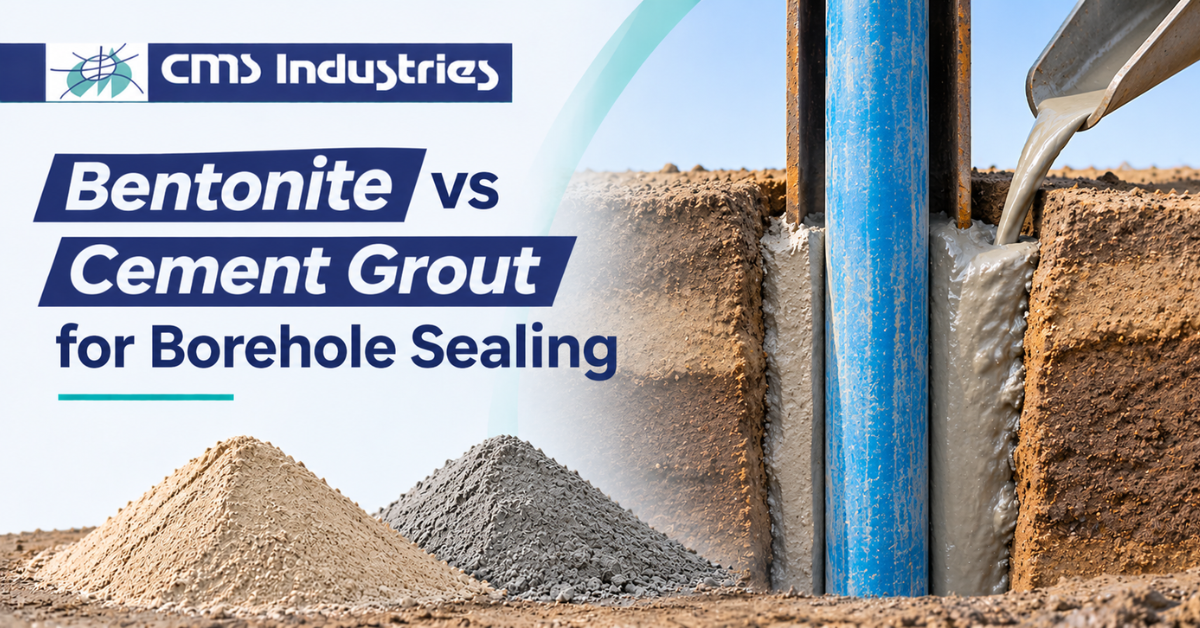
A poorly sealed borehole does damage long after the drilling rig has gone. The open annulus can allow flow of surface water and pollutants down into the aquifer, leakage of water between layers, and an open abandoned borewell can endanger lives. Depending on the sealing material you choose, the hole stays closed well or not.
The debate of bentonite vs cement grout is one of the oldest in the drilling trade. Both work. Both can fail in the wrong situation. The guide compares the two on the points that matter: how they seal, where each one struggles, how to mix them, and what Indian rules say about abandoned borewells. The facts are taken from US state well codes, Indian Supreme Court orders, Central Ground Water Authority documents, and published grout studies.
Why Borehole Sealing Matters
This is why the seal deserves as much attention as the drilling. A grout seal does three things:
- Prevents surface and shallow-layer contamination from migrating down the borehole
- Avoids the cross-flow of aquifers of different quality/pressure
- Protects and supports the liner from corrosive water and soil movement
In India, abandoned borewells also have a life-safety duty. In 2010, the Supreme Court of India issued guidelines to prevent small children from falling into open borewells in Writ Petition (Civil) No. 36 of 2009. These include filling abandoned borewells from the bottom up to ground level.
How Each Material Seals
Bentonite grout works on the principle of expansion. Sodium bentonite absorbs water and swells to fill the annulus, creating a soft, flexible, very low permeability seal. Bentonite permeability is on the order of 1 × 10⁻⁷ to 1 × 10⁻⁹ cm per second based on Colorado Water Board guidance. Bentonite can expand 10 to 15 times its dry volume when hydrated.
Some forms of bentonite for sealing:
- High solids content bentonite slurry pumped through a tremie pipe
- Bentonite chips are dry, poured and hydrated in situ
- Bentonite pellets or coated tablets sinking in water before swelling
It sets hard. That is how cement grout works. Neat cement grout is Portland cement and water, sometimes with a little bentonite. It hardens to a tough, inflexible plug that bonds to rock and resists high pressure.
Bentonite vs Cement Grout for Borehole Sealing: Side-by-Side
Let’s go point by point.
| Property | High-solids bentonite grout | Neat cement grout |
| How it seals | Swells and stays flexible. | Sets hard and rigid |
| Permeability | About 1 × 10⁻⁷ cm/s or lower | Low when intact, but may crack |
| Heat during setting | None | Heat of hydration: can deform PVC casing |
| Shrinkage | Low below the water table; can dry and crack above it | Shrinks while curing; may pull away from casing |
| Effect on groundwater | Low pH impact | High pH, about 10 to 12, during curing |
| Strength | Low; soft and self-adjusting | High; supports casing |
| Saline water | Poor; not suited to high salinity | Suitable |
| Artesian or high-pressure wells | Not preferred | Strongly favoured |
| Mixing and clean-up | Easier | Needs mixer, pump and quick clean-up |
| Typical slurry density | At least about 9.4 lb/gal (1.13 SG) | About 15.6 lb/gal (1.87 SG) |
The main differences are explained in the sections below.
Where Bentonite Grout Works Best
Bentonite is good when it is kept wet. The Nebraska grout study, reported in The Driller, tested grouts with clear PVC casing, cameras, and dye. It was found that bentonite slurry grouts performed well below the water table, and bentonite chips performed very well both above and below it.
Bentonite also addresses two major cement issues. It does not generate heat of hydration and therefore will not soften or distort PVC casing. It has much less effect on water chemistry, which is important in monitoring wells where samples must be uncontaminated.
- When to select bentonite
- The seal is primarily submerged below the static water level.
- The shell is composed of PVC or other thermoplastics.
- The well is a monitoring well, and cement may influence pH readings.
- You need a flexible seal that moves with the ground.
Where Cement Grout Works Best
Cement makes its living in hard conditions. Pennsylvania’s guidance on well abandonment states that neat cement grout, placed under pressure, is strongly preferred for artesian wells and for wells that pass through more than one aquifer.
Cement also deals with salt. “In some saline conditions bentonite grout cannot be used, and cement is the alternative there,” a grout article in The Driller says. The Florida rules go further, banning the use of bentonite grout in wells with total dissolved solids exceeding 10,000 mg per litre.
Opt for cement if:
- The well is artesian.
- The groundwater is saline or otherwise contaminated such that the bentonite does not swell.
- The seal must be in a dry area above the water table.
- You need a good plug at the top of an old well.
The Weak Spots of Each Material
No grout is perfect. Here’s what to watch for.
Bentonite’s Achilles heel is drying out. The Nebraska study revealed that bentonite slurries with solids content less than 20%, 20%, and greater than 20% all showed heavy desiccation in the unsaturated zone. A second article in The Driller adds that pumpable slurries that dry out in this zone do not rehydrate when water returns. Fine silica sand or chips help.
Cement’s weak spots are shrinkage and heat. The Colorado guidance says pure cement shrinks as it cures, which can create poor sealing against both casing and borehole wall. Its heat of hydration will soften or melt the PVC casing. The Nebraska study also found that cement tends not to bond to PVC, leaving a micro-annulus that can carry contamination down the well.
One common fix is to add a little bentonite to the cement. Pennsylvania guidance suggests that 2 to 8% bentonite can reduce shrinkage. This is not agreed with by some researchers, but a paper presented to the Geological Society of America says the shrinkage benefit is partly a misconception and that overwatered bentonite-cement mixes become porous and weak. The safe way is to do the exact mix that your local code sets.
How to Mix Each Grout Correctly
Neat Cement Grout
Most U.S. well codes limit water to 6 U.S. gallons per 94 lb sack of Portland cement. New Jersey’s table requires 5.2 gal per sack for Type I and II cement, which yields a density of about 15.6 lb per gal.
In metric terms for a 50 kg Indian bag of cement:
| Mix basis | Water per 50 kg bag | Water-cement ratio |
| 5.2 US gallons per 94 lb sack | About 23 litres | About 0.46 |
| 6.0 US gal per 94 lb sack (upper limit) | About 26.5 litres | About 0.53 |
Before pumping, check the slurry with a mud balance. A light reading means too much water and a less strong seal.
High-Solids Bentonite Grout
Many codes require at least 20% bentonite solids by weight. One popular product guide suggests mixing a 50 lb bag with 24 gallons of water to make a 20% grout. 20% solids means about 250 kg of grout-grade bentonite per 1,000 litres of water in metric terms. Florida rules also call for a density of at least 9.4 pounds per gallon.
One caveat from Pennsylvania’s guidance is worth noting: high-solids grout is not made from bentonite labelled as drilling fluid or gel. At high solids, drilling-grade bentonite thickens too quickly. Use a grouting product and mix according to the manufacturer’s instructions.
Bentonite Chips
Add chips slowly to prevent bridging. In dry zones, the driller recommends adding approximately 2 gallons (7.5 litres) of clean water for each 50 lb (22.7 kg) of chips to keep them hydrated.
What Indian Rules Say About Sealing Abandoned Borewells
India’s rules put safety first. The Supreme Court in 2010 had ordered that abandoned borewells should be filled with clay, sand, boulders, pebbles or drill cuttings from bottom to ground level, a provision reiterated by the Central Ground Water Authority in its guidelines.
Similarly, efficient bentonite management is important in industrial applications, where controlling material consumption and maintaining product quality can improve operational efficiency. For insights into reducing bentonite usage and controlling silica levels in pellet plants, read CMS Industries’ article: How to Reduce Bentonite Consumption in Pellet Plants and Cut Silica.
A separate set of guidelines for abandonment of borewells published on the Government of India’s AIKosh data platform adds technical detail. Abandoned borewells should have the piping removed as far as possible and be filled with cement grout, concrete grout, bentonite grout or dry clay, it says.
CGWA has also warned that project proponents who do not comply with these directions may face cancellation of their No Objection Certificate, sealing of the tube well and penalties.
Bentonite and cement, therefore, are both accepted sealants in Indian practice. The selection should be based on site geology, water level, and water quality.
A Practical Sealing Plan
Next steps: Here is a logical order that many codes follow when abandoning a well:
- Take the pump, pipes, and debris out of the borehole.
- Measure the depth and static water level so you know which zone sits wet and which zone sits dry.
- To seal the deep, water-bearing section, place high-solids bentonite grout or chips from the bottom up through a tremie pipe.
- Where conditions require it, such as artesian flow, saline water, or areas above the water table, use cement.
- Cement over the top with a trowel. For example, Florida requires at least the top 10 feet of an abandoned well to be neatly cemented to protect the bentonite seal.
- Restore the ground surface and record the work performed, including materials and volumes used.
Sourcing Bentonite for Sealing Work
Sodium bentonite major deposits in India are found in Kutch, Gujarat. CMS Industries is a bentonite miner and processor in Mandvi Taluka, Kutch, certified to ISO 9001:2015 standards. It supplies sodium bentonite powder and lumps for water well drilling, civil engineering, and pond sealing. It does not specify a borehole grouting grade on its website. So before you buy for a sealing job, ask CMS Industries whether a grade is suitable for high-solids grouting and ask for its swelling and solids data.
Final Word
THERE IS NO WINNER. Bentonite offers a flexible, low permeability seal that remains tight below the water table and never harms PVC casing. Cement forms a hard, strong plug that performs better than mud in artesian pressure, saline water, and dry zones. Many good seals will use both bentonite in the wet section and cement on top. Match the grout to the ground, mix it to spec, and the borehole will remain sealed permanently.
Frequently Asked Questions
1. Is bentonite or cement better for sealing a borewell?
Better is not always better. Bentonite is good for PVC casing and seals well below the water table. Cement copes better with artesian pressure, saline water, and dry areas. Many abandonment jobs use bentonite in the wet section and a neat cement cap at the top.
2. Can I use drilling mud bentonite for grouting?
Not for high-solids grout. Pennsylvania’s guidance says that high-solids grout is not made from bentonite labelled as drilling fluid or gel, because it thickens too fast. Buy a grout grade and follow the manufacturer’s directions for mixing.
3. What is the right water-cement ratio for neat cement grout?
Well codes typically do not permit more than 6 US gallons of water per sack of 94 lb or 26.5 litres per bag of 50 kg. A target of 5.2 gallons per sack, about 23 litres per 50 kg bag, yields a denser grout.
4. Why does bentonite grout fail above the water table?
Bentonite needs water to remain swollen. Slurry grout loses moisture in dry ground and shrinks and cracks. Research indicates it may not rehydrate later. In these dry upper zones, bentonite chips, sand-amended grout, or cement work better.
5. How should an abandoned borewell be sealed in India?
The Supreme Court and CGWA guidelines allow filling from the bottom to ground level with clay, sand, pebbles, or drill cuttings. Technical guidelines also allow cement or bentonite grout. Suppliers, such as CMS Industries, can advise on bentonite grades for sealing.