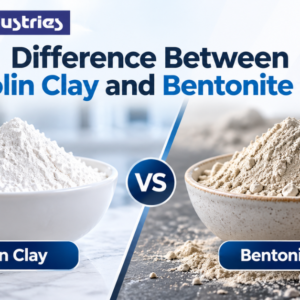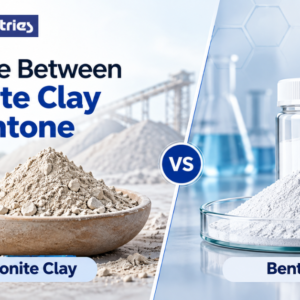



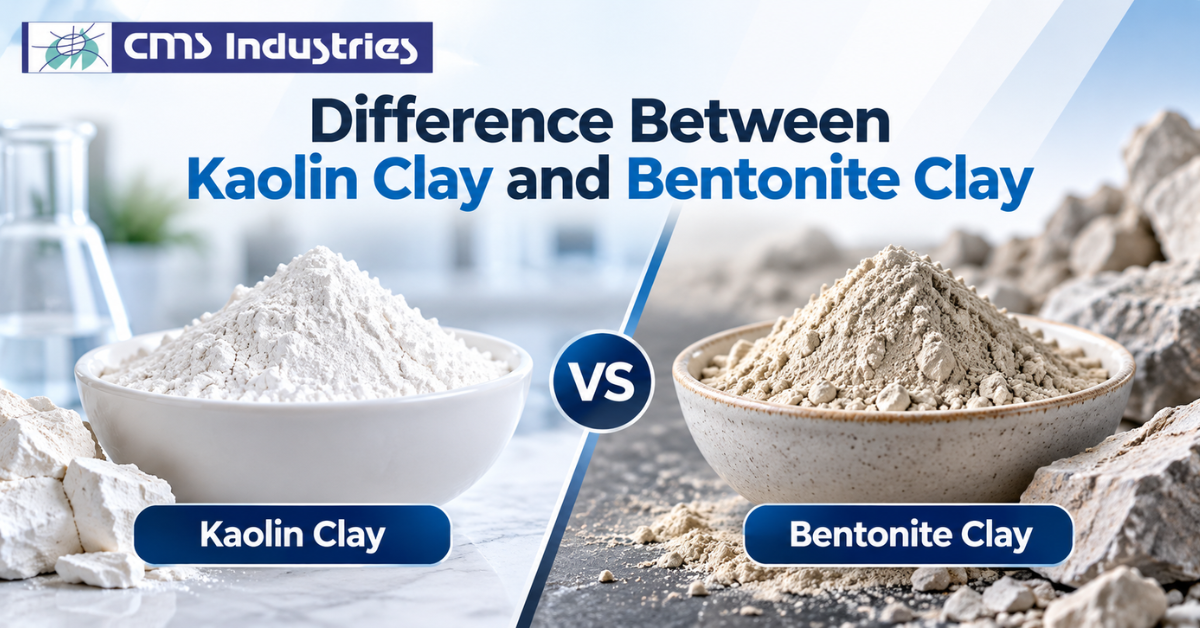
Both are soft, fine-grained clays and both show up in ceramics, cosmetics, and industry guides. The resemblance stops there. If you are looking up “kaolin clay vs bentonite clay”, you are probably looking at a material for a real job, so the details are important. Kaolin is a white, low-reactivity clay used to coat paper and form porcelain. Bentonite is an absorbent clay used to seal ponds, bind foundry sand, and thicken drilling fluid. Here’s why they behave so differently.
Quick Answer: Kaolin and Bentonite at a Glance
Kaolin is a white clay consisting mainly of the mineral kaolinite. It does not swell in water, has a low surface area, and is chemically inert. Bentonite is a clay composed mostly of montmorillonite. It has a much larger surface area, and the sodium variety expands to 15 times its original size in water. Kaolin is good for paper and ceramics. Bentonite is suitable for drilling, sealing, foundry, and absorbent jobs.
The bottom line:
- Main mineral: Kaolin contains kaolinite. Bentonite consists of montmorillonite.
- Layer design: Kaolinite has two layers per unit. Montmorillonite has three of these.
- Kaolin swelling: does not expand. Sodium bentonite swells up very much.
- Surface area: Kaolinite has a surface area of about 10 to 30 m²/g. Montmorillonite attains 600 to 800.
- Texture: Kaolin is soft and non-abrasive and feels very smooth. Bentonite has a slick feel and gels when wet.
- Common jobs: Coating and filling paper with kaolin; making ceramics. Bentonite drills, seals, binds, and absorbs.
What Is Kaolin Clay?
According to the Industrial Minerals Association Europe, kaolin, or china clay, is a white, soft, plastic clay that is made up of fine, plate-like particles. The name comes from a place in China, Kao-Lin. Granite breaks down to form kaolin. This process is called kaolinisation. The feldspar is changed to kaolinite; the quartz and mica remain mostly unchanged.
According to the Natural Resources Authority of Jordan, kaolin’s shape, particle size, colour, softness and non-abrasiveness are the properties that determine its uses. According to the Industrial Minerals Association Europe, kaolin is chemically inert and a poor conductor of heat and electricity.
What Is Kaolin Used For?
The two biggest uses are in coating and filling paper and in producing fine ceramics. The Natural Resources Authority of Jordan said that on paper, kaolin makes print sharper and paper whiter and smoother. The Minnesota state report lists plastics, adhesives, rubber, paint, refractories, cement, and bricks. All of these contain kaolin, as it is stable and does not react with the other ingredients.
What Is Bentonite Clay?
Bentonite is produced when volcanic ash falls into water and transforms into clay. Montmorillonite is what the Kansas Geological Survey calls its primary ingredient, while the Wyoming State Geological Survey describes bentonite as any natural material that is primarily composed of clay minerals from the smectite group. Wyoming miners used to call it “mineral soap” because it felt soapy when wet. Geologists called it bentonite in 1898.
The two most important kinds are:
- Sodium bentonite swells to 15 times its size and makes thick gels.
- Calcium bentonite will adsorb liquids and impurities but will swell much less.
Wyoming sodium bentonite is a good example of those characteristics translating into demand. It is used for cat litter (25%), drilling muds (20%), foundry binders (19%), and iron ore pelletising (13%). The rest, 23 per cent, goes for other uses.
Structure: Why Kaolinite and Montmorillonite Behave Differently
It is at the atomic scale, so let’s look at the actual gap.
Kaolinite is a 2-layer clay. The SLB drilling glossary refers to it as a common two-layer clay that does not swell upon water contact. (For reference, a soil science explainer from the European Geosciences Union gives kaolinite particles a size of 0.2 to 2 micrometres. This means an effective surface area of 10 to 30 square metres per gram, because only the outer surfaces are involved in reactions. It also refers to a very low cation exchange capacity of between 1 and 10 cmol/kg.
The montmorillonite has a three-layer structure. In 1949, a chapter of mining engineers described sandwiching an aluminium sheet between two silica sheets. Because the unit crystal is much thinner than that of kaolinite, it has more surface area. The inner surfaces are connected so water and ions can pass between the layers. According to the European Geosciences Union explainer, the effective surface area is between 600 and 800 square metres per gram. The specific surface areas of montmorillonite and kaolinite are given as 750 m²/g and 30 m²/g, respectively (Taylor & Francis).
This is the reason for much of what follows.
Kaolin Clay vs Bentonite Clay: Side-by-Side Comparison
Swelling and Water Behaviour
Kaolinite is stable in water. SLB notes that it does not shrink or swell with changes in water content. Sodium bentonite does the reverse. Jordan’s Natural Resources Authority says it can expand to 15 times its original size, while calcium bentonite absorbs liquids but doesn’t expand much.
One trait distinguishes the two clays for different jobs. A swelling clay can either seal a leak or keep a borehole open. The paper can be coated with non-swelling clay without changing the shape of the paper.
Surface Area and Absorption
More surface area means more room to hold liquids, ions, and impurities. Bentonite is the clear winner here. The water cannot get between the layers, so the kaolin has a lot less. One company markets its cosmetic-grade bentonite as having a higher oil absorption capacity and being able to absorb other impurities as well. Instead, kaolin provides a milder, more inert profile.
Texture, Colour, and Purity
The white is kaolin. Industry sources describe it as a soft, non-abrasive, plate-like powder, and that whiteness makes it a pigment, filler, and extender. Bentonite is a performance product in water, not a cosmetic. It is the same swelling behaviour that makes it useful that is responsible for its “mineral soap” slickness in wet form.
Typical Uses
- Kaolin – paper coating and filling, fine ceramics, paint, plastics, rubber, adhesives, refractories, cement and bricks.
- Bentonite: drilling muds, foundry sand binders, iron ore pelletising, cat litter, civil engineering slurries, sealing.
One detail shows how differently they act. SLB lists kaolinite as a common component of mud drill solids. Drillers add bentonite on purpose, but kaolinite is a natural passenger coming from shale and claystone.
Where Bentonite Gets Used in Industry
Natural bentonite is available in company product catalogues and is used in many different sectors. Bentonite grades from CMS Industries cover applications such as oil drilling, water well drilling, horizontal directional drilling, foundry sand binding, civil engineering and piling, geosynthetic clay liners, pond sealing, water treatment, agriculture, animal feed, paper, cosmetics, earthing, iron ore pelletising and cat litter. The company also lists sodium and calcium bentonite as separate grades.
Look at the overlap. That list includes paper and cosmetics, and kaolin is involved in both. The clays compete in some markets but find different niches in them.
Which Clay Fits Which Job? Next Steps
Use this checklist to help you choose:
- Swelling? Find out if you need it. If the job requires a clay that will swell and seal, select sodium bentonite. If you want the clay to be stable, go with kaolin.
- Do the work. Bentonite is used for drilling, sealing, foundries, binding, and absorbing. Kaolin is used for coating, filling, whitening, and ceramic forming.
- Absorption needs. Bentonite has a larger surface area; thus, it holds more liquid and impurities.
- Check colour and texture. Kaolin produces a white, soft, non-abrasive finish.
- Check the grade. Different rules for food, feed, cosmetic, and industrial uses. Ask the supplier for documents.
- Do a little test run. Lab results disprove assumptions.
Common Myths About Kaolin and Bentonite
- “They are the same clay, just different names. Different minerals, different layering structures. Bentonite is simply a more concentrated form of kaolin.”
- “Bentonite absorbs more”, says one paper coater, “but we want a white, stable pigment, not a swelling clay.
- ”Kaolin swells a little,” says SLB. It remains stable with changes in water content. All bentonite swells the same.” Calcium bentonite swells considerably less than the sodium type.
Final Thoughts
The difference between these two clays is a matter of structure. Kaolin has a compact two-layer structure and therefore remains white and stable and has a low surface area. Bentonite has three layers in its design. When exposed to water, the layers open up, swell, absorb, and gel. Kaolin. Selected for coating, filling, and ceramics. Bentonite is used for drilling, sealing, binding, and absorbing. If you are sourcing natural bentonite, suppliers such as CMS Industries publish lists of applications showing which grade is suitable for which job. Next steps: read the grade data sheet, check the swelling rating, and run a small batch.
Frequently Asked Questions
What is the main difference between kaolin clay and bentonite clay?
Kaolin is a white, non-swelling clay composed of kaolinite with a low surface area. Bentonite is made up of montmorillonite, has a much larger surface area, and the sodium type swells strongly in water. That’s what makes their work different.
Does kaolin swell like bentonite?
No. Kaolinite is a two-layer clay that does not swell when wet. Sodium bentonite can expand to 15 times its original volume. Calcium bentonite swells much less than the sodium variety but still more than kaolin.
Which clay absorbs more, kaolin or bentonite?
Bentonite holds more. It has an effective surface area of 600 to 800 square metres per gram because water and ions can fit between its layers. The outer surfaces of kaolinite have only about 10 to 30 m² per gram.
What are kaolin and bentonite used for?
Most of the kaolin consumed is used in paper coating and filling, ceramics, paint, plastics, and rubber. Uses of Bentonite: Drilling mud, foundry sand binders, iron ore pelletising, cat litter, and sealing work. Both are found in some paper and cosmetic products.
Can kaolin replace bentonite in drilling or sealing?
Not so good. Sodium bentonite contributes swelling and gel formation, which is important to the function of drilling fluids and seals. Kaolin does not swell and is not able to plug leaks or build a gel in the same way. Match the work to the clay.