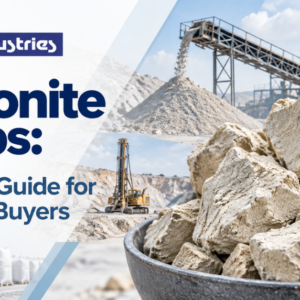



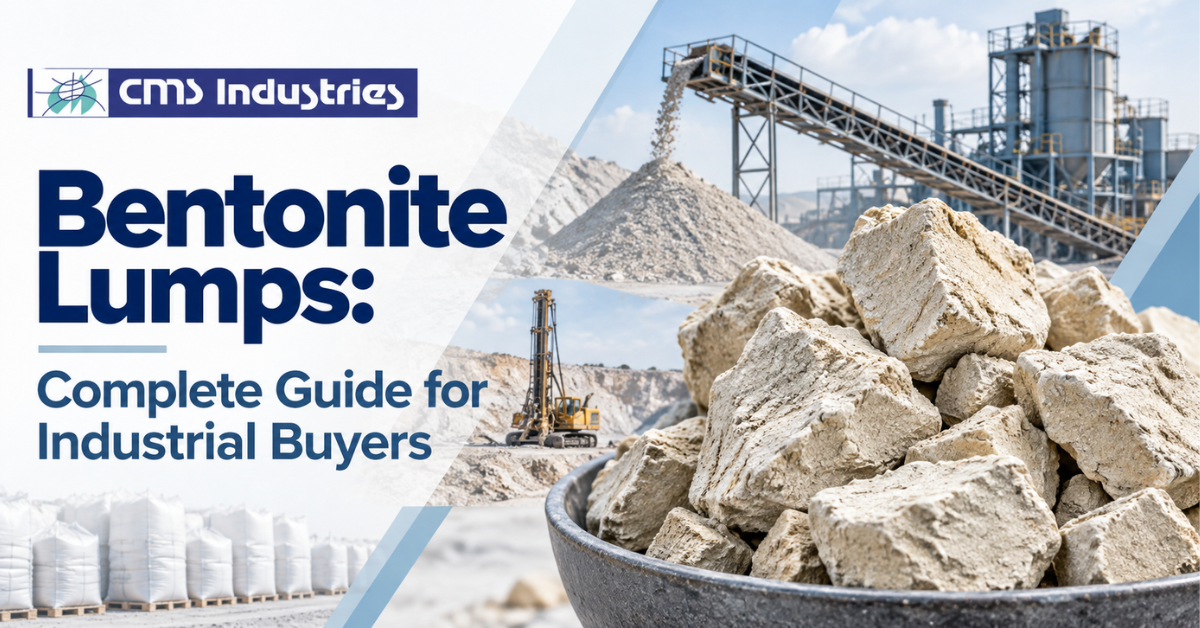
Buyers seeking bentonite for drilling, foundry, sealing, or pelletising will find lump and powder offers side by side. Prices seem to be the same, but the products are not. Bentonite lumps are the raw, dried, broken-up form of the clay, and what you do with them next determines your cost and your results. In this guide, you will learn how lump bentonite is made, what to test for, and where buyers go wrong. Let’s break it down.
Quick Answer: What Buyers Need to Know
Sodium bentonite is natural, mined bentonite sold in lumps rather than in a fine powder. Buyers either grind it themselves in their own plant or pay a processor to grind it. Check these four things before you order: type of bentonite (sodium or calcium), moisture content, lump size, and test results for your application.
The short version:
- What it is: Pulverised and crushed bentonite ore before fine milling.
- Who buys it: Mills, powder producers and plants with their own grinding lines.
- The main checks are type, moisture, lump size, montmorillonite content, and lab results.
- Typical end uses post-milling are drilling fluid, foundry binder, sealing, pelletising, and cat litter.
What Are Bentonite Lumps?
Bentonite is formed when volcanic ash lands in water and becomes clay. According to the Kansas Geological Survey, its chief ingredient is montmorillonite. The 1949 mining engineers’ chapter estimates the montmorillonite content at 85 to 90 per cent, with the balance feldspar, gypsum, calcium carbonate, quartz, and traces of other minerals.
In the pit, crude ore is moist. A U.S. patent on upgrading crude sodium bentonite says the ore contains 30 to 40 per cent moisture when it is mined. Producers dry it. The same patent says drilling-fluid bentonite should have 10 per cent moisture or less. Lumps are the crushed and dried pieces between raw ore and fine powder. Some buyers take them as-is. Others grind them in a mill.
“The next step,” says the Wyoming State Geological Survey. Bentonite from the pits is blended, ground, dried, and processed to finished products at the mills.
Sodium vs Calcium Lumps
The behaviour of the lumps depends on the type of bentonite:
- Sodium bentonite is capable of swelling up to 15 times its original volume in water, producing thick gels, according to Jordan’s Natural Resources Authority.
- Calcium bentonite swells less and adsorbs liquids and impurities.
From the above patent, most natural bentonites have calcium as the main exchangeable ion. Producers can treat calcium types with soda ash to bring them nearer to sodium behaviour. One patent summarising the research says only 2 to 4 percent soda ash by weight can improve the clay’s properties, and a Saudi university paper confirms that soda ash replaces sodium with calcium in the clay. Q: Are the lumps natural or treated? A: Ask all suppliers.
How Lumps Become Powder: Processing Steps
The usual path, step by step, is:
- Extract the ore. According to the state survey, Wyoming’s bentonite is from surface pits no deeper than about 50 feet. Open-pit mining is quite common elsewhere as well.
- Air-dry on stockpiles. This is called a customary practice in the patent language, as it takes out some of the moisture prior to oven drying.
- Crush. The dried ore is then reduced in size using jaw crushers. This is the stage of lumps.
- Dry to desired dryness. Finishing is done in rotary kilns or belt dryers.
- Activate if required. Plants mix calcium bentonite with soda ash to increase swelling and binding performance.
- MILL AND SCREEN: Final mesh size determined by grinding & screening. A manufacturer data sheet for premium Wyoming drilling bentonite states it will pass about 80 percent of a 200 mesh screen.
A market research report on bentonite plants lists the same sequence of drying, crushing, and sodium activation. This should be considered a general outline, as there will be variations for each plant.
Where Industrial Buyers Use Lump Bentonite
Wyoming data showing the spread. Wyoming sodium bentonite is used in cat litter (25 percent), drilling mud (20 percent), foundry binders (19 percent), and iron ore pelletising (13 percent). The other 23 per cent goes to other uses.
Drilling Fluids
The most tightly specified use is drilling. Bentonite tests for drilling fluids are included in both API Specification 13A and ISO 13500:2006. These limits are tabulated on a manufacturer data sheet as per API 13A Section 9:
- At least 30 viscometer readings at 600 rpm.
- 15.0 cc or less water loss.
- Residue on 200 mesh sieve, 4.0 per cent maximum.
- A yield point less than three times the plastic viscosity.
According to the patent text citing the API standard, the test uses a 22.5-pound-per-barrel suspension in water. Lumps are not meeting these numbers as they sit in the pile. But the milled product does.
Foundry Sand Binding
Foundries use bentonite as a binder for moulding sand. CMS Industries says its foundry grade builds green and dry compressive strength. Compare a bunch and ask for those 2 numbers.
Civil Engineering, Sealing, and Pelletising
Pelletising of swelling clay. Trench staking and sealing. Suppliers list lump-derived grades for piling, horizontal directional drilling, geosynthetic clay liners, and pond sealing. Bentonite is used as a binder in pelletising in iron ore plants. CMS Industries says its IOP grade has a higher natural share of iron and low silica, so it adds no extra slag. Check that claim against your own furnace data.
What to Check Before You Buy
Use this checklist to compare offers:
- Check type of bentonite. Ask if the lumps are naturally sodium, naturally calcium, or soda-ash treated.
- Moisture request on loading. If it’s wet and lumpy, you pay freight on water. Drilling grades should have 10% or less moisture after drying, and typical supplier data sheets list 8 to 12%.
- Indicate a range of lump sizes. Consistent dry pieces for more even milling.
- Ask for application tests. API 13A viscometer readings and volumetric readings of filtrate are required for drilling buyers. Foundries require green and dry compressive strength. Buyers of sealants request swelling data.
- Test for mineral purity. In general, the higher the montmorillonite content, the stronger the swelling and binding. Labs often estimate this with the methylene blue test.
- Obtain a certificate of analysis. Keep a retained sample and send it to an independent lab.
- Organise shipment. Before you sign the dotted line, ask about packaging, port access and loading capacity.
Sourcing From India: What One Producer Reports
The Kachchh district of Gujarat in India is a well-known bentonite region. For example, look at CMS Industries. The company’s website says it has ISO 9001:2015 certification and has manufacturing units in Mandvi Taluka near the ports of Mundra and Kandla. The site mentions a capacity of over 9,000 metric tonnes of powder and over 26,000 metric tonnes of lumps per month. It has mines at Vandh, Pundi, Sherdi-Mandvi, Miyani and Raidhanjar-Abdasa. It also lists agency and direct export sales. You can also explore its guide on bentonite balls.
Those are corporate figures. Use them as a starting point and check them with samples, certificates, and, if possible, an audit of the site. For export buyers, port access is most important, as inland freight adds cost for every tonne of lumps.
Common Mistakes Buyers Make
Here is why many first orders are disappointing:
- Buy on price per tonne only. A less expensive lot with higher moisture may cost more per dry tonne.
- Assuming all bentonite swells like Wyoming clay. Calcium types swell far less, and some lower grades fail to meet API targets.
- Skipping the lab test. Data sheets are typical, not your lot.
- Mixing lump and powder specs. API 13A tests the milled product as a suspension rather than as the raw lumps.
- Neglecting fineness after milling. The high residue on 200 mesh hurt drilling performance.
Final Thoughts
Bentonite lumps are a raw material and not a finished product. They vary in value by type of clay, moisture, and how well your plant or processor converts them to powder. Take lumps on the job. Test all lots and read supplier claims carefully. Producers like CMS Industries publish lists of capacity, location, and grade, and those pages give you a place to start your questions. Next steps: Write your spec, request samples from two or three suppliers, and compare lab results before placing a full order.
Frequently Asked Questions
What are bentonite lumps used for?
Buyers grind them up for drilling fluid, foundry binders, sealing products, iron ore pelletising, and cat litter. Treated lumps are also used by some plants for water treatment and agriculture. The type, moisture, and fineness you need depend on the end use.
How do lumps differ from bentonite powder?
Lumps are pieces that are dried and crushed. Powder is clay that has been milled and screened to a mesh size. Lumps are cheaper to process at the source, but you have to grind them, and performance tests are done on milled powder.
What moisture level should drilling bentonite have?
One patent for improving crude bentonite has proposed that the moisture content of the drilling-fluid products be 10% or less. Manufacturer data sheets often list 8 to 12 per cent. Always ask for the figure yourself on your own lot.
Can calcium bentonite lumps work for drilling?
Sometimes yes. Producers treat calcium bentonite with soda ash to increase swelling, and a treated lot can meet API 13A specifications. Before you commit, test each lot against the 600 rpm reading and filtrate limits.
Which tests show the quality of a lot?
Request moisture, API 13. A viscosity, filtrate volume, 200 mesh residue, and swelling data. Purchasers of foundry sand add compressive strength. The methylene blue result is an estimate of montmorillonite content.