


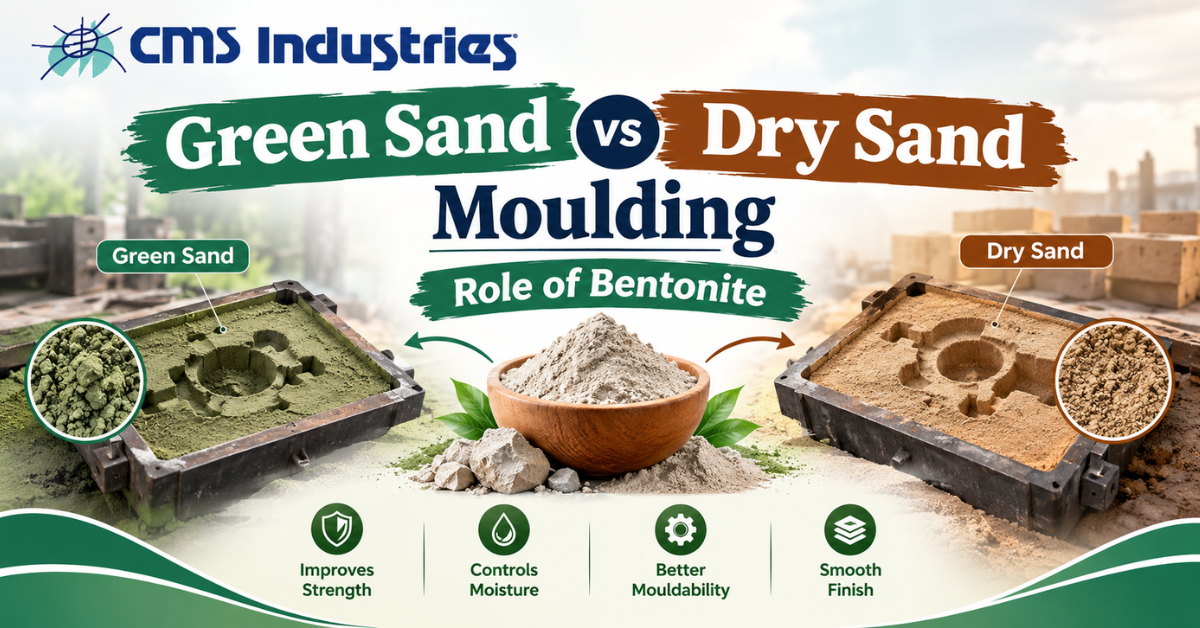
Go to almost any metal casting foundry, and you’ll find sand all over the place, in mould flasks, in reclamation bins, moving on conveyors from one station to the next. Most of that sand gets its strength from one clay mineral: bentonite. But how bentonite is used and how much a mould really requires depends a great deal on whether the foundry is running green sand or dry sand moulding.
Now let’s take a look at the differences between these two processes and why bentonite plays such a different role in each.
What Is Green Sand Moulding?
Foundries use green sand moulding to make sand moulds for casting metal, most commonly. “Green” has nothing to do with colour. It is not about sand which has been dried out first, but the moisture still in the sand when the molten metal is poured.
The normal green sand mix is composed of high-quality silica sand with about 5% to 10% bentonite clay as binder, 2% to 5% water, and a small percentage of sea coal for better surface finish on the finished casting. Foundrymen like the process because it is cheap, quick to set up, and works well for both small runs and high-volume casting.
Green sand moulds also collapse easily as the metal solidifies, thus reducing the stress on a casting as it cools and shrinks. That collapsibility is a real plus for smaller and mid-sized castings, but it does limit the size of a green sand mould that can be practical before handling and assembly become difficult.
What Is Dry Sand Moulding?
Dry-sand moulding uses a similar initial mixture but removes most of the moisture before the mould is used, either by air drying or oven curing. Dry sand moulds are better for larger, heavier castings and more intricate shapes where a green sand mould might crack or produce surface defects from trapped steam since there is far less steam generated when molten metal contacts the mould surface.
The tradeoff is cost and time. Depending on the size and type of binder, sand moulds may take several hours to dry and cure. This makes dry sand moulding slower and more expensive per casting than green sand. Thus, dry sand is typically reserved for larger parts or jobs where the surface finish and dimensional accuracy are more important than production speed.
Main Differences Between Green Sand and Dry Sand Moulding
Here’s a side-by-side view of how the two processes stack up:
- Moisture content. The green sand mould should be wet when poured. Dry sand moulds are dried or cured before pouring, sometimes to well under 2% moisture.
- Setup speed: Green sand moulds are ready almost instantly after ramming. Dry sand moulds need time to dry or cure, which may take several hours.
- Casting size: Green sand is widely used for small to medium castings, typically up to a few tonnes. For larger and heavier parts, dry sand is more reliable.
- Steam and gas defects: Steam surface defects can be generated on more complex shapes by green sand. If you pour dry sand, it will produce far less steam. So it is less risky.
- Cost per casting: Green sand is cheaper and faster. That is why it makes up the large majority of the moulding done in foundries all over the world. Dry sand costs more due to the drying time and energy use.
- Surface finish and accuracy: Dry sand moulds tend to hold finer detail and tighter tolerances, so this is important for intricate or precision parts.
The Role of Bentonite in Green Sand Moulding
Bentonite is the binder that provides green sand with its strength and shape-retaining abilities. When water is mixed with the sand, the clay particles of bentonite get a sticky ionic coating, and they stick right onto the sand grains, holding the whole thing together during the stress of ramming, pattern removal, and pouring of molten metal.
According to a peer-reviewed study that monitored the behaviour and degradation of bentonite in foundry sand under repeated heat exposure, industrial practice usually involves a bentonite binder content of about 8% to 10% in a green sand mixture. The same clay also compensates for a physical problem with silica sand. When heated by molten metal, the individual grains expand. If the grains are sitting too tightly packed, that expansion can create surface defects on the casting called buckles, rat tails and scabs. This is countered by the fact that the clay itself contracts when heated. So the expansion of the sand is offset, and the mould surface is kept intact.
This exposure to heat also explains why green sand cannot be recycled indefinitely. During each casting cycle, some of the active clay is broken down into what foundry engineers call dead clay, material that no longer bonds well. One reason why binder quality and consumption rate are so important to the overall cost per casting for a foundry is that over many cycles, foundries need to add new bentonite back into the sand system to maintain consistent mould strength.
Why Dry Sand Moulds Use Bentonite Differently
Dry sand moulding still uses a clay or chemical binder to hold the sand together, but the drying step changes the behaviour of the binder and uses of bentonite in cosmetic industry. The bond mechanism of green sand is moisture-driven and therefore dry sand systems work differently in that the mould is cured before being poured, as opposed to being poured while damp. Some dry sand processes still use bentonite as part of the mix, while others gravitate toward oil-based, resin, or chemically bonded binders suited to a cured, low-moisture mould.
Steam is the main reason that dry sand moulding exists at all. When you pour molten metal into a green sand mould, it produces steam very quickly. On larger or more detailed moulds, that steam can crack the mould or produce surface defects. The solution to that problem is the pre-removal of most of the moisture, but it does require additional drying time and equipment.
Bentonite Grades: Sodium Vs Calcium for Foundry Use
In the foundry, not all bentonites are the same, and the type used changes the properties of the finished mould.
- The sodium bentonite bonded sand is generally gummier to the feel when tempered with water and is more durable and less brittle than calcium bentonite bonded sand. It has higher green and dry compressive strength.
- Calcium bentonite swells less and is often mixed with sodium bentonite to trade off cost vs. performance. Calcium bentonite safe for cows is generally more available and cheaper in some areas.
The mixture of both is used in many foundries, the ratio being adjusted to suit the size of casting, the kind of metal being poured, and the desired hardness of mould.
Advantages and Limitations of Each Process
Green sand moulding is good if:
- Production volume and turnaround speed are more important than fine surface detail
- Castings are small to medium sizes
- Cost per unit needs to be low across a large production run
When dry sand moulding works best:
- Castings are large, heavy, or geometrically complicated
- Surface finish and dimensional accuracy are important.
- Longer lead times and higher unit cost are acceptable compromises.
Neither process is in all cases better than the other. Most foundries decide on the casting, the metal alloy, and the balance of cost, speed, and finish quality that a given order calls for.
Choosing Between Green Sand and Dry Sand Molding
Usually, the foundry asks a few practical questions to decide between the two:
- What size is the casting? Bigger, heavier parts are more likely to be cast in dry sand for structural integrity.
- What surface detail is required on the part? Fine detail and tight tolerances often denote dry sand.
- What is the production quantity and schedule? Green sand is usually the choice for high-volume, fast turnaround work.
- How much does each one cost? As far as cost per casting is concerned, green sand makes for a much lower cost.
- What is the metal alloy being poured? Some alloys and pour temperatures are more prone to steam-related defects, which guides the decision toward dry sand.
How CMS Industries Supports Foundry Bentonite Needs
CMS Industries converts the raw bentonite from its mines in Gujarat into a special Foundry Bentonite grade, designed for high green and dry compressive strength and reliable binding performance for sand mould work. Whether it is high-volume green sand production or larger dry sand moulds, the correct grade of bentonite for the job helps with mould strength, casting quality, and consistency of the sand over repeated use.
Final Thoughts
Both green sand and dry sand moulding use bentonite to bind the sand grains together, but the method of binder application and the amount of moisture retained in the mould distinguish the two processes. Green sand is good for speed and cost on smaller castings, but dry sand sacrifices time and money for strength and accuracy on bigger, tougher parts. No matter what process the foundry runs, getting the bentonite grade and ratio right is still one of the more practical decisions behind a clean, defect-free casting.
Frequently Asked Questions
What is the main difference between green sand and dry sand molding?
Green sand moulds are poured with molten metal when moist; dry sand moulds are first dried or cured. This difference in moisture changes the limits on casting size, setup speed, surface finish, and cost per casting.
How much bentonite goes into a green sand mold?
In general, industrial practice uses about 8% to 10% bentonite by weight in a green sand mixture, but the exact ratio depends on the type of sand, size of the casting, and desired strength of the mould.
Why does bentonite prevent casting defects like buckles and scabs?
The sand grains made of silica expand when heated by the molten metal, and the bentonite shrinks under heat to counter this. This is to prevent sand expansion and to stop the mould surface from cracking or scabbing during the pour.
Is sodium bentonite or calcium bentonite better for foundry molds?
Sodium bentonite generally produces a stronger compressive strength and a tougher, less brittle mould. Calcium bentonite swells less and is often blended with sodium bentonite to offset performance with cost;
Which process is cheaper, green sand or dry sand molding?
Green sand moulding is economical and saves time as there is no drying or curing stage involved. The dry sand moulding process costs more because of the extra time and energy required to dry the sand, but it is more suitable for larger or more detailed castings.